Spanish junior tennis glossary: previa, W.O., seeds and more
What W.O., previa, bye, seed, wildcard, coeficiente, estrellas and IPIN mean in Spanish junior tennis, term by term.
Federated junior tennis in Spain and the Canary Islands has its own vocabulary on draw sheets, in the rulebooks and in the rankings, from absoluto to W.O. by way of previa, cabeza de serie, coeficiente and IPIN. The terms you see most on a draw are the entry codes (DA, Q, WC, LL), the bye and the W.O., and most of the rules come from the Royal Spanish Tennis Federation (RFET) and the Canary Islands Tennis Federation (FCT).
What do the letters on a draw sheet mean?
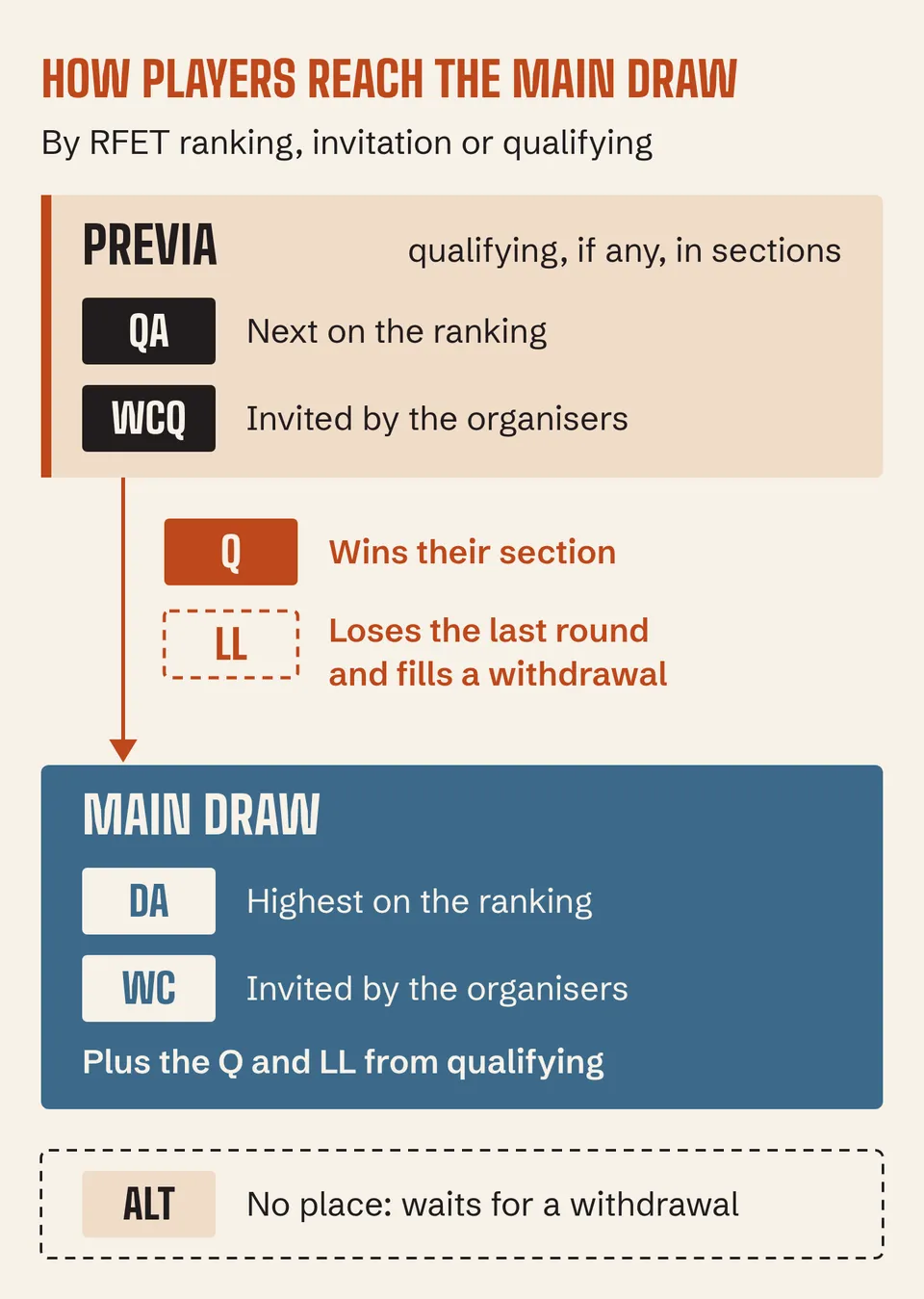
Next to each name, the draw shows how the player got in. These are the codes in the RFET's Reglamento Técnico (section III.C):
| Code | Stands for | Who it is |
|---|---|---|
| DA | Direct acceptance | Gets into the main draw on ranking |
| Q | Qualifier | Has won their section of the previa (qualifying) |
| QA | Accepted into qualifying | Gets into the previa on ranking |
| WC | Wildcard into the main draw | Invited by the organising committee |
| WCQ | Wildcard into qualifying | Invited by the organising committee |
| LL | Lucky loser | Lost in the last qualifying round and takes the place of someone who withdraws before their first match; the order is drawn |
| ALT | Alternate | Missed out on ranking and is waiting for a withdrawal |
What do the tournament terms mean?
Bases del torneo (tournament regulations)
The document the tournament director publishes before the event. It sets out how to enter, the match format, the surface, how the draws are made up, and when and where the draw takes place.
Bye (exento)
A free pass into the next round, given when there are not enough players to fill the draw. Byes go to the seeds first, in order, and any left over are drawn and spread across the sections of the draw.
Cabeza de serie (seed)
A player the rules do not draw freely: seed 1 goes on the top line, seed 2 on the bottom line, and the other seeds are drawn only among the lines reserved for them. Seeds come from the RFET ranking on the day of the first draw, and an unranked player cannot be seeded. A main draw of 9 to 16 players has four seeds; one of 48 to 64 has sixteen. In qualifying there are up to two per section.
Consolación (consolation draw)
A draw for players who lose their first match in the main draw. It is optional, except in under-10 events, where it is compulsory once there are at least four entries. Its points are multiplied by 0.10.
Cuadro final (main draw)
The main stage of a tournament, also called the fase final or cuadro principal. It is made up of direct acceptances, qualifiers, wildcards and, where needed, lucky losers. A tournament can have a main draw only, or qualifying followed by a main draw.
Invitación (wildcard)
A place the organising committee gives a player regardless of ranking, either in the main draw (WC) or in qualifying (WCQ). A player who has played the previa cannot then get a main-draw wildcard. The Campeonato de Canarias has four: two from the host club and two from the FCT. See how junior competition works in the Canaries.
Juez árbitro (referee)
The referee in charge of an official tournament. They must hold a licence and an RFET or ITF qualification, and are appointed by the referees' committee of the federation that authorises the tournament. The referee draws up the acceptance list, schedules the matches, sends in the reasons for any walkovers and uploads the results to the RFET's platform.
Lista de aceptación (acceptance list)
The list the referee draws up, with entrants in order of their RFET national ranking. It settles who goes straight into the main draw (DA), who plays qualifying (QA) and who is an alternate (ALT).
Match tie-break
A tie-break to 10 points, won by two clear, played instead of a third set. It is used, for example, at the Campeonato de Canarias and in every under-10 event, which is played as two short sets to 4 games.
Pre-previa (pre-qualifying)
A stage before qualifying that the organising committee may hold to hand out wildcards into qualifying. It scores like qualifying.
Previa (qualifying)
The stage for players who do not get straight into the main draw. It is split into sections, and the winner of each goes through to the main draw, where they appear with a Q. Its points are multiplied by 0.25; at the Spanish and regional championships the championship's own coefficient applies as well. See how the RFET ranking works.
Tierra batida and pista dura (clay and hard court)
Two kinds of court surface. Each tournament's regulations state which one it is played on, and every match, qualifying included, is played on that surface; only for force majeure may the referee move matches to another one. What changes between them is on clay or hard court.
W.O. (walkover)
A match won without being played, because the opponent does not turn up or cannot play. A player who loses their first match by walkover scores no points. On top of that, every unjustified walkover, in any round, costs 30% of the points the draw's winner earns. At the Campeonato de Canarias, a first-round walkover costs 30% of the entry fee, or 20% if it is justified. And for the cadete Campeonato de España, losing by a walkover that was not backed by documents before the territorial ended does not count as having played it.
What are the categories?
Absoluto
On the licence, the category of players who turn 19 to 29 during the year. In competition it is also the open draw with no junior age limit, which cadetes, júniors and second-year infantiles (those turning 14 that year) may enter. For the ranking, an absoluto draw has a coefficient of 1. More in how tennis age categories work in Spain.
Alevín, infantil, cadete, júnior
The junior age categories: alevín (11 and 12), infantil (13 and 14), cadete (15 and 16) and júnior (17 and 18), counting the age a player turns during the year. Below them is the under-10 category, which the Canaries call benjamín. See how tennis age categories work in Spain.
Categoría de edad (age category)
Your age category, set by the age you turn between 1 January and 31 December. It decides which draws you can enter: your own and some older ones, never a younger one. Not to be confused with the categoría de ranking. See how tennis age categories work in Spain.
Categoría de ranking (ranking band)
The bands of the national ranking: 1.ª categoría (places 1 to 50), 2.ª A (51 to 150), 2.ª B (151 to 300) and 3.ª from 301, split into groups G-10 to G-1. They depend on ranking position, not age. See how the RFET ranking works.
Edad deportiva (sporting age)
The age that counts in competition, which is the age you turn during the calendar year. Everyone moves up on 1 January, whatever their birthday. See how tennis age categories work in Spain.
Licencia federativa (federation licence)
The licence that makes you a member of the RFET, lets you play official tournaments and puts you on the ranking. It is issued by the regional federation, includes compulsory sports-accident insurance and runs for one season, from October to September. The Licencia Escuela only covers the amateur circuit. See getting a tennis licence in the Canaries.
How are ranking points worked out?
Coeficiente (coefficient)
A multiplier applied to the points for a result. There are three kinds: by type of tournament (from 1.25 for an ordinary event to 3.5 for a Campeonato de España), by the draw's age category (from 0.15 for under-10 to 1 for absoluto) and by stage or format (0.25 for qualifying and pre-qualifying, 0.10 for consolation, 0.20 for one-day tournaments). The tournament-type coefficient applies only to the main draw, except at the Spanish and regional championships, which apply it to their qualifying too. See how the RFET ranking works.
Estrellas (stars)
The measure of a draw's strength: 1 to 19 stars from the ranking of its eight best players on the day of the first draw, plus 1 to 11 more if it offers prize money, which junior events are not allowed to do. The more stars, the more points each round is worth. See how the RFET ranking works.
Ranking de la RFET
The Spanish national ranking: it adds up a player's best tournaments of the last twelve months, is a single list for all ages and closes on the last day of each month. See how the RFET ranking works.
Which championships and circuits are there?
Campeonato de España (Spanish Championship)
The national championship of each category, run by the RFET. Its points are multiplied by 3.5. What it asks of the regional championship depends on the category. In alevín and infantil the regional federation enters its players, who must have played the regional championship; only wildcards are exempt. In cadete you must have played its final stage; wildcards are exempt, and so is a player with an injury backed by a medical certificate sent before the regional championship ends. In júnior you do not need to have played it. In cadete and júnior, the regional champion goes straight into the main draw. See from island events to national and international tournaments.
Campeonato insular (island championship)
Each island's championship, by category. In the Canaries, the winner and the runner-up go straight into the Campeonato de Canarias. See how junior competition works in the Canaries.
Campeonato territorial (regional championship)
The championship of each regional federation; in the Canaries, the Campeonato de Canarias, run by the FCT. It carries a coefficient of 3, qualifying included. Playing it is required for the alevín, infantil and cadete Campeonato de España, and its champion goes straight into the main draw of the cadete and júnior Campeonato de España. See how junior competition works in the Canaries.
Circuito juvenil de ámbito nacional (national junior circuit)
A junior circuit the RFET recognises because it is played in at least five of Spain's autonomous communities and meets minimum entry numbers per draw. There can be no more than 11 a year. Its events score with a coefficient of 1.75, or 2.5 if they meet extra RFET requirements. See how junior competition works in the Canaries.
Federación territorial (regional federation)
The tennis federation of each autonomous community; in the Canaries, the Federación Canaria de Tenis. It issues licences, sends the official tournament calendar to the RFET and uploads the draws to the RFET's platform. See getting a tennis licence in the Canaries.
IPIN
The International Player Identification Number. Players get it by registering with the ITF and paying a yearly fee (70 US dollars for junior membership in 2026, according to Tennis Europe), and they need it to play the ITF World Tennis Tour Juniors and the Tennis Europe Junior Tour. Once a player gives it to the RFET, their international points are added to the national ranking. See what the ITF junior circuit is.
ITF World Tennis Tour Juniors
The International Tennis Federation's worldwide junior circuit. In 2026 it is open to players born from 2008 to 2013, from the time they turn 13. In the Spanish ranking, its points are multiplied by 15. See what the ITF junior circuit is.
Tennis Europe Junior Tour
The European circuit of 12 and under, 14 and under and 16 and under tournaments, held in Tennis Europe's member countries. Players need an IPIN. In the Spanish ranking, its points are multiplied by 2 in alevín, 3 in infantil and 4 in cadete. See what the Tennis Europe Junior Tour is.
Where is each subject explained in full?
| If you want to know... | Read |
|---|---|
| Which category you are in and which draws you can play | How tennis age categories work in Spain |
| How points are worked out | How the RFET ranking works |
| How the island championships work | How junior competition works in the Canaries |
| How players reach national and international events | From island events to international tournaments |
| How the ITF junior tour works | The ITF junior tour |
| How the European junior tour works | The Tennis Europe Junior Tour |
| What changes between clay and hard court | Clay or hard court |
| How to get a licence | Getting a tennis licence in the Canaries |
| What a season costs | What a junior season costs |
| What support is available | Grants and support |
Sources
- RFET, Reglamento Técnico de Competición 2026, sections II.D, II.F, II.G, II.H, II.I, III.B, III.C, III.D, III.E, III.G and IV.H. Consulted on 5 October 2026.
- RFET, Reglamento de Clasificación 2026 (from January 2026), general principles and articles 2, 5, 8, 11, 12 and 14. Consulted on 5 October 2026.
- RFET, Reglamento de Licencias 2025-2026 (from October 2025), articles 1, 2, 4 and 4.4. Consulted on 5 October 2026.
- RFET, Ranking Nacional, preguntas frecuentes (FAQ). Consulted on 5 October 2026.
- RFET, regulations of the individual Campeonatos de España for alevín, infantil, cadete and júnior (updated 29 January 2026). Consulted on 5 October 2026.
- ITF, Reglas del Tenis 2026 (Spanish edition of the Rules of Tennis, published by the RFET), appendix on the match tie-break. Consulted on 5 October 2026.
- ITF, World Tennis Tour Juniors Regulations 2026 (published 5 December 2025), sections 4 and 6. Consulted on 5 October 2026.
- Tennis Europe, Junior Tour Rules & Regulations 2026 (June 2026 version), section 2 and IPIN. Consulted on 5 October 2026.
- Federación Canaria de Tenis, Normativa de Clasificación de los Campeonatos de Canarias 2025/2026 (signed 16 March 2026). Consulted on 5 October 2026.