Clay or hard court: what is the difference?
Clay is slow and Spain's pista rápida is medium pace for the ITF: the intended ball differs, clay has ball-mark checks and each tournament states its surface.
The main difference between a clay court (tierra batida) and a hard court, which Spanish tournaments announce as pista rápida, pista dura or resina, is pace. The International Tennis Federation (ITF) measures pace by how much the court slows the ball as it bounces and how much bounce it gives back. On that test, the ITF rates most clay courts as slow and most acrylic (resin) courts as medium-slow or medium: for the ITF they are not fast. That is why the Rules of Tennis provide a different ball for each pace, and why clay has a few rules of its own, such as checking the ball mark. In Spain, every tournament states its surface in its rules.
What counts as clay and what counts as a hard court?
The ITF's technical classification has no "hard court" type. It sorts courts by how they are built, and it says plainly that its table of surface types describes construction, not how a court plays.
| ITF type | What it is | Usual name in Spain |
|---|---|---|
| Clay | Loose mineral as the playing layer, with no carpet or membrane underneath holding it together. Always porous. | Tierra batida |
| Artificial clay | Carpet filled with sand or rubber, made to look like clay | Tierra artificial |
| Hybrid clay | A clay dressing on a carpet base | Tierra híbrida |
| Acrylic or polyurethane | A textured, pigmented resin coating a few millimetres thick, laid on a base | Pista rápida, pista dura, resina |
| Asphalt, concrete | When the material itself is the playing surface | Pista rápida, pista dura |
For the ITF, artificial and hybrid clay are not clay: they are separate types. When asphalt or concrete is only the base under an acrylic coating, the ITF classifies the court by the coating. Other terms are in the glossary of junior tennis in Spain.
How does the ITF decide whether a court is fast or slow?
With its Court Pace Rating test (CPR): a ball cannon fires balls at the surface, and the ball's speed is measured before and after the bounce. That gives two values:
- Friction. A rougher surface takes more horizontal speed off the ball, so the court plays slower.
- Restitution. The ball's vertical speed coming off the bounce compared with its speed going in. A court that gives back more bounce feels slower, because the player has more time to reach the ball.
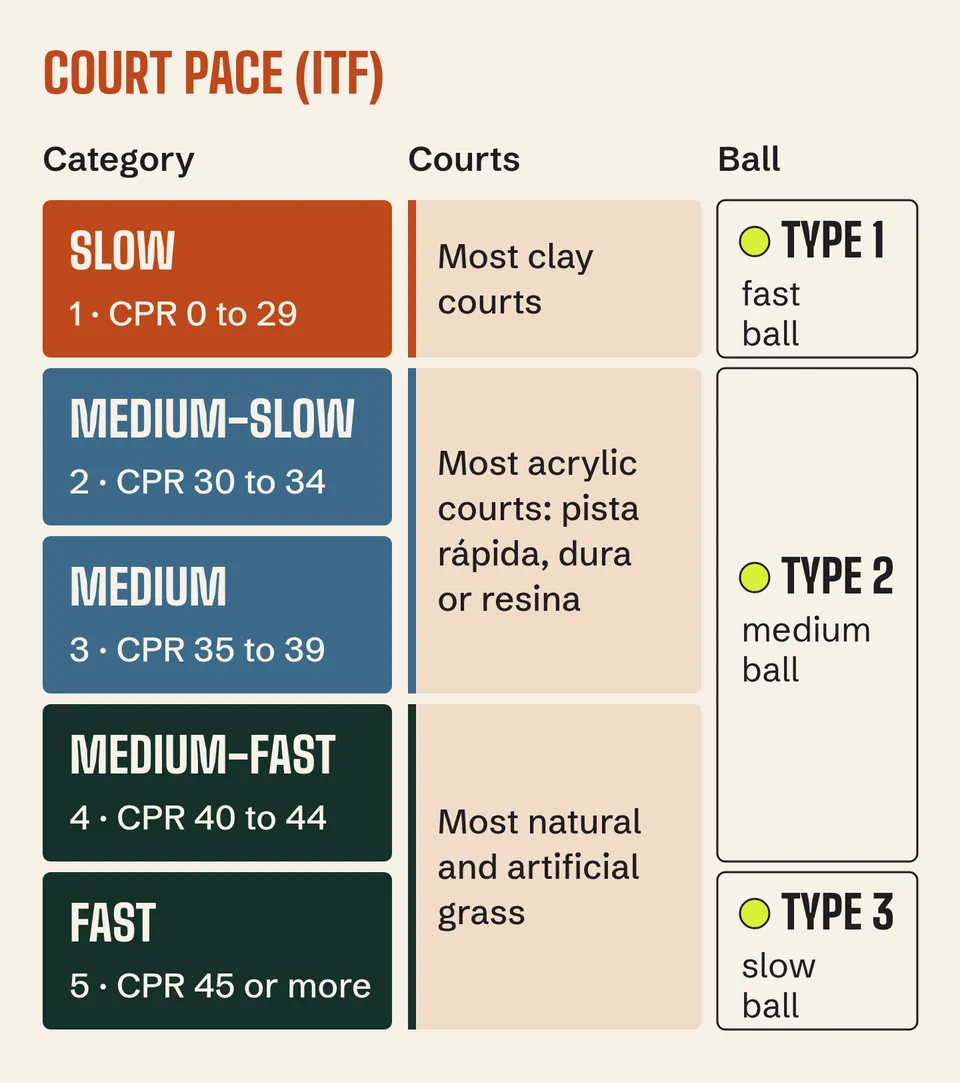
The two values are combined into the CPR, which puts the court into one of five categories:
| ITF category | CPR | Examples given in the Rules of Tennis |
|---|---|---|
| 1, slow | 0 to 29 | Most clay courts and other loose mineral surfaces |
| 2, medium-slow | 30 to 34 | Most acrylic surfaces and some carpets (categories 2 and 3) |
| 3, medium | 35 to 39 | |
| 4, medium-fast | 40 to 44 | Most natural and artificial grass and some carpets (categories 4 and 5) |
| 5, fast | 45 or more |
Two points matter when comparing. First, although Spain calls it a "fast court", most acrylic courts are medium-slow or medium for the ITF. As examples of medium-fast and fast pace, the ITF gives most natural and artificial grass and some carpets. Second, the categories are bands and every court has its own CPR: category 2 borders category 1, where most clay sits, and two courts of the same type can play differently. As a guide, the ITF allows 5 CPR points either way for a well-built new court, and notes that CPR can vary with the materials under the playing layer.
Is the same ball used on both?
Not necessarily. The Rules of Tennis approve three types of ball for adult and junior tennis and say which court pace each one is meant for. They pair the fast ball with the slow court, and the slow, larger ball with the fast court:
| Ball | Meant for |
|---|---|
| Type 1 (fast) | Slow courts |
| Type 2 (medium) | Medium-slow, medium and medium-fast courts |
| Type 3 (slow) | Fast courts, and recommended at altitude above 1,219 m |
All three weigh the same, 56.0 to 59.4 grams, and Type 3 is slightly larger than the other two. The Rules also allow the green (Stage 1) ball in competition, though not at professional events or at ITF and regional junior tournaments. Each national federation decides which national events use it, and the RFET makes it compulsory in the under-10 category. On top of that:
- Any tournament played under the Rules of Tennis must use a ball on the ITF's approved list, and the organisers announce beforehand how many balls are used and when they are changed.
- Official events of the Royal Spanish Tennis Federation (RFET) are played with RFET-approved balls, at least three new balls per match, except in consolation draws and short-set events, which use used balls in good condition. The Spanish youth singles championships (alevín to júnior) use balls chosen by the RFET: four new ones, changed at the start of the third set.
- On the Tennis Europe Junior Tour, a tournament that wants to use Type 1 or Type 3 balls must ask Tennis Europe at least 45 days in advance.
Which rules change on clay?
The rules of the game are the same, but clay keeps a mark of the bounce, and that has consequences:
- Checking the mark. Ball marks can only be checked on clay. With a chair umpire, a player asks on a point-ending shot or by stopping the point, and the umpire comes down to check it if they cannot be sure from the chair. If nobody can find or read the mark, the original call stands, and the umpire's decision is final. A player who rubs out the mark before the decision loses the call, and a player who crosses the net to look at it can be penalised for unsportsmanlike conduct.
- Without a chair umpire. In Tennis Europe Junior Tour matches played without an umpire, a player may ask the opponent to show the mark and may cross the net to see it. Rubbing it out concedes the point, and a player who calls a ball out should normally be able to show the mark. If the players disagree, they can call the Supervisor, or an off-court umpire, to decide.
- Shoes. At RFET events players must wear shoes made for the surface, and the referee can ban shoes that could damage it. On the ITF junior circuit and the Tennis Europe Junior Tour, players on clay must wear shoes accepted for clay or granular surfaces, never grass-court shoes, and the supervisor can ban a pair that does not comply.
Which surface do junior tournaments in Spain and the Canary Islands use?
None of the regulations that govern these tournaments sets a surface. The RFET's Reglamento Técnico, the rules of the Spanish youth singles championships in force in 2026 (updated 29 January 2026) and the Canary Islands Tennis Federation's rules for the 2025/2026 Canary Championships (Campeonatos de Canarias) all leave it open. What the RFET does require:
- Every tournament publishes its rules (bases), and they state the playing surface, together with the balls and when they are changed.
- The whole tournament, qualifying and main draw, is played on the same surface. Only in a case of force majeure, if the event would otherwise not finish on its dates, can the referee schedule matches on another surface.
- There is at least one practice court of that same surface.
On the Tennis Europe Junior Tour, all match courts, qualifying included, must be exactly the same surface, although bad weather can move play to another surface, covered or not. Practice courts should preferably be the same, but it is not compulsory.
In practice, you check the surface tournament by tournament, in its bases. How those tournaments fit together on the islands is explained in how junior competition works in the Canaries.
An example: reading a tournament's rules
One set of bases says tierra batida. From the above: most clay courts are category 1, slow; the ball meant for that pace is Type 1, although the ball actually used is the one the organiser announces; ball marks can be checked; and you need clay-court shoes.
Another says pista rápida, pista dura or resina. Most of those courts are category 2 or 3, and the ball meant for them is Type 2. There are no ball-mark checks, and shoes must suit that court.
Questions people ask
Can you find out the exact pace of a particular court?
Only if the surface product has been classified by the ITF. The ITF publishes its list of classified surfaces, with their category, on its website, and each classification lasts three years. A tournament's bases do not give that figure.
Does artificial clay count as clay?
Not for the ITF. Artificial clay is a carpet filled with sand or rubber that looks like clay, and the ITF lists it as a separate type. If it matters for a tournament, the bases should say so precisely.
Does a brand-new court play like a used one?
Not always. The ITF does not test a new court until it has settled: an acrylic court usually needs about a week, and a clay or artificial grass court may need several months. Climate, shade, use and maintenance all play a part.
Sources
- ITF, Rules of Tennis 2026: rule 3 (the ball), appendix I (the ball and the classification of court pace) and the ball mark inspection procedures in appendix VII. Consulted on 5 October 2026.
- ITF, ITF Approved Tennis Balls, Classified Surfaces & Recognised Courts 2026 (effective 1 January to 31 December 2026), part B (court properties and the pace test, method ITF CS 01/02) and part C (classification programme and surface types). Consulted on 5 October 2026.
- RFET, Reglamento Técnico de Competición 2026, sections II.F.1 and II.G (bases, courts and balls), III.D.8 (change of surface), III.G.4 (under-10) and V.C (code of conduct, dress). Consulted on 5 October 2026.
- RFET, rules of the Spanish individual championships for cadete, júnior, infantil and alevín (updated 29 January 2026). Consulted on 5 October 2026.
- Federación Canaria de Tenis, Normativa de Clasificación de los Campeonatos de Canarias 2025/2026 (signed 16 March 2026). Consulted on 5 October 2026.
- ITF, ITF World Tennis Tour Juniors 2026 Regulations (published 5 December 2025, updated 24 March), article III, section C (dress and equipment). Consulted on 5 October 2026.
- Tennis Europe, 2026 Tennis Europe Junior Tour Rules & Regulations (June 2026 version): courts, balls, shoes and appendix G (matches without a chair umpire). Consulted on 5 October 2026.