What is the ITF junior tour and how do you enter?
Who can play the ITF junior tour, what grades J30 to J500 mean, how to enter and what its points are worth in the Spanish ranking.
The ITF World Tennis Tour Juniors is the International Tennis Federation's worldwide circuit for players under 18. In 2026 it is open to players born from 2008 to 2013, from the point they turn 13. They need an ITF IPIN and a set of compulsory online courses. Tournaments are graded from J30 up to J500, with the junior Grand Slams and the season-ending Finals above them. Every result earns points for the ITF junior world ranking, and the RFET (the Royal Spanish Tennis Federation) multiplies those points by 15 and adds them to a player's Spanish ranking.
Who can play?
A player who meets all of these:
- They are licensed with a national federation that belongs to the ITF (in Spain, the RFET; see how to get a tennis licence in the Canaries).
- They were born between 1 January 2008 and 31 December 2013. They can start in the year they turn 13, as long as the birthday falls on or before the first day of the tournament's singles main draw, and they can play until the end of the year they turn 18.
- They hold a current junior IPIN and have completed the ITF Academy's compulsory courses.
- They have not gone over the number of tournaments allowed for their age:
| Age on the first day of the main draw | ITF junior tournaments allowed |
|---|---|
| 13 | 10 (14 for a player in the ITF junior top 50) |
| 14 | 14 (18 for a player in the top 20) |
| 15 | 18 (22 for a player in the top 20) |
| 16 | 25 |
| 17 and 18 | No limit |
The count runs from one birthday to the next, not by calendar year, and any appearance counts: singles, doubles or qualifying. How these ages line up with the Spanish categories (cadete for under-16s, júnior for under-18s, and so on) is on how tennis age categories work in Spain, and the terms used here are in the junior tennis glossary.
What do the grades J30 to J500 mean?
They are the tournament levels. The ITF Juniors Committee sets each tournament's grade, looking, among other things, at the strength of the draw, player feedback, how well the event is run and the spread of events around the world. The higher the grade, the more points:
| Grade | Winner | Final | Semi-final | Quarter-final | Last 16 | Minimum main draw |
|---|---|---|---|---|---|---|
| Grand Slam | 1,000 | 700 | 490 | 300 | 180 | 64 |
| J500 | 500 | 350 | 250 | 150 | 90 | 48 |
| J300 | 300 | 210 | 140 | 100 | 60 | 32 |
| J200 | 200 | 140 | 100 | 60 | 36 | 32 |
| J100 | 100 | 60 | 36 | 20 | 10 | 32 |
| J60 | 60 | 36 | 18 | 10 | 5 | 32 |
| J30 | 30 | 18 | 9 | 5 | 2 | 16 |
The winner of the ITF Junior Finals also takes 1,000 points. Doubles have a separate table with fewer points.
Nothing is earned until a player wins a main-draw match. A bye (going through a round without playing) does not count; a walkover (the opponent does not turn up) does. At the Grand Slams, a qualifier who loses in the first round of the main draw gets 30 points, and a player who loses in the last round of qualifying gets 20. J30 and J60 events may start with round-robin groups before the knockout rounds.
How do you enter?
- Get an IPIN. This is the ITF's international player identification number. You can register at ipin.itftennis.com from the age of 12 years and 11 months, and the fee covers 52 weeks from registration: 70 US dollars for the junior membership, according to the ITF's IPIN guide of June 2026. The pro membership (90 dollars) is a separate one and does not include the junior membership on its own: it has to be selected at registration or added later, at no extra cost. The junior IPIN also covers the Tennis Europe Junior Tour.
- Complete the compulsory courses on the ITF Academy site. Until they are done, the ITF can block access to the entry system.
- Pick a tournament in the ITF junior tour calendar, which lists each month's events with their country, grade and surface.
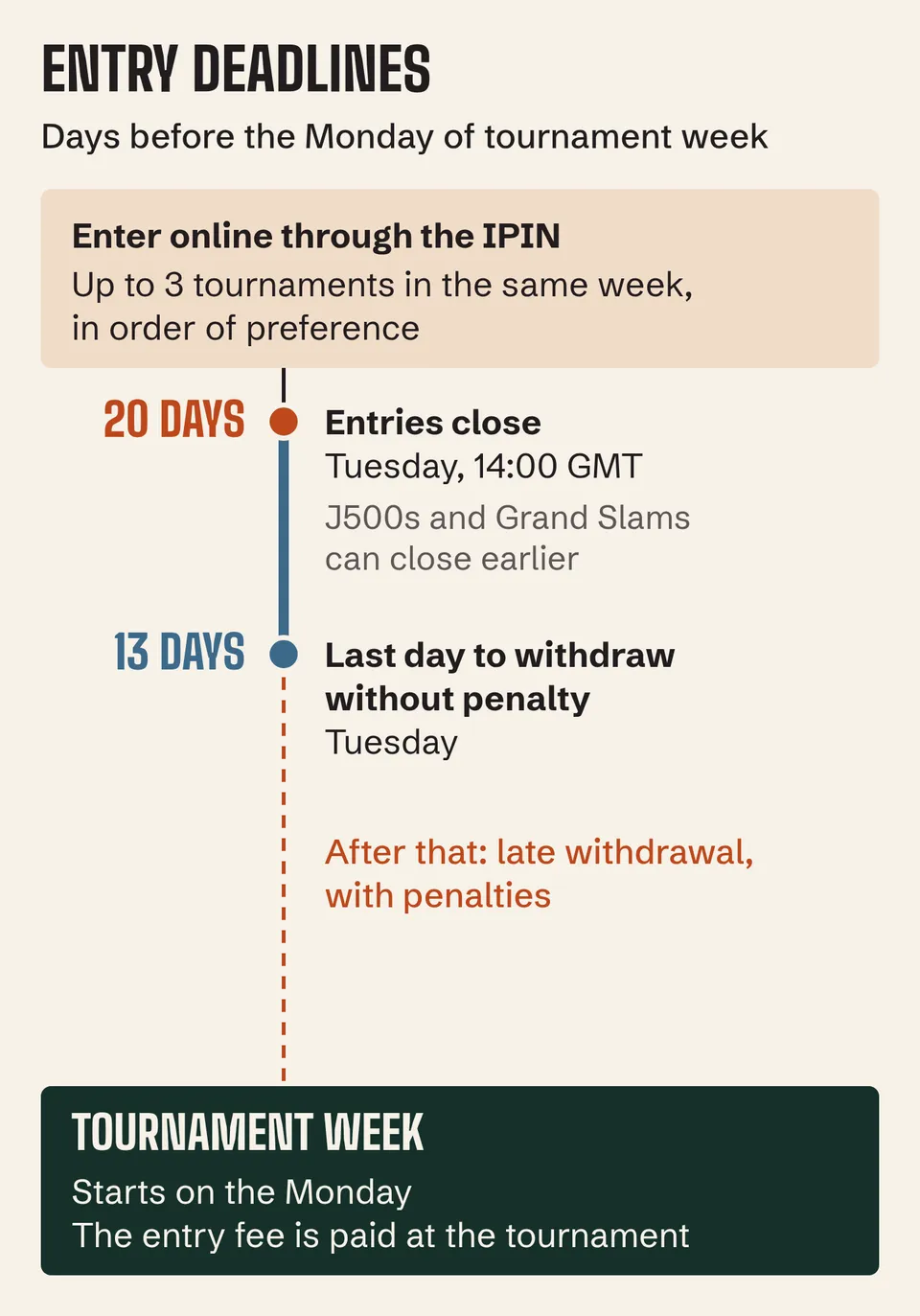
- Enter online through the IPIN system. Entries close on the Tuesday 20 days before the Monday of tournament week, at 14:00 GMT; for J500s and Grand Slams the deadline can be earlier. You can enter up to three tournaments in the same week, putting them in order of preference.
- Withdraw in time if you are not going. The withdrawal deadline is the Tuesday 13 days before the Monday of the tournament. After that it is a late withdrawal, which carries penalties, although the first three in a year are excused if you withdraw online before qualifying sign-in closes.
- Pay the entry fee at the tournament. The regulations cap it by grade and by the hospitality the tournament provides: for the main draw, from 70 dollars (outdoor J30 and J60 without accommodation) to 160 (indoor events with full hospitality, meaning accommodation and meals). What a whole season adds up to is on what a junior tennis season costs in the Canaries.
Who gets into the draw?
Entries are ranked in this order: first by ITF junior ranking; then players with an ATP or WTA ranking; then players with a World Tennis Number (WTN), the ITF's playing rating, at a reliability of at least 50%. Last come players with none of these: half the remaining places go to players from or resident in the host country, and the rest go to the rest of the region, then the zone, then the rest of the world, with lots drawn at each step. The organiser and the national federation also hand out wild cards.
J30 to J300 events keep one or two main-draw places for players aged 16 and under (born in 2010 or later) from the tournament's own region, chosen by WTN. In the WTN a lower number is better. For those places, J300 events ask for a WTN of 15.99 or better for boys and 17.99 for girls, and J200 events 17.99 and 19.99.
How does the ITF junior ranking work?
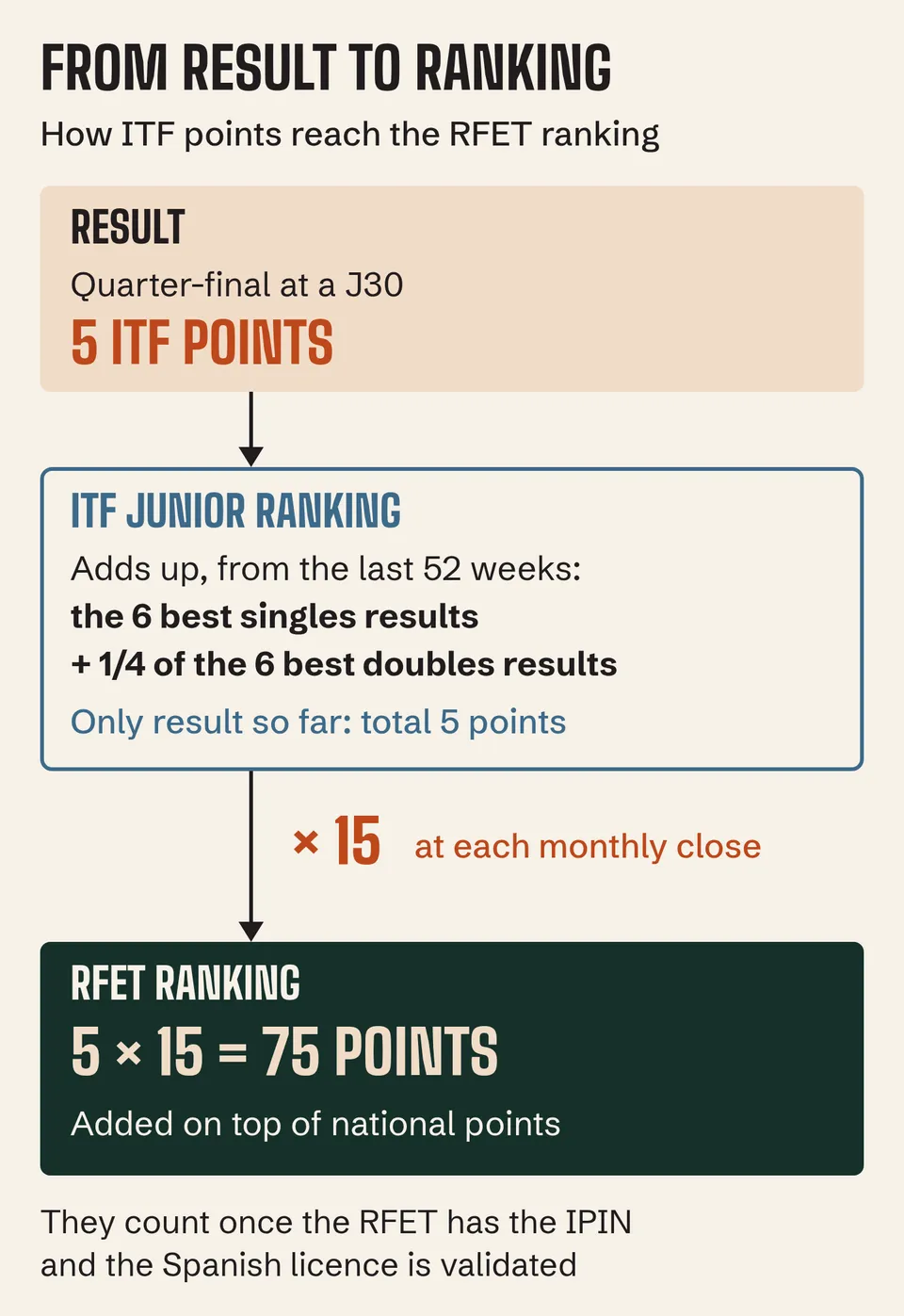
It adds up a player's six best singles results from the last 52 weeks, plus a quarter of their six best doubles results. The ITF updates it weekly at itftennis.com/juniors. If a player plays two editions of the same J100 or higher event within the year, only the better one counts; at J30 and J60 level, the same tournament can count more than once.
The ranking also opens a door to the professional game: 15,000-dollar ITF World Tennis Tour professional events keep up to three main-draw places for juniors in the top 100 of the ranking who are at least 14 and cannot already get in on their professional ranking or WTN.
What are the points worth in the Spanish ranking?
At each monthly close, the RFET takes a player's points from the latest published ITF junior ranking, multiplies them by 15 and adds them to their national points. They sit on top of the national total rather than taking the place of one of the player's best Spanish tournaments. For the points to count, the player must have given their IPIN to the RFET's ranking department (Departamento de Clasificación) and hold a validated Spanish licence. How the national points themselves are worked out is on how the RFET ranking works.
Moving up a circuit does not wipe the slate at once. A player who moves from Tennis Europe to the ITF junior tour (from 16 to 17) keeps, for six months, the Tennis Europe points they had in the December ranking. Those points stop counting at the July close. The same applies when a player moves from the junior tour to the professional one, from 18 to 19.
A worked example
A player born in 2012, already 14, with no ITF ranking but a WTN, enters a 32-player knockout J30. They get in on their WTN, win two matches and lose in the quarter-finals. The table gives them 5 ITF points, their only result so far. At the next monthly close, the RFET adds 5 × 15 = 75 points to their national ranking. They have also used one of the 14 tournaments allowed at 14.
Questions people ask
Does a player have to play Tennis Europe before the ITF tour?
No. The ITF regulations ask for the right age, an IPIN, the courses and an affiliated federation; they do not require any other circuit first. Between 13 and 16 a player can play both. The whole route is on how to move from island tournaments to national and international events.
Why is a player not in the ITF ranking after playing a tournament?
Because only players who win at least one main-draw match score, apart from the Grand Slam qualifying cases above. Losing in the first round, or in qualifying at an ordinary event, earns nothing.
Can a player enter another tournament in the same week?
As a rule, only one ITF World Tennis Tour event a week, junior or professional, with narrow exceptions: for example, a player who loses that week at a professional event may accept a wild card into a junior main draw. And a player who fails to turn up, withdraws or retires during the main draw cannot play any other tournament that week.
Do tournaments help with travel?
Not for individual players. The regulations only allow travel help to be offered to national federations, in advance and without tying it to a named player. The help available in the islands is on grants and support for young tennis players in the Canaries.
Sources
- ITF, ITF World Tennis Tour Juniors 2026 Regulations (published 5 December 2025, updated 24 March 2026), regulations 4, 6, 10 to 14, 28, 30, 31, 37, 39, 41, 43, 44, 54 and 60 and appendices A, F, H and L. Consulted on 5 October 2026.
- ITF, ITF World Tennis Tour Juniors 2026 Organisational Requirements, hospitality tiers (pp. 41 and 42). Consulted on 5 October 2026.
- ITF, IPIN Guide & FAQ (June 2026), general questions. Consulted on 5 October 2026.
- ITF, World Tennis Tour Juniors calendar. Consulted on 5 October 2026.
- RFET, Reglamento de Clasificación 2026 (ranking regulation, from January 2026), article 8. Consulted on 5 October 2026.
- Tennis Europe, 2026 Tennis Europe Junior Tour Rules & Regulations (June 2026 version), IPIN section. Consulted on 5 October 2026.