How to move up from island to international junior tennis
How a junior tennis player from the Canaries moves up: island, Canary and Spanish championships, Tennis Europe and ITF juniors, with 2026 ages and rules.
A junior tennis player from the Canary Islands moves up in steps. Their island championship is the way into the Canary Islands Championship, and in alevín (under 12), infantil (under 14) and cadete (under 16), having played the Canary Championship is required for the Spanish Championship of the category; in júnior (under 18), in 2026, it is not. In cadete and júnior, tournaments that count for the ranking of the Royal Spanish Tennis Federation (RFET) also earn places by ranking in the Spanish Championship. On the international tours, the Tennis Europe Junior Tour takes players from the year they turn 10, and the International Tennis Federation's (ITF) junior tour from 13. Neither asks for national results: they ask for an age, an ITF registration and good standing with the federation.
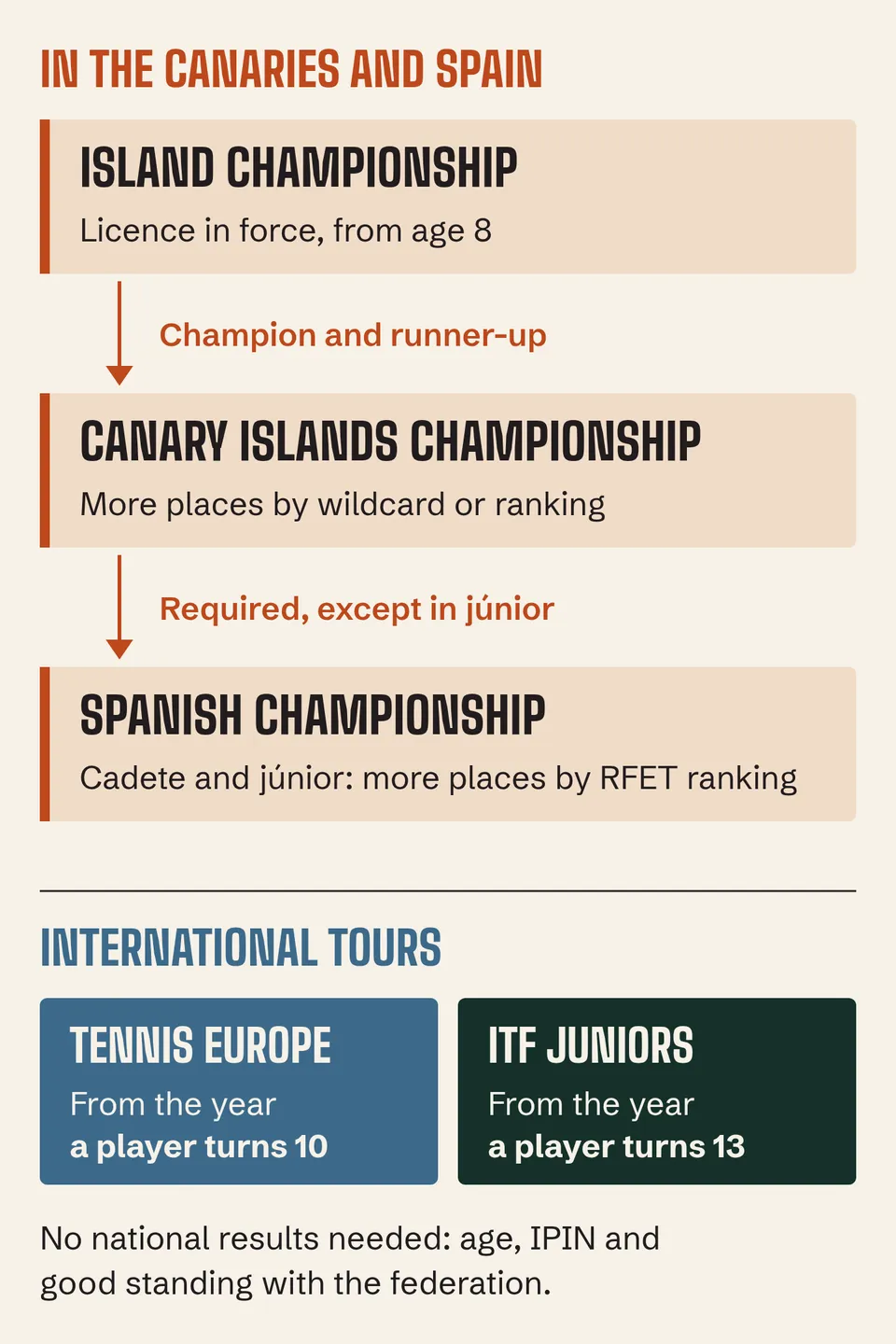
The stages at a glance
| Stage | Age set by the rules in 2026 | What it takes | Explained in |
|---|---|---|---|
| Island championship | By category; from age 8 | A federation licence in force | Categories, licence |
| Canary Islands Championship | By category | Island champion or runner-up, or a wildcard or ranking place | Competition in the Canaries |
| National tournaments and circuits | By category | A licence; points go to the RFET ranking | RFET ranking |
| Spanish Championship | Up to 12 (alevín), 14 (infantil), 16 (cadete) or 18 (júnior) in the calendar year | Having played the Canary Championship, except in júnior | Competition in the Canaries |
| Tennis Europe Junior Tour | 12 and under, 14 and under, 16 and under | An ITF IPIN and good standing with the federation | Tennis Europe |
| ITF World Tennis Tour Juniors | From the year a player turns 13 to the year they turn 18 | An IPIN and the ITF's mandatory courses | ITF juniors |
What does a player need to start?
A federation licence in force for the Canaries and the RFET, which is what the Canary Islands Tennis Federation (FCT) asks for at its championships. How to get one is on the page about the tennis licence in the Canaries. To play an official tournament a player must be 8 on the day the main draw starts, although the regional federation may admit players turning 8 that year to its under-10 championships (RFET Technical Regulation 2026, section III.B).
The year of birth decides the category, and the category decides which draws a player can enter: see how the age categories work. Junior tennis terms are in the glossary, and what changes between surfaces is in clay or hard court.
How does a player reach the Canary Championship?
Through their island. The champion and runner-up of each island championship go straight into the Canary Islands Championship (the Canary Championship for short) for their category; the other places go by wildcard and by ranking. Eligibility, format, entry deadlines and help with travel between islands are on how junior competition works in the Canaries.
And the Spanish Championship?
Each category has its own rules, updated on 29 January 2026, and the age limit is the age a player turns by 31 December of the championship year.
| Category | How a player from the Canaries gets in |
|---|---|
| Alevín (under 12) and infantil (under 14) | The FCT enters its players. Each regional federation has at least two places per event, and the rest are shared out by its number of licences in the category. Playing the Canary Championship is required, except for wildcards. |
| Cadete (under 16) | The Canary champion goes straight into the main draw; if the champion withdraws in time, the runner-up can take the place. Others get in through the national ranking or through qualifying, where the Canary runner-up is guaranteed a place if their ranking does not reach the main draw. Playing the Canary Championship is required, except for wildcards or an injury certified in time. |
| Júnior (under 18) | The Canary champion goes straight into the main draw; if the champion withdraws in time, the runner-up can take the place. Others get in through the national ranking or through qualifying, with no guaranteed place for the runner-up. In 2026, playing the Canary Championship is not required. |
Sources: the RFET rules for the Spanish individual championships in alevín, infantil, cadete and júnior (in Spanish).
What role does the national ranking play?
It fills the places not won at a regional championship: in cadete and júnior, 34 of the 64 main-draw places and all 48 qualifying places go by national ranking. Points come from tournaments on the official calendar, including the open tournaments and national circuits that stop in the islands, and championships weigh more. The calculation is on how the RFET ranking works.
When can a player start on the international tours?
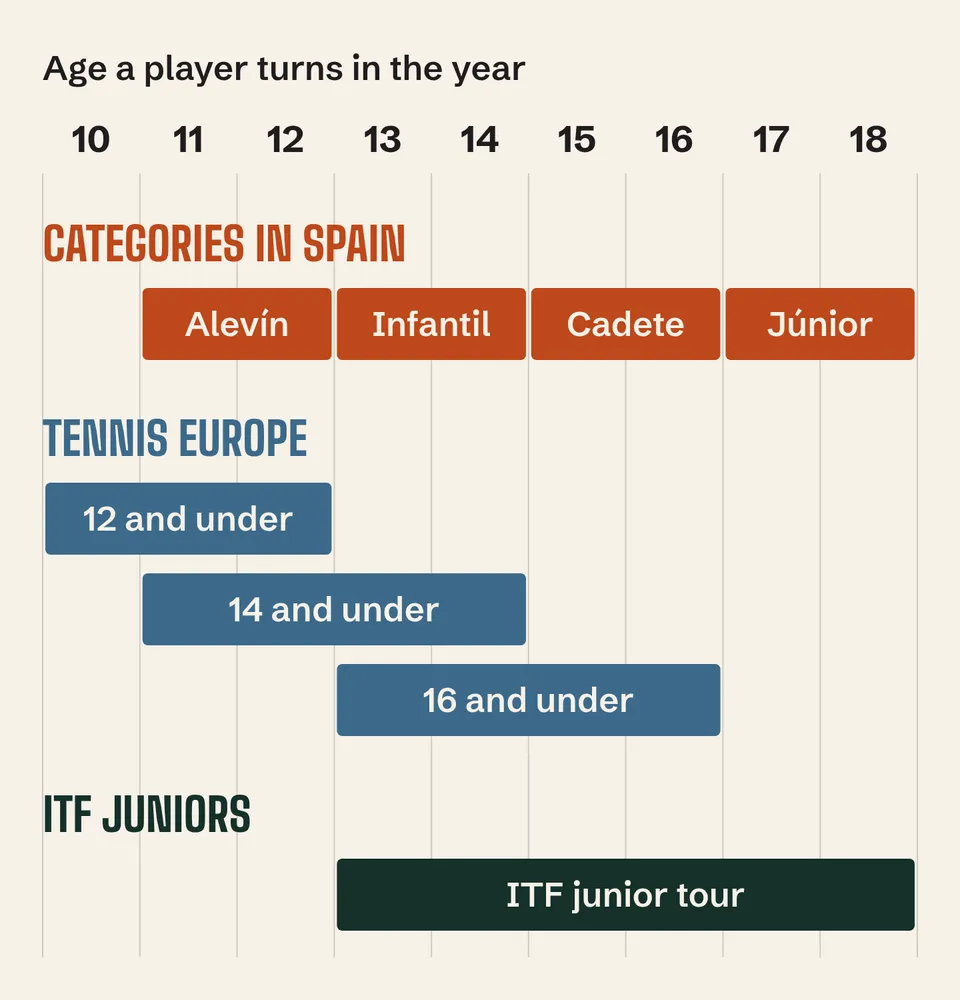
The international tour that takes the youngest players is the Tennis Europe Junior Tour, the European circuit for under-16s. It has three age groups in 2026:
| Age group | Who can play in 2026 |
|---|---|
| 12 and under | Born 2014 to 2016, and already 10 when the main draw starts |
| 14 and under | Born 2012 to 2015, and already 11 when the main draw starts |
| 16 and under | Born 2010 to 2013 |
To play it:
- Register with the ITF and pay for an IPIN, the international player identification number. It is an annual fee paid to the ITF; the Tennis Europe rules set the junior fee at 70 US dollars for 2026.
- Check that the player is in good standing with the RFET: a member of the federation and not suspended.
- Enter each tournament online yourself, with no further approval from the federation. Only for the European Junior Championships, the Tennis Europe Junior Masters and the 14 and under Development Championships does the federation make the entries.
Entering does not guarantee a place. In 14 and under and 16 and under, draws fill first by the Tennis Europe ranking. Players without that ranking, and all 12 and under players, are put in order by their national federation, mainly by national ranking, and that order counts for the remaining places.
While a player can still play 12 and under, they can play no more than ten 12 and under tournaments a year, and any 14 and under events they play count towards the same limit. A player who goes over loses the points won at that tournament and receives suspension points. The rest is on what the Tennis Europe Junior Tour is.
And the ITF junior tour?
The ITF World Tennis Tour Juniors is the worldwide under-18 circuit, with tournaments graded J30, J60, J100, J200, J300 and J500 as well as the junior Grand Slams. In 2026 it is open to players born from 2008 to 2013: from the year they turn 13, once their birthday has passed when the main draw starts, until the end of the year they turn 18. They need an IPIN and must complete the ITF Academy's mandatory courses, and entries are made online through the IPIN system.
Places go first by ITF junior ranking. Players without one get in by their World Tennis Number (WTN), the ITF's level rating, which counts when its confidence level is 50% or higher. For players with neither, the remaining places are drawn by lot, with half for players from the host country.
Younger players have a yearly limit on tournaments, counted from one birthday to the next:
| Age | ITF junior tournaments allowed |
|---|---|
| 13 | 10 (14 if in the top 50 of the ITF junior ranking) |
| 14 | 14 (18 if in the top 20) |
| 15 | 18 (22 if in the top 20) |
| 16 | 25 |
| 17 and 18 | No limit |
At J30 to J300 events, the regulations also reserve places for players aged 16 and under from the region where the tournament is held (Europe, for an event in Europe) who hold a WTN; J200 and J300 events also set a minimum WTN. Grades and points are on the ITF junior tour.
What does it cost, and who helps?
Each step adds travel. For the Canary Championship, the FCT or, in Gran Canaria and Tenerife, the island federation pays travel for alevín, infantil and cadete players who qualified through their island and show they have no means or no one to go with them; in júnior it covers the player's flight and accommodation, without a companion. Players who enter by wildcard or ranking pay their own way. For the Spanish individual championships, from alevín to júnior, the FCT pays travel for players with no means or no one to go with them. What a full season costs is on the cost of a junior tennis season in the Canaries, and public and federation support on grants and support for young players.
Questions people ask
Does a player have to play Tennis Europe before the ITF tour?
No. The ITF regulations ask for the right age, an IPIN, the mandatory courses and membership of a national federation affiliated to the ITF; they do not require Tennis Europe events. The two can overlap between 13 and 16.
Can a player enter the Spanish júnior championship without playing the Canary one?
In 2026, yes: the júnior rules say playing the regional championship is not required, and the places not reserved for regional champions or wildcards go by ranking. In alevín, infantil and cadete it is required, with the exceptions in the table above.
How long does each stage last?
The ages in the rules set it, not a fixed timetable: each junior category with a Spanish Championship (alevín, infantil, cadete and júnior) lasts two years, and the ITF junior tour ends in the year a player turns 18. When each player moves up depends on their level and ranking.
Sources
- Federación Canaria de Tenis, Normativa de Clasificación de los Campeonatos de Canarias 2025/2026 (signed 16 March 2026), travel cover sections. Consulted on 5 October 2026.
- RFET, rules of the Spanish individual championships in alevín, infantil, cadete and júnior (updated 29 January 2026). Consulted on 5 October 2026.
- RFET, Reglamento Técnico de Competición 2026, section III.B. Consulted on 5 October 2026.
- ITF, ITF World Tennis Tour Juniors 2026 Regulations (published 5 December 2025), rules 4, 6, 36, 39 and 43 and appendices F, G and H. Consulted on 5 October 2026.
- Tennis Europe, 2026 Tennis Europe Junior Tour Rules & Regulations (June 2026 version), sections 5 and 8. Consulted on 5 October 2026.