What are the conduct and umpiring rules in junior tennis?
Who officiates, how penalties work (warning, point, game), who calls the lines without a chair umpire and when coaches may advise in 2026.
In this article
- Who makes the decisions at a tournament?
- What behaviour is penalised?
- What are the penalties: warning, point, game?
- What time limits apply?
- Who calls the lines when there is no chair umpire?
- When do you call the referee?
- What can coaches and parents do?
- What happens after the tournament?
- Do the same rules apply at tournaments in the Canary Islands?
- Sources
In official junior tournaments in Spain, how players, coaches and families behave is governed by the Code of Conduct in the Reglamento Técnico, the competition rulebook of the Royal Spanish Tennis Federation (RFET). The chair umpire enforces it or, in a match without a chair umpire, the referee. Each offence moves one step up the same scale: a warning, then a point penalty, then a game penalty, and only the referee can disqualify a player. Without a chair umpire, each player calls the balls on their own side of the net and the server calls the score. Coaching during a match is banned, except in umpired matches from cadete (under 16) upwards and at some international events.
Who makes the decisions at a tournament?
Every official tournament is run under a qualified referee (juez árbitro), approved by the Spanish Tennis Umpires' Committee (CEAT).
| Official | What they decide |
|---|---|
| Referee (juez árbitro) | How the rules are interpreted, with no appeal. Only the referee can disqualify a player, and the referee applies the Code of Conduct in matches with no chair umpire. |
| Chair umpire (juez de silla) | Questions of fact in their match (whether a ball was in, the score), with the final word. Applies the Code of Conduct. |
| Line judge (juez de línea) | Calls on their line. The chair umpire overrules only a clear mistake. |
| The players | With no chair umpire, each calls the balls on their own side. |
Playing without a chair umpire is common in junior tennis. At the 2026 Spanish age-group championships, there is one at least from the singles quarter-finals and in the doubles final, and any match that is broadcast must have one. How a tournament runs from start to finish is in how a junior tennis tournament works.
What behaviour is penalised?
The Code of Conduct applies from the warm-up onwards and anywhere on the tournament site:
| Offence | What it covers |
|---|---|
| Unreasonable delay | Going over the time limits, or refusing to carry on playing |
| Audible or visible obscenity | Swearing that anyone can hear, and obscene gestures |
| Ball, racket or equipment abuse | Hitting the ball away or dangerously, throwing or smashing the racket, hitting the net or the chair in anger |
| Verbal or physical abuse | Insulting an official, the opponent or spectators, or touching anyone without permission |
| Best efforts | Not trying to win |
| Coaching | Receiving advice where it is not allowed |
| Unsportsmanlike conduct | Anything clearly abusive or harmful to the tournament that the other headings miss |
At national tournaments, guidance from the CEAT dated 3 February 2026 tells officials always to penalise a swear word even if muttered, an insult even if aimed at oneself, using a phone, a bathroom break taken only to break the opponent's rhythm, and a ball hit out of the court after the point is over. It also tells them not to be more lenient with younger age groups.
What are the penalties: warning, point, game?
| Offence in the same match | Penalty |
|---|---|
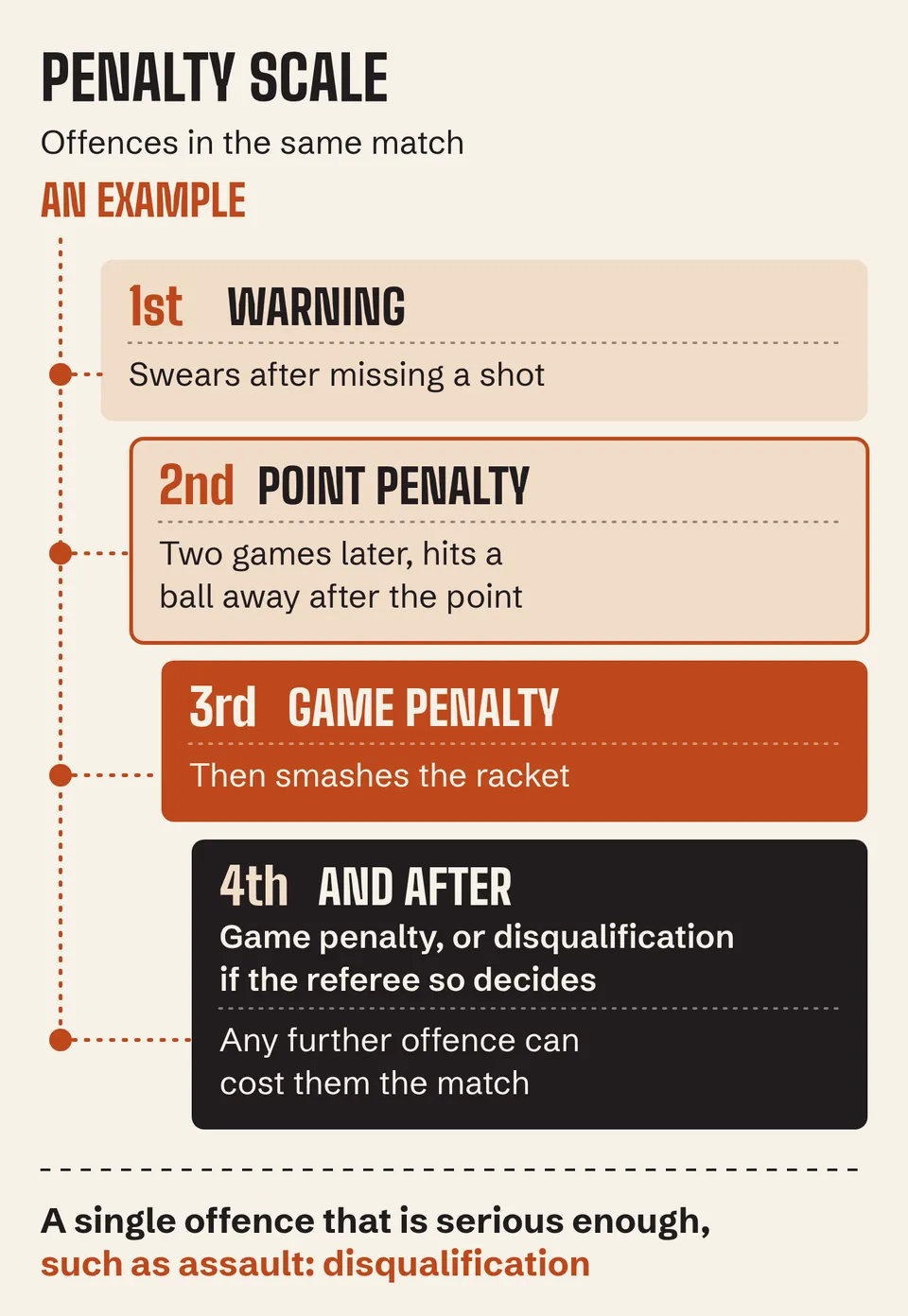
| First | Warning |
| Second | Point penalty |
| Third | Game penalty |
| Fourth and after | Game penalty, or disqualification if the referee so decides |
An example. A player swears after missing a shot: warning. Two games later they hit the ball out of the court: they lose a point. If they then smash their racket, they lose a game, and from there any further offence can cost them the match.
A single offence that is serious enough, such as assault or a gross insult to the umpire, is enough for disqualification. A disqualified player loses the points from that tournament and, in the RFET ranking, also has 30% of the points of that draw's winner taken off their total. They can also be removed from their other events, unless the offence was about punctuality or clothing or was committed by their doubles partner. In doubles, on-court penalties apply to the pair.
What time limits apply?
| Moment | Limit |
|---|---|
| Being ready on court after the match is called | 10 minutes; at 15 minutes the match is lost unless the referee excuses the delay |
| Between points | 25 seconds |
| Change of ends | 90 seconds; no rest after the first game of each set or during a tie-break |
| Between sets | 120 seconds |
Delays have a scale of their own: the first time, a time warning; after that, a fault if you are serving or a lost point if you are receiving. In best-of-three singles, each player gets one bathroom break, taken between sets.
Who calls the lines when there is no chair umpire?
The ITF's procedures for 2026, which the RFET publishes in Spanish, set out these rules:
- Each player calls every ball on their own side, straight after the bounce and loud enough for the opponent to hear.
- Any doubt goes in the opponent's favour.
- Except on clay, if you call a ball out and realise it was in, the point is replayed. If it was a winner or you had already made a wrong call in the match, you lose the point.
- Before every first serve, the server calls the score aloud.
- Only an official can call a foot fault, never the receiver.
On clay the mark decides: you can ask your opponent to show it and cross the net to look, whoever rubs it out concedes the point, and if you call a ball out and the mark shows it was in, you lose the point. More on that in clay or hard court.
When do you call the referee?
Without a chair umpire, whenever you disagree with your opponent: ask for the referee, their assistant or the official watching the courts. With a chair umpire, only if you disagree with how a rule has been interpreted; whether a ball was in is the chair umpire's decision.
- A call the referee did not see, on courts other than clay: the referee asks the player who made it whether they are sure, and if so, the call stands. The referee may stay to watch the rest of the match or put a chair umpire on it.
- A mark on clay: the referee first checks that the players agree which mark it is, then reads it; if the mark is inconclusive, the original call stands. If the players cannot agree which mark it is and it cannot be settled, the call of the player on whose side the mark is stands.
- A clear mistake the referee did see: the referee has the point replayed, or goes to the opponent if it was a winner. Another clear mistake costs the point, and a deliberate one brings a penalty for unsportsmanlike conduct.
- The score: only what both players agree on counts. If one says 40-30 and the other 30-40 because they disagree about the first point, play resumes at 30-30.
- Misconduct the referee did not see: the referee listens only to the players, never to people off the court, and cannot penalise what no official saw.
What can coaches and parents do?
Any communication with the player, spoken or by gesture, counts as coaching, and family members and companions are bound by the same rules as coaches. The referee decides where they sit.
| Competition in 2026 | Coaching during the match? |
|---|---|
| RFET official tournaments, alevín (under 12) and infantil (under 14) | No, except in team events |
| RFET official tournaments, cadete (under 16) and older | Only if the match has a chair umpire and so do all matches in that round and later rounds of the event |
| ITF World Tennis Tour Juniors J100 to J500 and junior Grand Slams | Yes, with or without a chair umpire, from the designated coach seats |
| ITF World Tennis Tour Juniors J30 and J60 | Only with a chair umpire |
| Tennis Europe Junior Tour: Super Category, Category 1, European Championships and Masters; on trial at some Category 2 and 3 events (depends on the age group) | Only in rounds with chair umpires |
Where the RFET allows it, coaching follows these rules:
- Brief and discreet, without holding up play or disturbing the opponent.
- Spoken or by gesture when the player is at the coach's end; gestures only at the other end.
- Never during the rest at a change of ends or while the player is off court for a bathroom break.
- Allowed during a pause the player did not cause, such as rain.
On the ITF and Tennis Europe tours, players also may not go over to talk to their coach at changeovers.
Players answer for their entourage. If a coach or relative swears, makes obscene gestures, insults or attacks anyone during the match, the player is penalised. In flagrant cases the referee can have that person removed, and if they refuse to leave, disqualify the player.
A polite, one-off protest is not penalised; a rude one is, and a polite one repeated too often gets an informal warning first.
What happens after the tournament?
Serious offences do not end at the court:
- RFET tournaments (Spanish Championships, national circuits, the Máster and the RFET calendar): the referee records offences in the CEAT's central register, and the RFET's single competition and discipline judge (Juez Único de Competición y Disciplina Deportiva) decides whether to open proceedings. Under the ordinary procedure, written submissions can be made within 72 hours of the match, and the decision can be appealed to the RFET Appeals Committee within 5 working days.
- Tournaments authorised by the Canary Islands Tennis Federation (FCT): offences are reported to the FCT (at the Canary Islands Championships, in the referee's report), and its disciplinary bodies are a single competition judge and a single appeals judge.
The RFET's disciplinary rules (Reglamento Disciplinario) sort offences into three classes:
| Class | Example | What it can cost |
|---|---|---|
| Minor | Slight discourtesy to an official | Lesser sanctions, such as a formal caution |
| Serious | An angry public protest against an umpire | A public reprimand, loss of ranking points or places, or one month to two years without a licence |
| Very serious | Assault | Two to five years without a licence and, exceptionally, a lifetime ban for repeat offences of extraordinary gravity |
Fines apply only to people who are paid or play for prize money, and prize money is banned at júnior (under 18) events and below. A sanction applies even while it is under appeal.
On the ITF and Tennis Europe tours, the penalties in each match add suspension points:
| Penalties in the match | Suspension points |
|---|---|
| Warning | 1 |
| Warning and point penalty | 2 |
| Warning, point penalty and one game penalty | 3 |
| Warning, point penalty and two game penalties | 4, plus 1 for each further game penalty |
| Disqualification after any of these | 1 more |
| Immediate disqualification for a single offence | 6 |
Ten points within 52 weeks means four weeks out of that tour.
Do the same rules apply at tournaments in the Canary Islands?
At the Canary Islands Championships, officiating is organised by the FCT's umpires' committee and the referee is the sole technical authority: club officials, players, coaches and delegates must accept the referee's decisions. If you are unsure about coaching or where family can sit, ask the referee before the match. Any terms you do not know are in the glossary.
Sources
- RFET, Reglamento Técnico 2026, in Spanish: sections I.A, II.H, II.I, IV and V (Code of Conduct). Consulted on 5 October 2026.
- RFET, Reglamento Disciplinario, in Spanish: articles 6, 11, 12, 21, 22, 24, 27, 29, 30, 32, 34, 36, 53 and 62. Consulted on 5 October 2026.
- RFET, Reglamento de Clasificación 2026 (ranking rules), in Spanish: article 14. Consulted on 5 October 2026.
- ITF, Rules of Tennis 2026, Spanish translation published by the RFET: rule 30 and appendices IV and VII. Consulted on 5 October 2026.
- ITF, Duties and Procedures for Officials 2026, Spanish edition published by the RFET: appendix E (matches without a chair umpire). Consulted on 5 October 2026.
- CEAT (RFET), Instruction of 3 February 2026 on applying the Code of Conduct, in Spanish. Consulted on 5 October 2026.
- CEAT (RFET), Central Register of Code of Conduct Offences, in Spanish. Consulted on 5 October 2026.
- RFET, 2026 rules of the individual Spanish Championships: alevín, infantil, cadete and júnior (29 January 2026), in Spanish. Consulted on 5 October 2026.
- ITF, ITF World Tennis Tour Juniors 2026 Regulations (published 5 December 2025, updated 24 March 2026): article III, sections K and S to X. Consulted on 5 October 2026.
- ITF, Off-Court Coaching Procedures, ITF World Tennis Tour Juniors (version of 1 January 2026). Consulted on 5 October 2026.
- Tennis Europe, 2026 Tennis Europe Junior Tour Rules & Regulations (June 2026 version): appendix C, sections K and S to X. Consulted on 5 October 2026.
- Canary Islands Tennis Federation, Canary Championship Rules 2025/2026 (16 March 2026), officiating section, and technical and disciplinary bodies, in Spanish. Consulted on 5 October 2026.
Keep reading
How do the Spanish junior tennis championships work?
How to get in, how matches are played and when the Spanish alevín, infantil, cadete and júnior championships are held, singles and teams.
Spain's national junior tennis circuits and their points
The eleven national junior circuits of 2026, when they score 1.75 or 2.5 in the RFET ranking and which of them stop in the Canaries.
How does a junior tennis tournament work?
How players get into a federated junior tournament in Spain: the RFET ranking list, qualifying, seeds, byes, lucky losers, consolation and formats.