How do the Spanish junior tennis championships work?
How to get in, how matches are played and when the Spanish alevín, infantil, cadete and júnior championships are held, singles and teams.
In this article
- Which Spanish junior championships are there?
- How do you get into the cadete and júnior championships?
- How do you get into the alevín and infantil championships?
- How are matches played?
- How do the club team championships work?
- Is there a championship between regions?
- How many ranking points are they worth?
- Common questions
- Sources
The Spanish junior championships (Campeonatos de España) are the events where the Royal Spanish Tennis Federation (RFET) awards the national title each year in all four youth age groups, not only the under-18 one: alevín (under 12), infantil (under 14), cadete (under 16) and júnior (under 18). Each has a 64-player singles draw per sex and a 32-pair doubles draw, and all four are played between June and August. In alevín and infantil you get in through your regional federation (the tennis federation of your autonomous community; in the Canaries, the Canary Islands Tennis Federation) after its own qualifying phase; in cadete and júnior the draw mixes regional champions with players from the national ranking. There are also club team championships in all four age groups and, in infantil only, a championship between regional teams.
Which Spanish junior championships are there?
| Age group | Maximum age (on 31 December) | Singles draw | How you get in | 2026 dates |
|---|---|---|---|---|
| Alevín | 12 | 64: 16 round-robin groups of 4, then a 16-player knockout | Your regional federation enters you after its qualifying phase | 20 to 27 June |
| Infantil | 14 | 64, straight knockout | Your regional federation enters you after its qualifying phase | 6 to 12 July |
| Cadete | 16 | 64, plus a 48-player qualifying draw (previa) | Regional title, ranking, wildcard or qualifying; you must have played the regional championship | 13 to 21 June (qualifying from the 13th, main draw from the 15th) |
| Júnior | 18 | 64, plus a 48-player qualifying draw (previa) | Regional title, ranking, wildcard or qualifying; the regional championship is not required | 8 to 16 August (qualifying from the 8th, main draw from the 10th) |
Age goes by calendar year: you can play each championship up to the year in which you turn that age. Which birth years fall into each age group, and who may play up, is on how tennis age categories work. Draw terms such as previa, wildcard and W.O. are in the junior tennis glossary.
The RFET announced these dates on 9 December 2025. As of 5 October 2026, its Spanish championship calendar does not yet list the 2027 dates. In 2026 the alevín, cadete and júnior were played on clay (tierra batida), and the infantil on outdoor hard courts (pista dura) with no covered courts; clay or hard court explains what changes between them.
How do you get into the cadete and júnior championships?
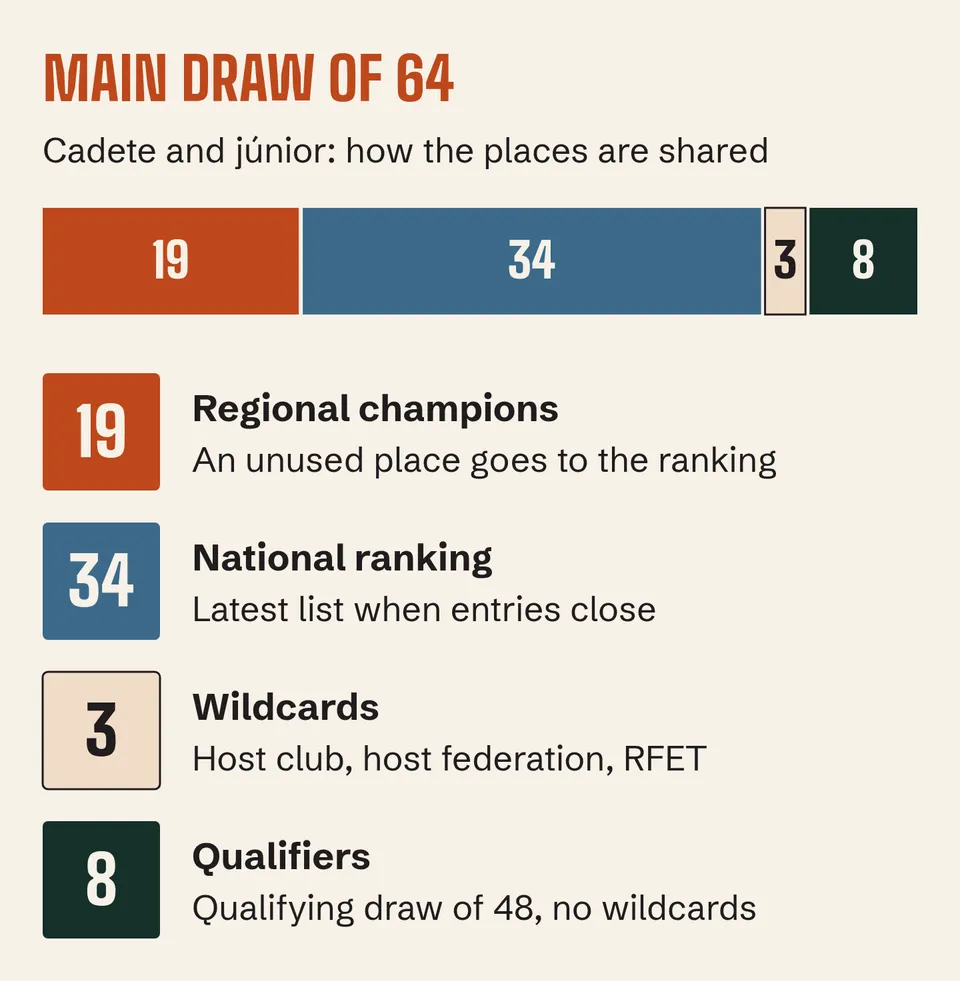
Both are built the same way. The 64-player main draw is made up of:
- 19 places for regional champions, which each regional federation reports before entries close. A place a federation does not use goes to the ranking.
- 34 places from the national ranking, using the latest list published when entries close.
- 3 wildcards: one from the host club, one from the regional federation where the event is held, one from the RFET.
- 8 places for qualifiers, from a 48-player qualifying draw filled by ranking, with no wildcards.
You enter yourself on the RFET website. Under the rules, entries close 14 days before the start; in 2026 they closed on 2 June for the cadete and 28 July for the júnior. To play the qualifying draw you must sign in person with the referee by 18:00 the day before it begins.
The difference lies in the regional championship:
| Cadete | Júnior | |
|---|---|---|
| Must you have played the regional championship? | Yes, its final stage, unless you have a wildcard or a documented injury | No |
| Regional runner-up | Guaranteed a qualifying place if their ranking does not reach the main draw | No guaranteed place |
| If the champion withdraws | Their own runner-up takes the place, if the referee is told up to 24 hours before qualifying sign-in closes | Same |
The cadete injury exception needs all of this:
- A medical certificate dated before the regional championship ends, stating when the injury started and when it ends, submitted with your entry to the Spanish championship.
- The certificate sent to the regional championship's referee and to the regional federation before that championship ends.
- No tournaments played during the dates the certificate covers.
Losing by walkover (W.O., not turning up to play) without documents justifying it before the regional championship ends does not count as having played.
How do you get into the alevín and infantil championships?
There are two phases. Each regional federation runs its own qualifying phase, choosing its dates and how many players take part, and every regional phase must finish at least three weeks before the national phase. The federation then enters its players, plus up to three reserves who played the regional phase. Without the regional phase you cannot get in, except by wildcard.
The 64-player draw has 61 places shared among the federations and 3 wildcards. Every federation gets at least two players per event, and the rest are shared out according to how many licences in that age group and sex each one held on 30 September of the previous year.
For a player from the Canary Islands, the regional championship is the Campeonato de Canarias; the route to it from each island's championship is on junior competition in the Canary Islands.
How are matches played?
A super tie-break is a tie-break to 10 points, won by two, played instead of the deciding set.
| Age group | Singles | Doubles |
|---|---|---|
| Alevín | Groups: two sets, with a super tie-break at one set all; from the last 16, best of three sets. Only each group winner goes through | No-ad scoring and a super tie-break instead of a third set |
| Infantil | Best of three tie-break sets | As alevín |
| Cadete and júnior | Main draw best of three sets; in qualifying, a super tie-break instead of a third set | As alevín |
Doubles draws have 32 pairs. Regional doubles champions and one host-club wildcard go in first, and they need not be in the singles draws; the rest go in by ranking. In alevín and infantil those other pairs must both be in the singles draws. In cadete, players in the other pairs must be in the qualifying or main singles draw, or have signed for qualifying. In júnior the rules do not require singles entry to play doubles.
How do the club team championships work?
There is one per age group (the cadete one is called the Yellow Cup), each with a boys' and a girls' event:
| Alevín | Infantil | Cadete | Júnior | |
|---|---|---|---|---|
| Ages (turned during the year) | 8 to 12 | 11 to 14 | 13 to 16 | 13 to 18 |
| 2026 dates | 17 to 22 August | 3 to 8 August | 23 to 28 June | 30 June to 5 July |
| Entries close | Monday five weeks before | Monday four weeks before | Monday four weeks before | Monday four weeks before |
The rules are the same in all four:
- Who plays: clubs affiliated to the RFET, up to 32 teams per event. If more enter, places are guaranteed for the host club, each autonomous community's team champions, the previous year's winners and three wildcards; every federation gets at least one team, and the rest are shared by licences in that age group.
- The tie: four singles and one doubles for boys; three singles and one doubles for girls, with a deciding doubles played as a single 10-point match tie-break at 2-2. Every match is two sets with a super tie-break. Teams that lose their first tie go into the consolation draw.
- The team: up to 15 players entered for boys and 10 for girls, and at least half of those who play each tie must meet the nationality or residence rules at the end of this page. Within the same year, a player cannot play another official team competition for a different team.
- Costs: the host club pays accommodation and meals for four players and a captain per boys' team, and three players and a captain per girls' team, until they are knocked out, except for teams from the same province. The rules do not cover travel.
Is there a championship between regions?
Among the junior age groups, the RFET runs a championship for regional teams (por comunidades autónomas) only in infantil. In 2026 it was played from 31 August to 4 September. Each regional federation enters one team per event, of up to six players aged 11 to 14 who have held a licence with that federation for at least three consecutive years (the current one and the two before). Each tie has two singles and one doubles; in the main draw, singles are best of three sets. What the Canary federation covers for the players it selects is on junior competition in the Canary Islands.
How many ranking points are they worth?
Every Spanish championship, singles or team, multiplies points by 3.5 in the RFET national ranking. A regional championship multiplies by 3, a national junior circuit by 1.75 or 2.5, and other tournaments by 1.25.
Common questions
Does it cost anything to enter the singles championships?
No. All four singles rulebooks forbid entry fees. In 2026, according to each championship's fact sheet, the organisers covered lunch and dinner from the evening before the main draw until the day a player was knocked out: for every player in alevín and infantil, and for main-draw players in cadete and júnior, plus one official per regional federation (in infantil, one per four players). Travel and hotel are paid by each family, apart from any help from their federation (what a season costs).
Can a foreign player who lives in Spain take part?
Yes, with a valid RFET licence and one of these since 1 January of the previous year: being eligible to represent Spain, Spanish nationality, or official residence in Spain with an NIE (foreigner's identity number) or an EU citizen registration certificate. The licence must be validated on the RFET platform (how to get a licence).
What does winning the cadete or júnior title bring?
The national title and, under the rules, a place representing Spain at the European individual championship for that age group, if the champion is eligible to represent Spain and the dates allow. Otherwise the RFET assigns that place. How the European circuit works is on the Tennis Europe Junior Tour, and the whole route on how to move up from island to international junior tennis.
Sources
- RFET, rules of the Spanish individual championships for alevín, infantil, cadete and júnior, updated 29 January 2026. Consulted on 5 October 2026.
- RFET, rules of the Spanish club team championships for alevín, infantil, cadete and júnior, and the infantil regional team championship, updated 29 January 2026. Consulted on 5 October 2026.
- RFET, "Definidas oficialmente las fechas y sedes de los Campeonatos de España de Tenis 2026 juveniles" (9 December 2025), and the 2026 Spanish championship calendars for junior singles and junior teams. Consulted on 5 October 2026.
- RFET, 2026 fact sheets for the Spanish singles and doubles championships, linked from the junior singles calendar: alevín (14 April 2026), cadete (12 May 2026), infantil (4 June 2026) and júnior (5 August 2026). Consulted on 5 October 2026.
- RFET, Reglamento de Clasificación 2026 (from January 2026), article 11. Consulted on 5 October 2026.
Keep reading
How much does a season of junior tennis cost in the Canary Islands?
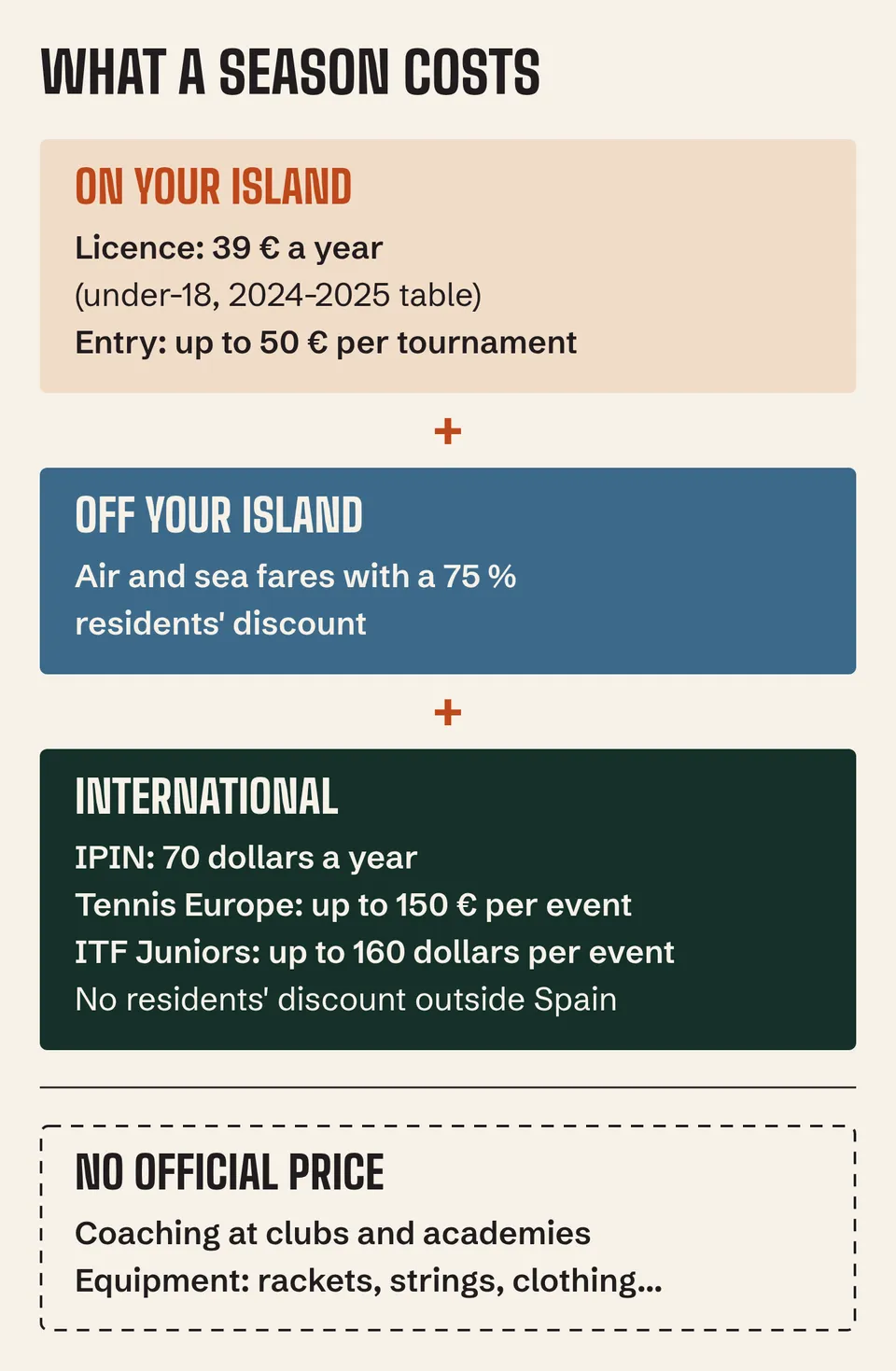
Licence once a year, up to 50 € per tournament in Spain, 75 % residents' discount on travel and up to 150 € per Tennis Europe event: 2026 costs.
Spanish junior tennis glossary: previa, W.O., seeds and more
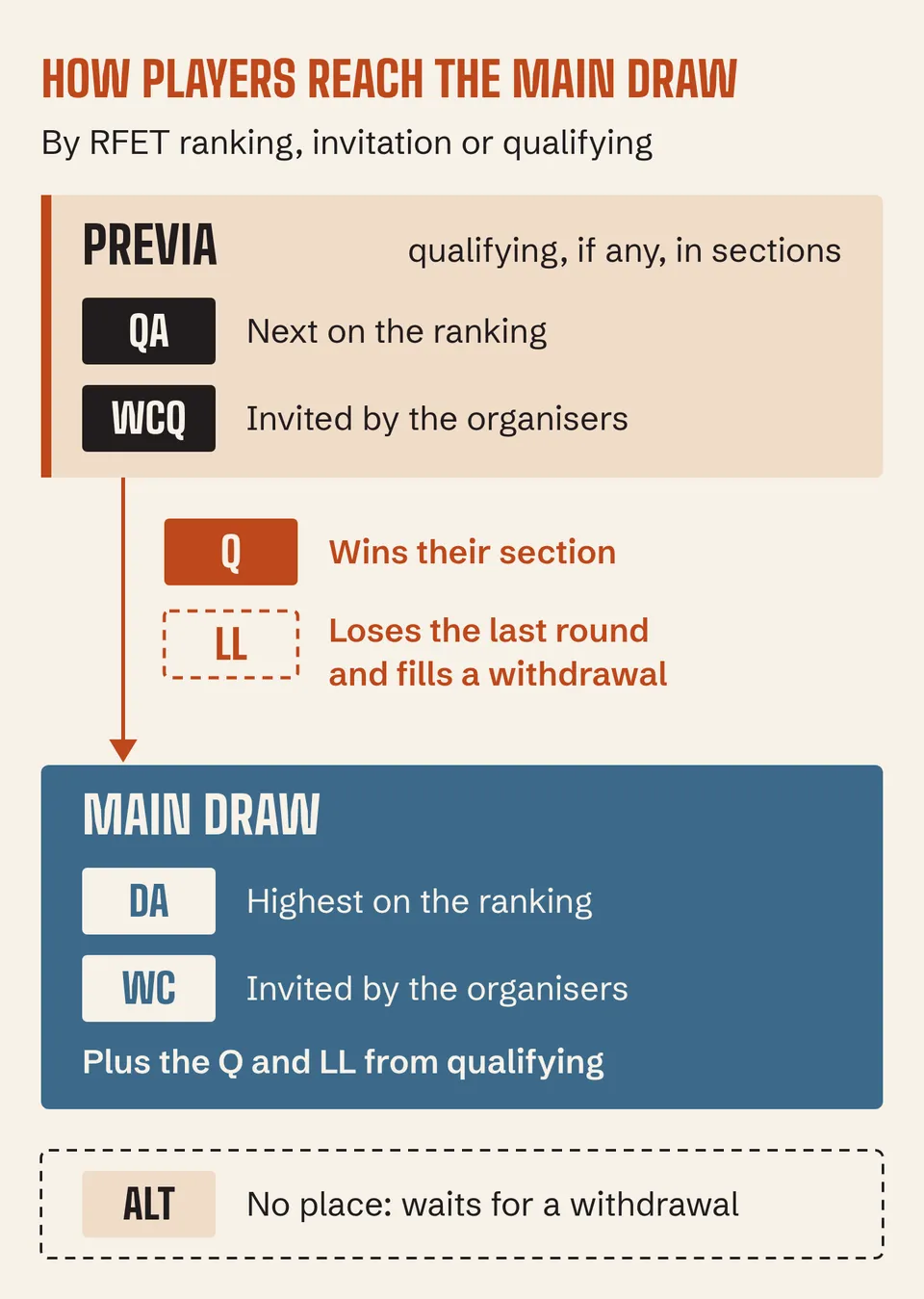
What W.O., previa, bye, seed, wildcard, coeficiente, estrellas and IPIN mean in Spanish junior tennis, term by term.
How do you get a tennis federation licence in the Canary Islands?
How to get or renew a tennis licence in the Canary Islands for 2026-2027: who needs one, types, cost, steps, insurance and injuries.