Spain's national junior tennis circuits and their points
The eleven national junior circuits of 2026, when they score 1.75 or 2.5 in the RFET ranking and which of them stop in the Canaries.
In this article
- What makes a circuit "national"?
- Which national circuits are there in 2026?
- How much is a circuit tournament worth?
- How much difference does it make in practice?
- What does annex 1 require for 2.5?
- Which circuits stop in the Canary Islands in 2026?
- How do the masters score?
- How can you check whether a tournament counts as a national circuit?
- Common questions
- Sources
Spain's national junior circuits (circuitos juveniles de ámbito nacional) are named series of tournaments, such as the Rafa Nadal Tour or the TDC Series, that the Royal Spanish Tennis Federation (RFET) recognises because they are played in at least five of Spain's autonomous communities and meet its minimum standards. They count for more in the national ranking than an open tournament: their draws are multiplied by 1.75 instead of 1.25, and by 2.5 when a tournament also meets the fifteen requirements in annex 1 of the RFET's ranking regulation. The RFET allows no more than eleven a year, and in 2026 its calendars page lists eleven. Six of them have stops in the 2026 calendar of the Canary Islands Tennis Federation (FCT): TDC Series, Champions Bowl, the RPT-Marca circuit, Spartan Tenis Tour, Warriors Tour and Rafa Nadal Tour.
What makes a circuit "national"?
The name alone does not. The RFET's Reglamento de Clasificación 2026, its ranking regulation, sets these conditions in article 11:
| Requirement | What it means |
|---|---|
| Reach | Tournaments in at least five autonomous communities |
| Maximum number of draws | Up to 15 singles draws per category and sex at under-10, under-12 and under-14, and up to 30 at under-16 and under-18 |
| Format | Week-long tournaments (Monday to Sunday) or weekend ones; weekend ones must have three consecutive days of play |
| Minimum entries per draw | Week-long: 20 boys and 12 girls. Weekend: 16 boys and 8 girls |
| Categories | The same throughout the circuit, with a boys' and a girls' event in each |
| Calendar | Sent to the RFET and the regional federations before 28 November of the year before. After that, no date changes and no extra tournaments; only the venue may change |
| One tournament a week | Never two tournaments of the same circuit in the same week |
If a circuit misses 30 % or more of its calendar in any category (by dropping the category or falling short of the minimum entries), it loses the right to stage those events the following season.
Which national circuits are there in 2026?
The RFET's calendars page lists these eleven in its "Circuitos Juveniles de Ámbito Nacional" section:
| Circuit |
|---|
| Rafa Nadal Tour |
| RPT-Marca circuit (in three series: Junior Cup, Challenge and Jóvenes Promesas) |
| MMO Sub'16 |
| Warriors Tour |
| Babolat Cup |
| Champions Bowl |
| Spartan Tenis Tour (listed by the RFET as "Spartan Tour") |
| TDC Series |
| AS Young Tour |
| Blue Tennis Cup |
| Barcelona Open Banc Sabadell Sub'14 |
Each entry links to the circuit's own website, with its tournaments and rules.
How much is a circuit tournament worth?
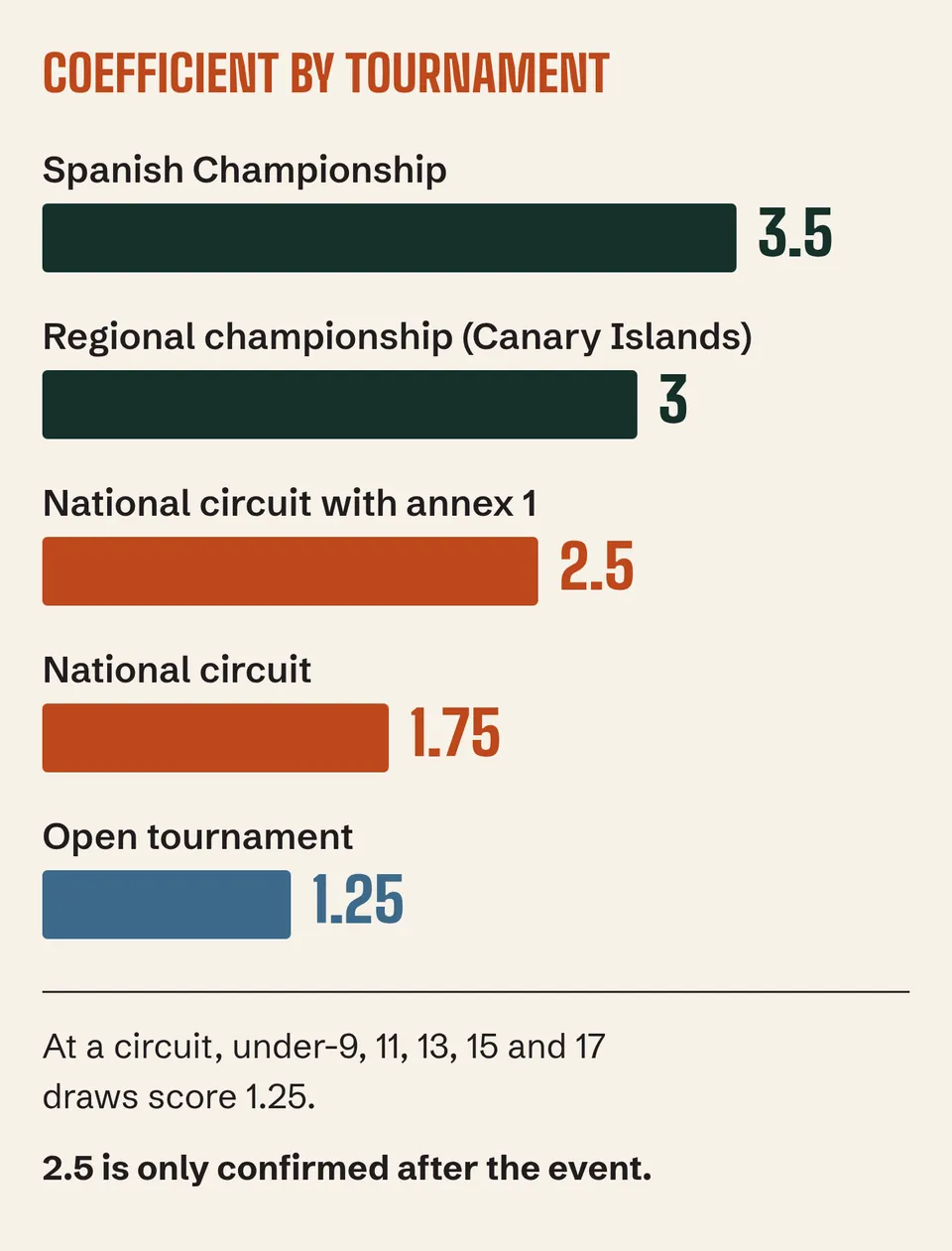
The coefficient multiplies the points each round is worth, which depend on the draw's star rating. How stars and points work is explained in how the RFET ranking works.
| Tournament | Coefficient |
|---|---|
| Spanish Championship | 3.5 |
| Regional championship (in the islands, the Canary Islands Championship) | 3 |
| National circuit meeting the annex 1 requirements | 2.5 |
| National circuit recognised by the RFET | 1.75 |
| Open tournament or other circuit (in general) | 1.25 |
| Circuit draws for in-between ages (under-9, 11, 13, 15, 17) | 1.25 |
| A circuit masters draw with fewer than 8 or more than 16 players | 1.25 |
Two special cases: at alevín (under-12), an open, social or provincial championship event played with a group stage (round robin) of at least 16 players scores 1.50, in its final draw as well; and a tournament played in a single day has a coefficient of 0.20.
Three rules worth knowing:
- Only the standard categories (under-10, alevín, infantil, cadete and júnior) can score 1.75 or 2.5. The ages for each are on Spanish tennis age categories.
- 2.5 cannot be advertised in advance. The regulation forbids a circuit from promising that a tournament will score 2.5. It is applied afterwards, to the tournaments that actually met annex 1.
- Only what was on the calendar counts. A tournament scores 1.75 or 2.5 only if it was in the calendar sent to the RFET, with the categories to be played.
The coefficients apply to main draws; qualifying draws have their own coefficient of 0.25.
How much difference does it make in practice?
A cadete (under-16) girl reaches the semi-finals of a 10-star cadete draw. The regulation's table gives 70 points for that round, and the cadete age coefficient is 0.65. Depending on the tournament:
| Same result at | Calculation | Points |
|---|---|---|
| An open tournament | 70 × 1.25 × 0.65 | about 57 |
| A national circuit | 70 × 1.75 × 0.65 | about 80 |
| A national circuit meeting annex 1 | 70 × 2.5 × 0.65 | about 114 |
Because the ranking only adds up a player's best results over twelve months (fourteen tournaments at cadete), the same result weighs more when it comes at a circuit event. The regulation applies both coefficients, the tournament's and the category's, to the same points table; the example multiplies them, as the one on the ranking page does, so treat the figures as a guide.
What does annex 1 require for 2.5?
Fifteen conditions, grouped here under eight headings, which the referee checks in a report at the end of the tournament:
- Officiating: a qualified referee, one court supervisor for every six courts from the first round of the main draw, and a qualified chair umpire for every final.
- Rules: the RFET's competition rules (Reglamento Técnico) are followed, with an RFET-approved ball.
- Balls: at least three new balls from the first round of the main draw, with new balls for the third set from cadete upwards.
- Rest: one match a day. Two matches on the same day are allowed only in the first round of qualifying, when it is played best of two sets (4-game sets at under-10) with a 10-point match tie-break, and on the first day of Friday-to-Sunday tournaments, always with three hours' rest between matches.
- Late finishes: no match goes on court after 21:30 unless the weather has held play up.
- Players: free water for matches, a meal at a special price and information about accommodation.
- Prizes: trophies for the winner and the runner-up, and a prize worth at least €100 that can never be cash.
- Public information: a fact sheet open to every player that states expressly that the tournament meets these requirements.
Which circuits stop in the Canary Islands in 2026?
The FCT's 2026 calendar lists stops in the islands from six of the eleven. According to each circuit's own rules or website:
| Circuit | Categories in 2026 | How it ends |
|---|---|---|
| TDC Series (Tenis desde Canarias) | Under-10, alevín, infantil and cadete | TDC Finals, for the top 8 in each category of its own ranking; the final's winners (except under-10) get a wildcard into a Tennis Europe or ITF junior event |
| Champions Bowl (Champions Cup on its website) | Under-10, 12, 14, 16 and 18 | A national masters; the winner of each tournament qualifies directly, and the circuit's own ranking sets the seeds |
| RPT-Marca circuit | Under-12, 14, 16 and 18, depending on the event | A national masters by category |
| Spartan Tenis Tour | Under-10 to júnior at its island stop | A masters for the top 16 in each category who apply; to score in its ranking, players must have played at least two weeks |
| Warriors Tour | Under-10 to under-16; under-18 only at its Premium events | A national masters for the top 8 of its own ranking; players must have played at least two events |
| Rafa Nadal Tour | Under-12, 14 and 16 | Seven tournaments and a masters |
Each circuit's own ranking decides who gets into its masters (and, in some, the seeds there). It does not replace the RFET national ranking, which counts the same tournaments with the coefficients above. The international wildcards lead to Tennis Europe or the ITF junior tour.
Following a national circuit beyond its island stops means travelling. What that costs is on what a junior tennis season costs, and which travel grants exist and which events they cover on grants and aid for young players.
How do the masters score?
A national junior circuit's masters must have between 8 and 16 players in each draw. A draw with fewer or more than that scores 1.25. Who gets in is up to each circuit's own rules: its own ranking, winning a circuit tournament or applying, as the table above shows.
How can you check whether a tournament counts as a national circuit?
- Look the circuit up at the RFET. The RFET calendars page has a section for national junior circuits, with a link to each circuit's website.
- Find the tournament in your federation's calendar. The FCT calendar marks these events "circuito nacional". A tournament that is not in the official calendar does not score.
- Check the draw's category. An in-between age such as under-11 or under-13 scores 1.25, even at a circuit tournament.
- Read the fact sheet. A tournament aiming for 2.5 has to state that it meets annex 1. Even then, 2.5 is only confirmed after the event.
Entering step by step is covered in how to enter a federation tournament.
Common questions
Does a national circuit score more than the Canary Islands Championship?
Not for the same result in a draw of the same level. The Canary Islands Championship, as a regional championship, multiplies by 3 and the Spanish Championship by 3.5, against 1.75 or 2.5 for a circuit. How the championships work in the islands is on junior competition in the Canary Islands.
Can a player enter two categories at the same tournament?
Yes. The RFET's Reglamento Técnico allows two singles events in different categories at the same tournament, and the ranking counts them as two separate tournaments. Some circuits narrow this in their own rules: the TDC Series, for example, allow a player's own category and the one above.
Where does this fit in a player's progress?
National circuits are the step between island tournaments and international ones. The full route is on how to move up from island to national and international junior tennis, and the terms (draw, qualifying, stars) are in the glossary.
Sources
- RFET, Reglamento de Clasificación 2026 (signed 1 January 2026; PDF dated 10 February 2026), articles 1, 5, 11 and 12 and annex 1. Consulted on 5 October 2026.
- RFET, Calendarios 2026, section "Circuitos Juveniles de Ámbito Nacional", with a link to each circuit's website. Consulted on 5 October 2026.
- RFET, Reglamento Técnico de Competición 2026 (PDF dated 14 January 2026), simultaneous tournaments. Consulted on 5 October 2026.
- Federación Canaria de Tenis, 2026 calendar (PDF dated 1 March 2026). Consulted on 5 October 2026.
- TDC Series, competition rules, 2026 season (version 17.0, last modified 1 June 2026). Consulted on 5 October 2026.
- Champions Cup, 2026 rules (24 November 2025). Consulted on 5 October 2026.
- RPT, 31st Circuito Nacional RPT-Marca, 2026 calendar (25 November 2025). Consulted on 5 October 2026.
- Spartan Tenis Tour, 2026 circuit page, linked from the RFET's calendars page (updated 5 October 2026). Consulted on 5 October 2026.
- Warriors Tour, 2026 rules. Consulted on 5 October 2026.
- Rafa Nadal Tour, about the tour and home page, 2026 edition. Consulted on 5 October 2026.
Keep reading
Grants for junior tennis players in the Canary Islands
Grants and funding for junior tennis players in the Canary Islands: the tennis federation, the Canary Government and Gran Canaria. Eligibility, amounts, dates.
How to move up from island to international junior tennis
How a junior tennis player from the Canaries moves up: island, Canary and Spanish championships, Tennis Europe and ITF juniors, with 2026 ages and rules.
How much does a season of junior tennis cost in the Canary Islands?
Licence once a year, up to 50 € per tournament in Spain, 75 % residents' discount on travel and up to 150 € per Tennis Europe event: 2026 costs.