How does a junior tennis tournament work?
How players get into a federated junior tournament in Spain: the RFET ranking list, qualifying, seeds, byes, lucky losers, consolation and formats.
In this article
- Who gets in, and into which draw?
- What draw sizes are there?
- How does qualifying work?
- How many seeds are there, and where do they go?
- What is a bye, and who gets one?
- What is a lucky loser?
- Is there a consolation draw?
- A worked example: a 32-player main draw with qualifying
- How are matches played?
- How long is the warm-up, and how much rest is there?
- Common questions
- Sources
In a federated junior tennis tournament in Spain, entries are ordered by the national ranking of the Real Federación Española de Tenis (RFET, the Spanish tennis federation). The highest-ranked players go straight into the main draw (cuadro final); the next ones play a qualifying event (previa), if there is one, and its winners fill the remaining places. In a knockout draw a defeat puts you out, unless there is a consolation draw. Draw sizes, the number of seeds, byes and lucky losers all follow the tables and rules in the RFET's Reglamento Técnico (technical regulation). Unless the tournament's rules say otherwise, singles are best of three sets, every set with a tie-break.
Who gets in, and into which draw?
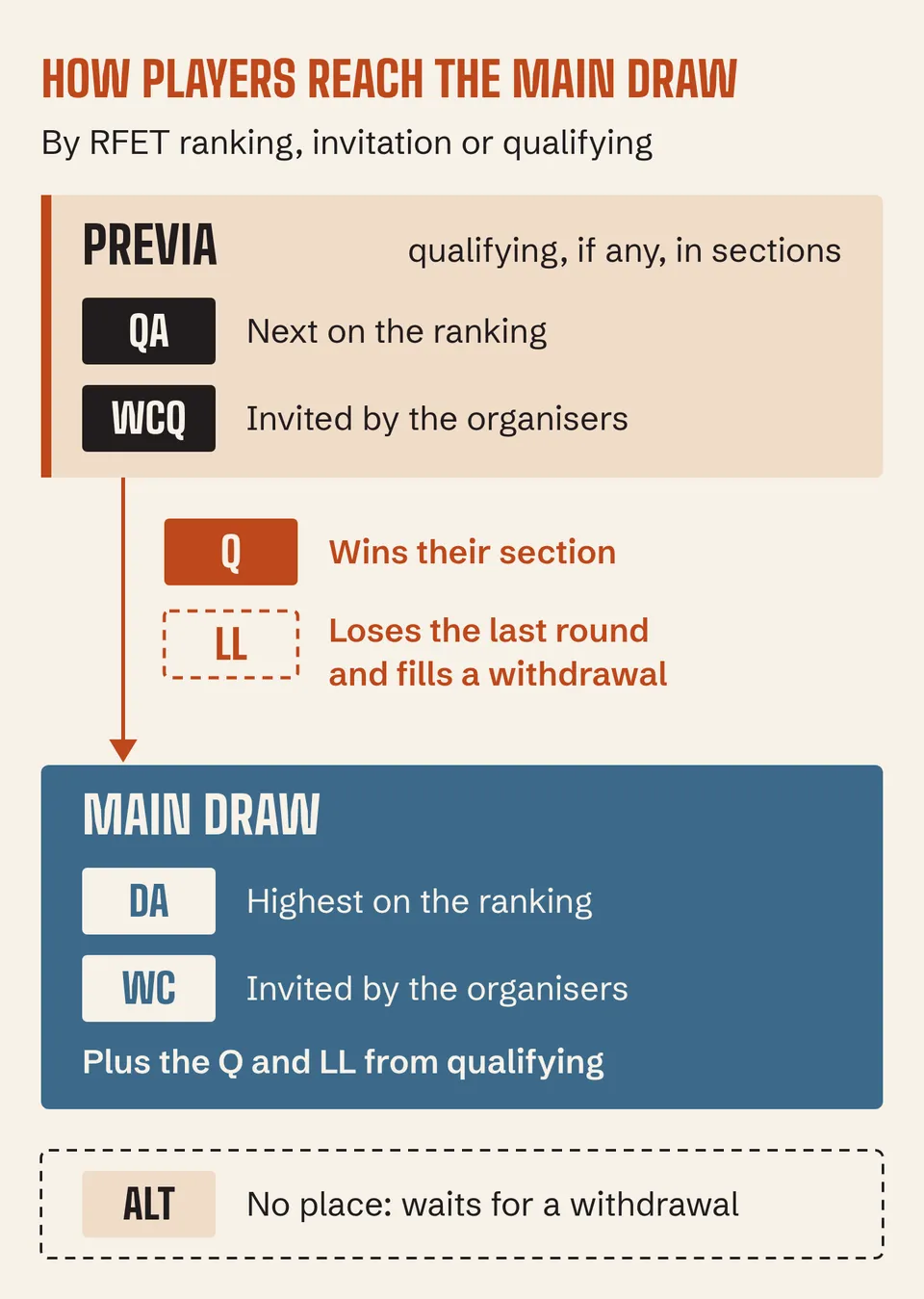
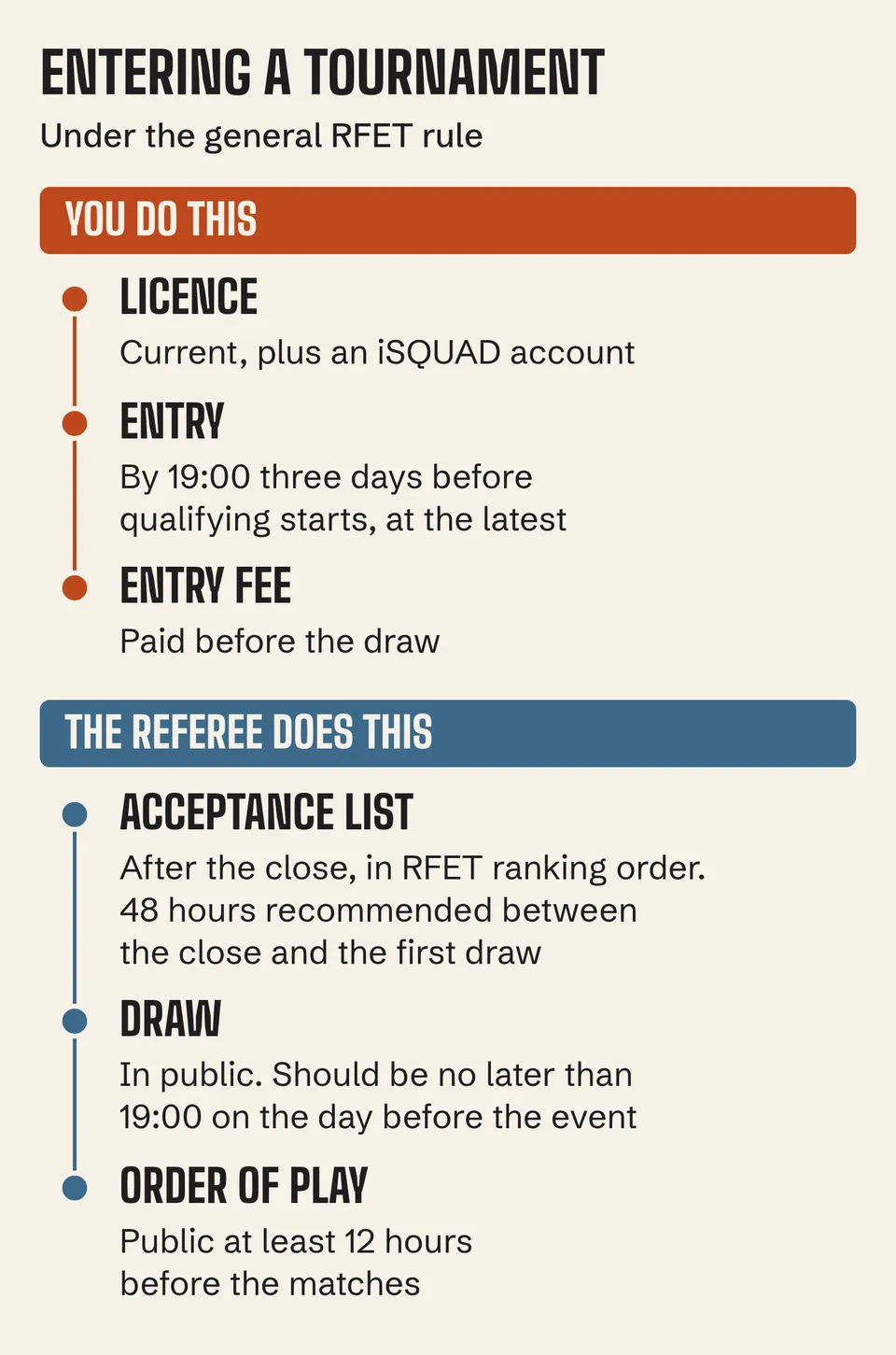
When entries close, the referee (juez árbitro, the official in charge of the tournament) puts the entries in order on the acceptance list. Only the RFET national ranking counts, and anyone without a valid licence at the close is left off. The top players are direct acceptances into the main draw (DA), the next ones go into qualifying (QA), and the rest are alternates (ALT), waiting for a withdrawal. On top of that, the organising committee hands out wildcards to the main draw (WC) and to qualifying (WCQ), whatever the player's ranking; once you have played qualifying, you can no longer be given a main-draw wildcard.
How to enter and when the list is published is covered in how to enter a federated tournament, and every abbreviation is in the glossary.
What draw sizes are there?
The organiser announces how the draws are made up before entries open, and has to follow this table from the Reglamento Técnico:
| Main draw | Wildcards (WC) | Qualifiers (Q) | Direct acceptances (DA) |
|---|---|---|---|
| 8 | 0 or 2 | 4 or 2 | 4 |
| 16 | 2 | 2 or 4 | 12 or 10 |
| 24 | 3 | 4 | 17 |
| 32 | 4 | 4 or 8 | 24 or 20 |
| 48 | 5 | 4 or 8 | 39 or 35 |
| 64 | 6 | 8 or 12 | 50 or 46 |
Draws of 12, 14, 28, 30, 56, 60 or 62 are also allowed. Without a qualifying event, the qualifiers' places go to direct acceptances. In junior tournaments, which run up to age 18, the main draw is capped at 64 players and qualifying at 128.
How does qualifying work?
The previa is split into as many sections as it has places in the main draw, and each section winner moves up, marked with a Q. It has its own wildcards: 6 in a qualifying draw of 32, for example, and 8 in one of 64.
In junior tournaments, a qualifying draw of 32 with 8 qualifiers is spread over two days of play, one of 64 over three and one of 128 over four, or a day less with the two-sets-and-match-tie-break format explained further down. The main draw starts on the day qualifying ends or the day after. For the ranking, qualifying points are multiplied by 0.25.
How many seeds are there, and where do they go?
Seeds (cabezas de serie) are chosen using the RFET ranking at the time of the tournament's first draw. A player with no ranking cannot be seeded; a wildcard can, if their ranking earns it. The number of seeds depends on how many players are in the main draw:
| Players in the main draw | Seeds |
|---|---|
| Up to 5 | 2 |
| 6 to 23 | 4 |
| 24 to 47 | 8 |
| 48 to 64 | 16 |
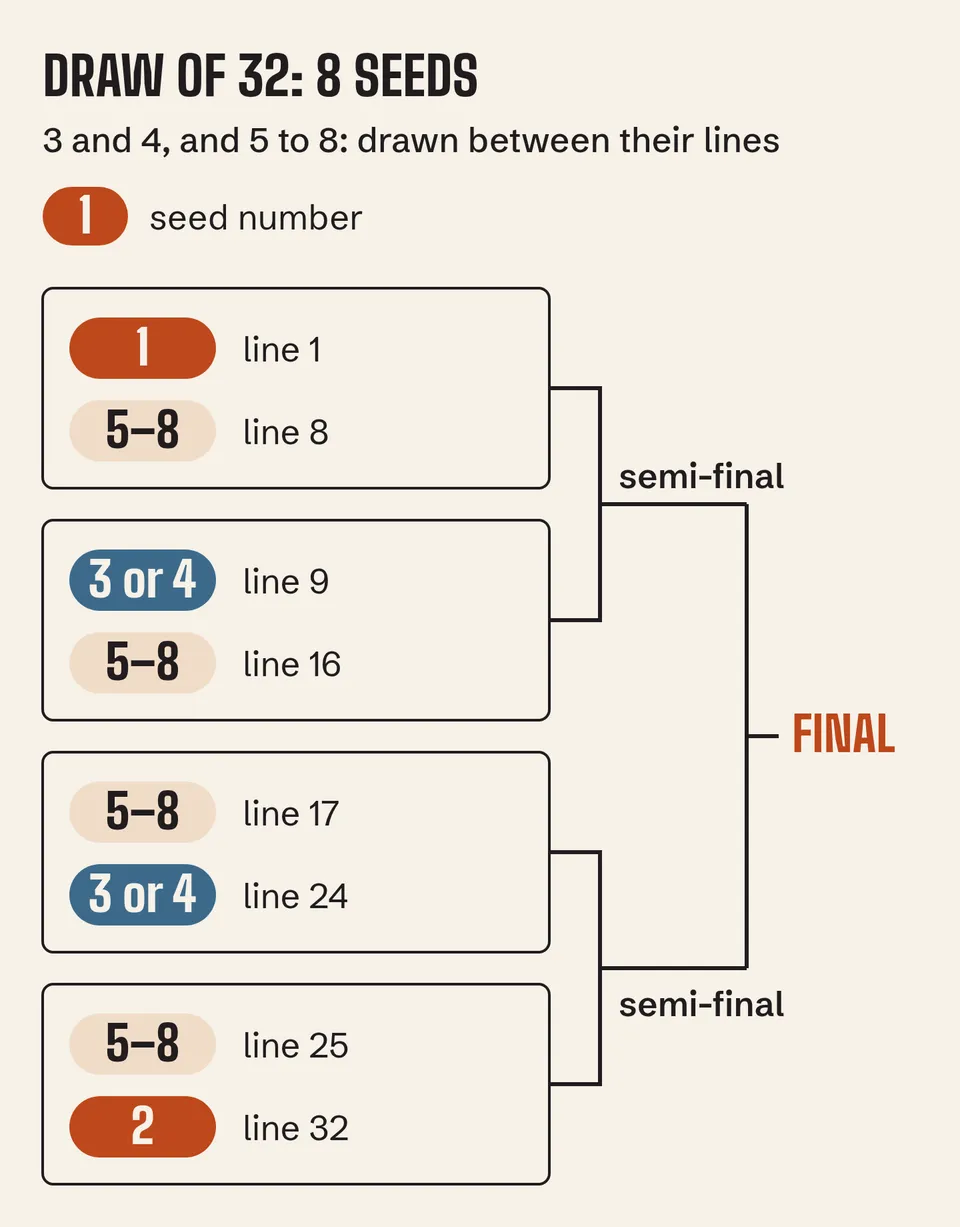
Seed 1 goes on the first line of the draw and seed 2 on the last. Seeds 3 and 4 are drawn between two fixed lines, and seeds 5 to 8, 9 to 12 and 13 to 16 are drawn in groups of four between theirs. That way the top two can only meet in the final, and the top four cannot meet before the semi-finals. In qualifying, each section has two seeds, one at the top and one at the bottom.
What is a bye, and who gets one?
A bye takes a player into the second round without playing, because there are not enough players to fill the draw. There are as many byes as empty places. They go to the seeds first, in order, and any left over are drawn and spread across the sections of the draw.
What is a lucky loser?
A player who lost in the last round of qualifying (or, if more are needed, in an earlier round) and gets into the main draw because someone withdraws before playing their first match. Once qualifying has started, main-draw vacancies can only be filled this way. The order of the lucky losers is drawn in public when qualifying ends, ranked players first. To be in line you sign in with the referee each day, up to half an hour before the first-round matches, and must be on court within 15 minutes of being called. Anyone who lost a qualifying match by walkover (W.O.) or by retiring is not eligible, unless there is a medical reason.
Is there a consolation draw?
It is optional: the organiser can run one for players who lose their first main-draw match. In weekend tournaments, a player who loses in the first round of the main draw may play the first round of the consolation draw the same day. In the under-10 category it is compulsory whenever it has at least four entries. For the ranking, its points are multiplied by 0.10.
A worked example: a 32-player main draw with qualifying
An infantil (under-14) tournament announces a main draw of 32 (20 direct acceptances, 8 qualifiers and 4 wildcards) and a qualifying draw of 32 (26 by ranking and 6 wildcards). Fifty players enter:
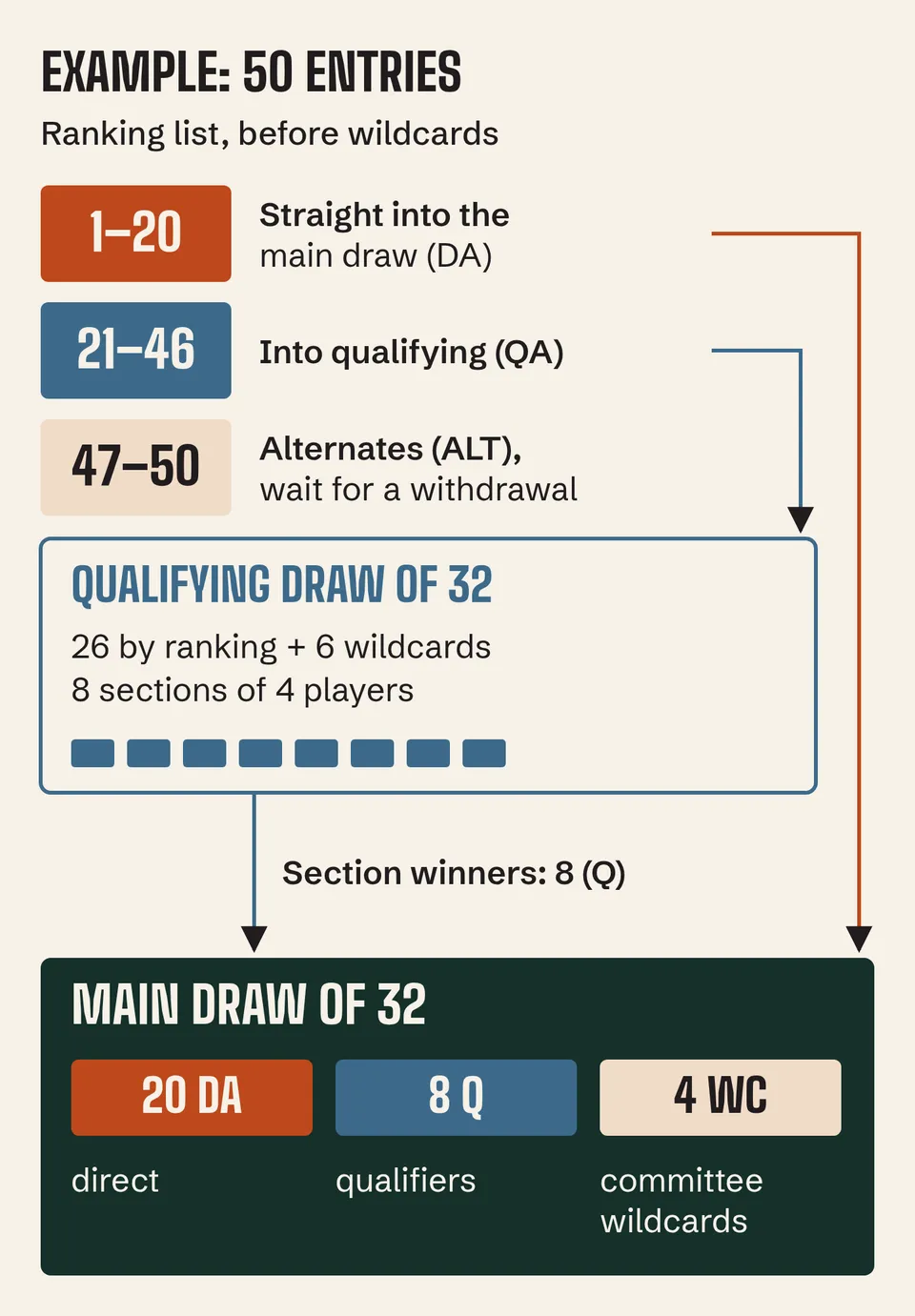
- On the acceptance list, before any wildcards are handed out, the 20 highest-ranked go straight into the main draw. Numbers 21 to 46 go into qualifying. Numbers 47 to 50 are alternates.
- Qualifying has 8 sections of 4 players, with up to 16 seeds, two per section. Each section winner goes through to the main draw.
- The main draw has 32 players, so it has 8 seeds. Seed 1 goes on line 1 and seed 2 on line 32; seeds 3 and 4 are drawn between lines 9 and 24, and seeds 5 to 8 between lines 8, 16, 17 and 25.
- If a direct acceptance pulls out after qualifying has started, the place goes to the first lucky loser in the draw.
If the same 32-player draw had no qualifying and only 27 players entered, there would be 5 byes, for seeds 1 to 5.
How are matches played?
Each tournament's rules pick a format from those allowed by the Rules of Tennis of the International Tennis Federation (ITF), and every match in one phase uses the same format. Best of five sets is never played.
| Format | How it is won | Where it is used |
|---|---|---|
| Best of three tie-break sets | Two sets of six games; at 6-6, a tie-break | Singles, unless the tournament's rules say otherwise |
| Two sets and a match tie-break | At one set all, a match tie-break to 10 points replaces the third set | Canary Islands championships, singles and teams; a qualifying round played on the same day as another; doubles, unless the rules say otherwise |
| Two short sets and a match tie-break | Sets to 4 games; at one set all, a match tie-break to 10 points | RFET under-10 category; Canary Islands benjamín (under-10) championship |
A tie-break goes to the first to 7 points with a two-point lead, a match tie-break to the first to 10 with a two-point lead. Under the Rules of Tennis, a short set goes to the first to 4 games with a two-game lead, with a tie-break at 4-4 (or at 3-3, if the body sanctioning the event so decides). The green-dot ball is compulsory at under-10; how the youngest players compete is explained in competition at under-10 and under-12.
How long is the warm-up, and how much rest is there?
- Warm-up: five minutes at most, unless the organisers decide otherwise.
- During a match: 25 seconds between points, 90 at changes of ends and 120 at the end of a set. After the first game of each set and during a tie-break, players change ends without a rest.
- Matches per day: at most one singles and one doubles, and one per event. Doubling up, meaning two matches in the same event on the same day, is only allowed where the Reglamento Técnico says so: because of the weather, in a single round of qualifying (played as two sets and a match tie-break) and on certain days or rounds depending on the type of tournament, such as the first or second round of a weekday tournament. In weekend tournaments, under-10 events may double up. National junior circuits have their own rules.
- Between two matches on the same day: the rest depends on how long the first one lasted.
| If the previous match lasted | Rest |
|---|---|
| Less than 1 hour | 30 minutes |
| Between 1 hour and 1 hour 30 | 1 hour |
| More than 1 hour 30 | 1 hour 30 minutes |
At under-10 and alevín (under-12), a player who doubles up in qualifying or on the first day of a single-weekend tournament gets three hours' rest, unless the doubling is due to bad weather. There must be 12 hours between a player's last match of one day and their first the next. The order of play is published at least 12 hours ahead, no junior match goes on court later than 21:30 and, at alevín and under-10, there is no play between 14:00 and 16:00 if the temperature is above 38 °C. Where to find the draw and your match time is covered in how to enter a federated tournament.
Common questions
Is every tournament a knockout?
No. The Reglamento Técnico also allows a league (liguilla), where everyone plays everyone, and a combination of group play followed by a knockout, which the regulation calls round robin.
How many points does losing your first match earn?
One point, in any draw and whatever its level, and none if the match is lost by walkover. The rest is explained in how the RFET ranking works.
Can a player enter two age categories in one tournament?
Yes, if their age allows it: at most three events per tournament, no more than two of them singles. Which categories a player can enter is explained in tennis age categories in Spain.
What happens if a player is late on court?
They must be ready within 10 minutes of the call; after 15 they lose the match, unless the referee takes the circumstances into account. The rest is in conduct and officiating at junior tournaments.
Sources
- RFET, Reglamento Técnico de Competición 2026 (technical regulation), sections II.E, III.A to III.E, III.G and V.C. Consulted on 5 October 2026.
- ITF, Rules of Tennis 2026 (Spanish edition, Reglas del Tenis, published by the RFET), rules 5 to 7 and 29 and appendices VI and VIII. Consulted on 5 October 2026.
- RFET, Reglamento de Clasificación 2026 (ranking regulation, from January 2026), articles 5 and 12. Consulted on 5 October 2026.
- Federación Canaria de Tenis, Normativa de Clasificación de los Campeonatos de Canarias 2025/2026 (Canary Islands championships rules, signed 16 March 2026), match formats. Consulted on 5 October 2026.
Keep reading
Spanish junior tennis glossary: previa, W.O., seeds and more
What W.O., previa, bye, seed, wildcard, coeficiente, estrellas and IPIN mean in Spanish junior tennis, term by term.
How do you enter an official tennis tournament in Spain?
With a current licence and an iSQUAD account, you enter before the deadline in the regulations and pay before the draw. Deadlines, withdrawals and walkovers.
What are the conduct and umpiring rules in junior tennis?
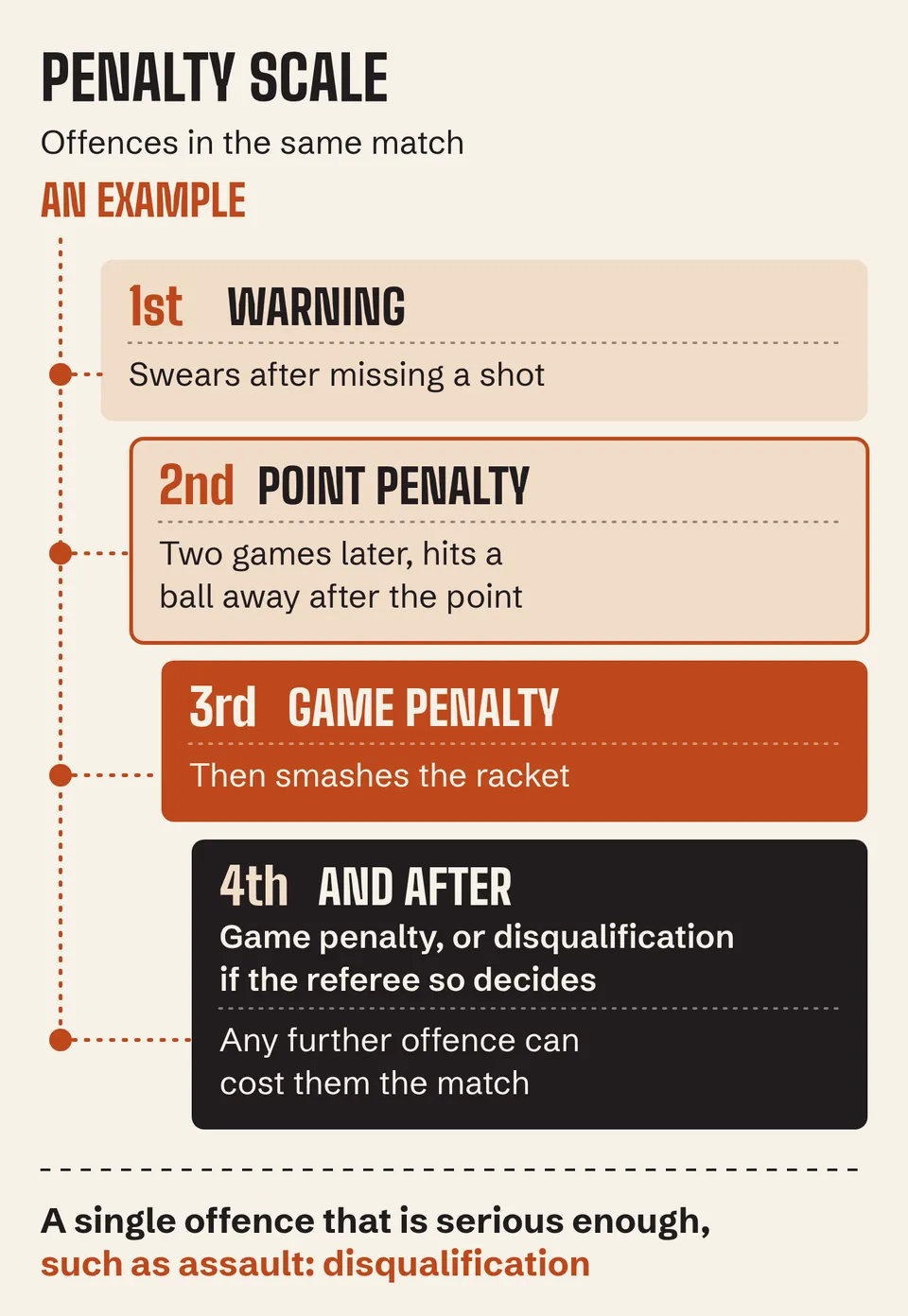
Who officiates, how penalties work (warning, point, game), who calls the lines without a chair umpire and when coaches may advise in 2026.