How do under-10s and under-12s compete in tennis in Spain?
Under-10s in Spain play with the green ball and short sets to 4 games; alevín players have no special ball. Ranking points and Canary championships.
In this article
In Spanish federation tennis, children compete in two categories before infantil: under 10 (sub-10, which the Canary Islands Tennis Federation's rules call benjamín) and alevín (under 12: players who turn 11 or 12 during the year). In the under-10 category, the Royal Spanish Tennis Federation (RFET) requires the green-dot ball and matches of two short sets to 4 games. The green ball is the last of the International Tennis Federation's (ITF) three children's balls before the standard one. Alevín has no compulsory ball or format of its own: RFET-approved balls and whatever format the tournament's rules set (best of three tie-break sets if they say nothing). Both categories earn points for the national ranking, with small coefficients, and the first Spanish Championship by age is the alevín one.
Which ball and which court go with each stage?
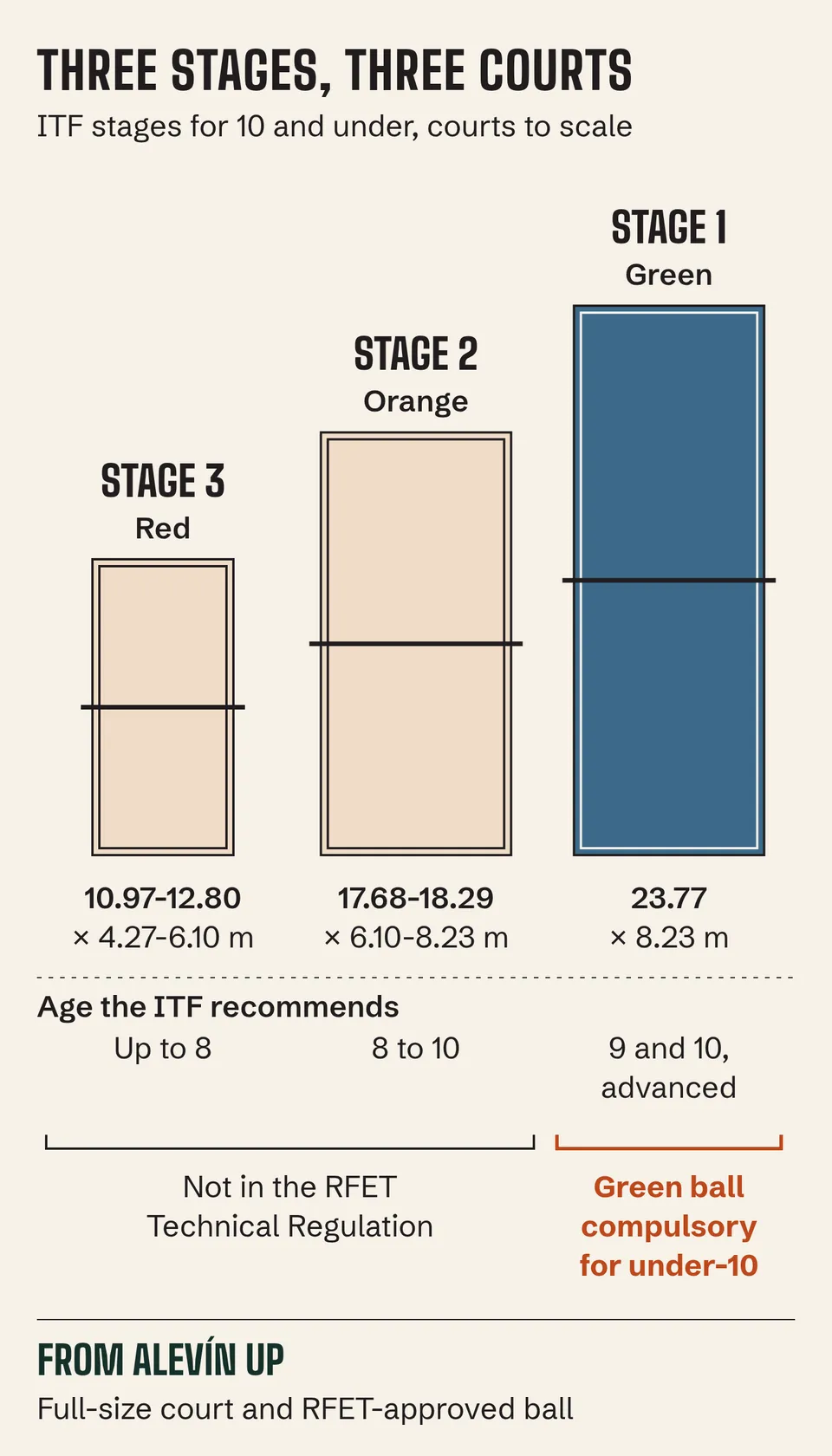
The ITF splits tennis for players aged 10 and under into three stages, each with its own ball: stage 3 (red), stage 2 (orange) and stage 1 (green). Players are meant to move from red to green and then on to the standard ball.
| ITF stage | Ball | Court the ITF recommends | Age the ITF recommends | Compulsory in official Spanish competition? |
|---|---|---|---|---|
| Stage 3 | Red, foam or felt | Red: 10.97-12.80 x 4.27-6.10 m | Up to 8 | No; the Technical Regulation does not mention it |
| Stage 2 | Orange | Orange: 17.68-18.29 x 6.10-8.23 m | 8 to 10 | No; the Technical Regulation does not mention it |
| Stage 1 | Green (yellow with a green dot) | Full size: 23.77 x 8.23 m for singles | Advanced players aged 9 and 10 | Yes, in every official under-10 event |
| Standard ball | Yellow or white | Full size | From alevín up there is no compulsory ball by age: it only has to be RFET-approved |
Since 2012 the yellow ball has been out of 10-and-under competition, a change the ITF launched as Tennis 10s, part of its Tennis Play and Stay campaign, as the RFET reported at the time (in Spanish). The 2026 Rules of Tennis keep it that way: in that competition only red, orange and green are allowed.
The court sizes come from Appendix VIII of the 2026 Rules of Tennis and the rebounds from Appendix I: red bounces 85 to 105 cm, orange 105 to 120, green 120 to 135 and the medium-speed standard ball 135 to 147. The rebounds are measured with the same test for every ball, so a red ball bounces roughly two thirds as high as a standard one.
In Spain, the RFET Technical Regulation 2026 (Reglamento Técnico, in Spanish) uses only one of the three: the green ball, compulsory in every official under-10 event (section III.G.4). Red and orange have no official competition of their own in that regulation; if a school or introductory event uses them, its own rules say so.
How are matches scored?
| Competition | Format |
|---|---|
| Any official under-10 event | Two short sets to 4 games and, at one set all, a 10-point match tie-break |
| Canary Islands benjamín Championship | The same: two short sets to 4 games and a 10-point match tie-break |
| Alevín tournaments | Whatever the tournament's rules set; if they say nothing, best of three sets with tie-breaks |
| Canary Islands alevín Championship | Two tie-break sets and, at one set all, a 10-point match tie-break |
A short set goes to the first player to reach 4 games with a two-game lead; at 4 all there is a tie-break, and the Rules of Tennis let the sanctioning body bring it forward to 3 all. A match tie-break goes to the first to 10 points with a two-point lead. The terms and how a draw is run are explained in how a junior tennis tournament works.
What changes for the youngest players?
The Technical Regulation has some rules of its own for the under-10 and alevín categories:
- Minimum age. Players must be 8 on the first day of the main draw. In regional under-10 championships, the regional federation may admit those who turn 8 that year (section III.B).
- Consolation draw. Every under-10 event with at least four entries must include a consolation draw, so losing the first match does not end the tournament (III.G.4).
- Two matches in a day. Under-10 weekend tournaments may schedule two matches on the same day. In the under-10 and alevín categories, when matches are doubled up in qualifying or on the first day of a single-weekend tournament, the rest between them rises to 3 hours (III.E.4).
- Heat. In the under-10 and alevín categories, no matches are played between 14:00 and 16:00 if the temperature is above 38 degrees (III.G.5).
Which draws each category can enter is in how tennis age categories work in Spain: under-10 players can play under 10 and alevín; alevín players, alevín and infantil. To play any of them you need a licence (how to get one in the Canaries) and an entry for each tournament (how to enter).
Does under 10 count for the national ranking?
Yes. Under-10 and alevín players are in the RFET national ranking like everyone else, with two differences: fewer tournaments count, and their draws are worth less.
| Category | Best singles tournaments that count | Coefficient for a draw of their age | Earns points in draws up to |
|---|---|---|---|
| Under 10 | 6 | 0.15 | Alevín |
| Alevín | 8 | 0.20 | Infantil |
An open adult draw is worth 1, so a result in an under-10 draw weighs far less than the same result among adults. The alevín details and the full calculation are on how the RFET ranking works; two of them:
- Each tournament also has its own coefficient, set by its level. In alevín, open, club and provincial championship events played in groups (round robin) give those groups and their final draw 1.50 with at least 16 players, and 1.25 with fewer.
- Tennis Europe points count double for an alevín. But Tennis Europe ranks nobody who turns 12 or less in the year, so an alevín only has those points from early December of the year they turn 12 (see the Tennis Europe Junior Tour).
All of this comes from the RFET Ranking Regulation 2026 (Reglamento de Clasificación, articles 1, 11 and 12).
Is there an under-10 Spanish Championship?
No. The first Spanish Championship by age is the alevín one, and the way in is through the regional championship: it is open to players no older than 12 on 31 December who, wildcards aside, played their regional federation's championship. How entry and play work is on the Spanish junior championships, and the route from the islands on junior competition in the Canary Islands.
When are the benjamín championships played in the Canaries?
In 2026, the Canary Islands Tennis Federation (FCT) plays the alevín singles championship in May and both under-10 championships, teams and singles, between late October and November:
| Canary Islands Championship | 2026 dates |
|---|---|
| Alevín singles | 1 to 10 May |
| Benjamín (under 10) teams | 30 October to 8 November |
| Benjamín (under 10) singles | 13 to 22 November |
Under the FCT's rules, the champion and runner-up of each island championship get a direct place in the Canary singles championship, benjamín included. The team championship works differently: 8 teams play it, the champion and runner-up of each province plus four more by ranking. One difference worth knowing: the travel aid in those rules for the Canary singles championship names the alevín, infantil and cadete categories, not benjamín.
An example
A girl born in 2016 turns 10 in 2026, so she is under 10 all year. In an under-10 draw she plays with the green ball, in short sets to 4 games, and her points are multiplied by 0.15. She can also enter the alevín draw at the same tournament. The green-ball and short-set rule is for under-10 events; in the alevín draw, the ball and format are whatever the tournament's rules set, and best of three tie-break sets if they say nothing. There her points are multiplied by 0.20. For the ranking, playing two categories at one tournament counts as two separate tournaments, so both results can be among her best 6. She cannot enter an infantil draw. On 1 January 2027 she becomes alevín: the green-ball rule no longer applies to her, and her best 8 tournaments count instead of 6.
Common questions
Can an official under-10 tournament use the orange ball?
No. The Rules of Tennis allow red and orange in 10-and-under competition, but the RFET Technical Regulation requires the green-dot ball in every official under-10 event.
Which ball do alevín players use?
The Technical Regulation sets no special ball for them: as in every category, it must be RFET-approved, and each tournament's rules name the brand. The red and orange courts in the Rules of Tennis are only for 10-and-under competition, so alevín players compete on a full-size court.
Can a 10-year-old play Tennis Europe?
Yes, in the 12 and under age group (12&U), if they have already turned 10 by the first day of the main draw. The requirements and what the points are worth are on the Tennis Europe Junior Tour.
Sources
- ITF, Rules of Tennis 2026 (PDF updated 23 December 2025): Rule 1, Appendix I (the ball), Appendix VI (short sets) and Appendix VIII (10 and under competition). Consulted on 5 October 2026.
- ITF, Balls technical sheet (November 2019). Consulted on 5 October 2026.
- RFET, Entran en vigor las nuevas pelotas y reglas de competición para menores de 10 años (news item, 2 January 2012, in Spanish). Consulted on 5 October 2026.
- RFET, Reglamento Técnico de Competición 2026 (PDF dated 14 January 2026), sections II.G, III.B, III.E and III.G (in Spanish). Consulted on 5 October 2026.
- RFET, Reglamento de Clasificación 2026 (from January 2026; PDF dated 10 February 2026), articles 1, 11 and 12 (in Spanish). Consulted on 5 October 2026.
- RFET, Spanish Alevín Singles Championship regulation (updated 29 January 2026) and list of sporting regulations (in Spanish). Consulted on 5 October 2026.
- Tennis Europe, Junior Tour Rules and Regulations 2026 (version June 2026), 12&U age eligibility and rankings. Consulted on 5 October 2026.
- Canary Islands Tennis Federation, Normativa de Clasificación de los Campeonatos de Canarias 2025/2026 (signed 16 March 2026, in Spanish). Consulted on 5 October 2026.
- Canary Islands Tennis Federation, 2026 calendar (PDF created 1 March 2026), 2026 Canary singles championships (PDF dated 28 December 2025) and 2026 Canary team championships (PDF dated 17 May 2026). Consulted on 5 October 2026.
Keep reading
How do the Spanish junior tennis championships work?
How to get in, how matches are played and when the Spanish alevín, infantil, cadete and júnior championships are held, singles and teams.
How do you enter an official tennis tournament in Spain?
With a current licence and an iSQUAD account, you enter before the deadline in the regulations and pay before the draw. Deadlines, withdrawals and walkovers.
How do you get a tennis federation licence in the Canary Islands?
How to get or renew a tennis licence in the Canary Islands for 2026-2027: who needs one, types, cost, steps, insurance and injuries.