What is the Tennis Europe Junior Tour and how do you enter?
Europe's junior circuit for 12, 14 and 16 & under: entering with an IPIN, deadlines, fees, the ranking and what its points are worth in Spain.
The Tennis Europe Junior Tour is the international junior circuit run by Tennis Europe, the European regional association of the International Tennis Federation (ITF). It has three age groups (12, 14 and 16 & under) and four levels of tournament, from Category 3, the entry level, up to Super Category. To play it you need an ITF IPIN, a Tennis Europe account and a federation licence. You enter yourself online, up to 27 days before the tournament week. The points you win also count in the Spanish federation's (RFET) national ranking, multiplied by 3 for an infantil and by 4 for a cadete.
Which ages play in each group?
As in Spain, what counts is the age you turn during the calendar year, not your actual birthday. In 12&U and 14&U you must also have reached the minimum age by the first day of the main draw.
| Group | Age turned during the year | Born in (2026) | Spanish categories at those ages |
|---|---|---|---|
| 16&U (16 and under) | 13 to 16 | 2010 to 2013 | Infantil and cadete |
| 14&U (14 and under) | 11 to 14 | 2012 to 2015 | Alevín and infantil |
| 12&U (12 and under) | 10 to 12 | 2014 to 2016 | Under-10 (the year a player turns 10) and alevín |
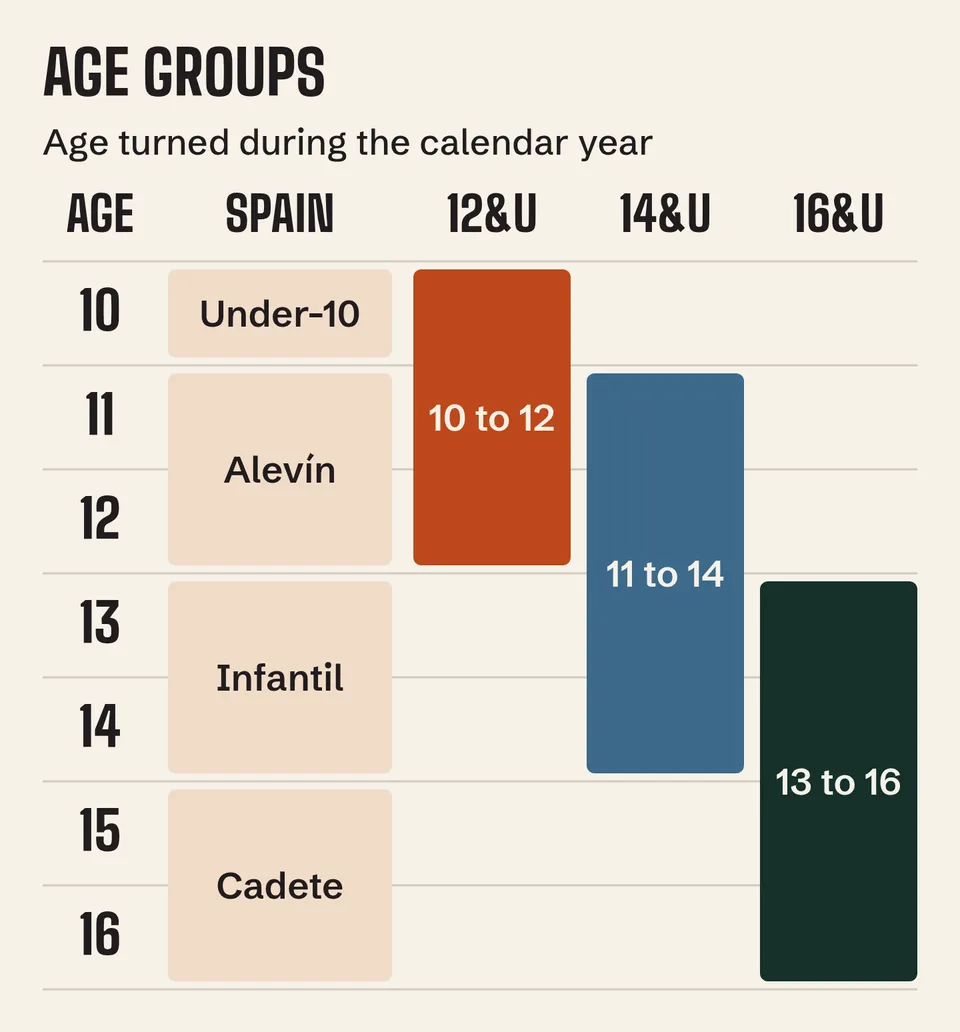
The Spanish categories (alevín is under-12, infantil under-14, cadete under-16) are explained in how tennis age categories work in Spain.
Two further limits. A player still eligible for 12&U cannot play 16&U. And while still 12&U-eligible, a player may play at most ten international 12&U and 14&U tournaments a year, not counting Tennis Europe team events or its 12&U Festival.
Tennis Europe ends in the year a player turns 16. The ITF junior circuit is open from the year a player turns 13 until the year they turn 18, so between 13 and 16 a player can play both.
What levels of tournament are there?
| Level | What it is | Age groups |
|---|---|---|
| Super Category | A small group of elite events, including the European Championships and the Junior Masters | 14&U and 16&U |
| Category 1 | Top-level events | 12&U, 14&U and 16&U |
| Category 2 | Established events with a proven standard of entry | 12&U, 14&U and 16&U |
| Category 3 | New and entry-level events | 14&U and 16&U |
Every new tournament starts in Category 3 (Category 2 in 12&U), and Tennis Europe reviews each event's level every year. Players do not enter the European Championships or the Junior Masters themselves: each national federation sends up to two boys and two girls per age group to the European Championships, and places at the Masters are earned through a separate yearly standings list, the Race.
How do you enter?
- Get an IPIN. This is the ITF's International Player Identification Number, which Tennis Europe's website now calls the World Tennis ID. You register online; in 2026 the junior membership costs 70 US dollars a year (the 90-dollar pro membership also opens ITF professional events). It lasts twelve months from purchase and is non-refundable. Players who only play Tennis Europe events do not need the online courses required on the ITF junior circuit. Without it you cannot enter, sign in as an alternate or accept a wild card.
- Create a Tennis Europe account on its website. All entries and withdrawals go through it.
- Keep your licence in order. Tennis Europe requires players to be members of their national federation and not suspended. In Spain that means the federation licence (licencia federativa), explained in how to get a tennis licence in the Canary Islands. Ordinary tournaments need no further approval from the federation.
- Enter on the website, never directly with the organiser. In 14&U and 16&U a player may enter up to three tournaments in the same week, ranking them in order of preference, and only one age group per tournament. Each week's tournaments, with their level and age groups, are listed under Calendar & Results on the Tennis Europe website.
Deadlines count back from the tournament week:
| Step | When |
|---|---|
| Entries open | 8 weeks before |
| Entry deadline | Tuesday, 27 days before, 14:00 GMT |
| Acceptance lists published | Monday, 21 days before, 15:00 GMT |
| Last day to withdraw without a penalty | Tuesday, 13 days before, 14:00 GMT |
| Sign-in at the tournament | By 18:00 local time on the day before qualifying or the main draw starts |
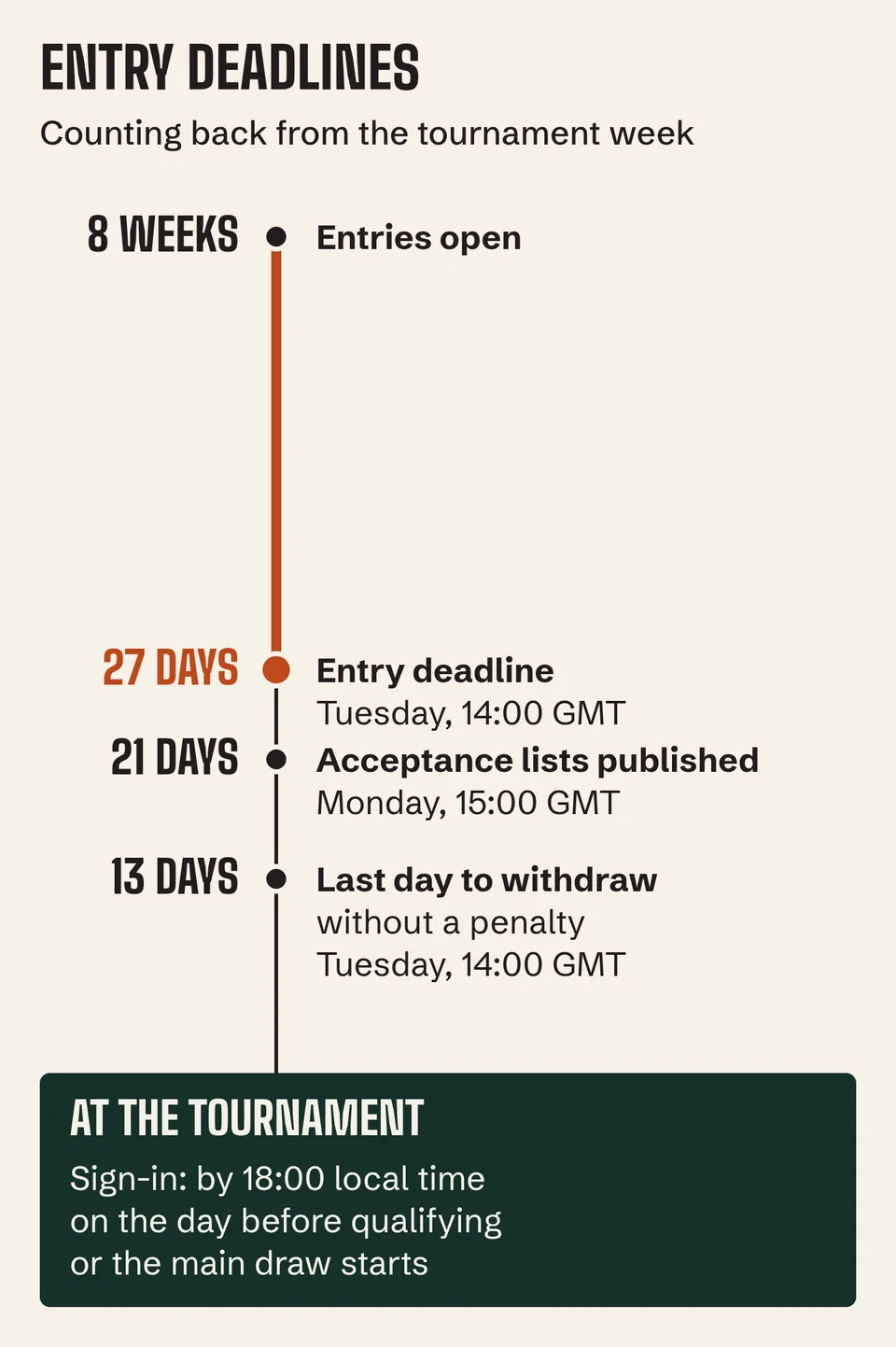
14:00 GMT is 14:00 in the Canaries in winter and 15:00 in summer (15:00 and 16:00 in mainland Spain). Withdrawing after the deadline once you are on an acceptance list brings a penalty.
The entry fee is paid in cash on arrival, up to a maximum set by the rules; the figure in brackets is the maximum for indoor events:
| Tournament (2026) | Main draw, maximum | Qualifying, maximum |
|---|---|---|
| 14&U and 16&U, Super Category, with free hospitality | €140 (€150) | €100 (€110) |
| 14&U and 16&U, Categories 1 to 3, with free hospitality | €120 (€130) | €90 (€100) |
| 14&U and 16&U, Categories 2 and 3, with reduced hospitality | €95 (€105) | €70 (€80) |
| 14&U and 16&U, Category 3, with no hospitality | €65 (€75) | €60 (€70) |
| 12&U, Category 1, with free hospitality | €110 (€120) | €80 (€90) |
| 12&U, Category 2, with reduced hospitality | €75 (€85) | €60 (€70) |
Medical, travel and liability insurance is the player's own responsibility, and nobody aged 16 or under may travel to or attend a tournament unaccompanied. What all of this adds up to over a season is covered in what a junior tennis season costs in the Canaries.
Who gets a place?
In 14&U and 16&U, places are given in this order:
- Players with a Tennis Europe ranking in that age group, best first.
- A fixed number of main-draw places that the organiser chooses from the remaining entries, putting the national squads proposed by federations first.
- Unranked players, ordered by their World Tennis Number (WTN), the ITF's playing-level rating, as long as its reliability score is 50 or more. This is new for 2026.
- Players with neither a ranking nor a WTN with a reliability score of 50 or more, in the order their national federation gives in the two days after the deadline.
A player who misses the main draw may still get into qualifying or go on the alternates list. 12&U has no ranking: each federation puts its own players in order, normally by national ranking, and the organiser chooses.
How does the Tennis Europe ranking work?
It adds up a player's six best singles results over the last 52 weeks and their two best doubles results, with team events (the Winter Cups and Summer Cups) counted on top. It is updated weekly, on Tuesdays, as two lists, 16&U and 14&U. A 14&U player appears on both, but only two results from 16&U events count for them.
This is the base table, used as it stands in 14&U. In 16&U every result is worth double.
| Round reached (singles) | Cat. 3 | Cat. 2 | Cat. 1 | Super Category | European Championships |
|---|---|---|---|---|---|
| Winner | 60 | 80 | 120 | 180 | 250 |
| Runner-up | 50 | 65 | 100 | 150 | 180 |
| Semi-final | 30 | 50 | 75 | 100 | 120 |
| Quarter-final | 20 | 30 | 50 | 70 | 80 |
| Last 16 | 15 | 20 | 30 | 40 | 50 |
In Categories 2 and 3 there are no points until a player wins a main-draw match. From 2026 those events may also be played as round-robin groups followed by a knockout, with their own table.
12&U has no ranking. Players turning 12 during the year collect unpublished "starting points". These switch on at the entry deadline of the first tournament of the following year, in early December of the year they turn 12, and from then on those players appear in the ranking.
What are those points worth in the Spanish ranking?
The RFET adds Tennis Europe points to its national ranking, multiplied by a factor that depends on the category:
| Spanish category | Factor |
|---|---|
| Alevín | 2 |
| Infantil | 3 |
| Cadete | 4 |
Tennis Europe leaves anyone turning 12 or younger during the year out of its ranking. So an alevín can only hold Tennis Europe points from early December of the year they turn 12, when their starting points switch on.
Only points won at Tennis Europe events count. For players turning 15 or 16 during the year, the Tennis Europe ranking also adds points from the ITF junior circuit and the ATP and WTA professional rankings, but the RFET does not convert those through this route. For the RFET to convert a player's points, the player needs a licence validated on its platform and must have given their IPIN to its ranking department.
An example. A cadete girl reaches the semi-finals of a 16&U Category 3 event. Tennis Europe gives her 60 points (the base 30, doubled). In the RFET ranking they are worth 60 × 4 = 240. An infantil boy who wins a 14&U Category 3 event takes 60 Tennis Europe points, which become 60 × 3 = 180 in the RFET ranking.
How the rest of the Spanish ranking is worked out, and what happens to these points when a player moves up to the ITF junior circuit, is on how the RFET ranking works.
Questions people ask
Can a player play a Tennis Europe event and a national tournament in the same week?
Yes, but only once they have played the Tennis Europe event and are out of everything there (singles, doubles and consolation). Two Tennis Europe events in the same week are not allowed: the player would lose all the points from that week.
Is accommodation paid for?
It depends on the level and the age group. In 14&U and 16&U, at Super Category and Category 1 events, main-draw singles players get free accommodation and meals at least until they are knocked out. At 12&U Category 1 events, the minimum is free accommodation and meals for national squads. At Category 2 the minimum is lunch and dinner for national squads, and at Category 3 it is optional. Each tournament gives the details on its fact sheet.
What is the usual route through the tour?
Tennis Europe describes it as starting with Category 3 events and working up towards Super Category, the European Championships or the Masters. How that fits with island and national tournaments is explained in how to move from island tournaments to national and international ones.
Sources
- Tennis Europe, Tennis Europe Junior Tour Rules & Regulations 2026 (16/14/12 & Under), June 2026 version: sections 2, 3, 5, 6, 7 and 8 and appendices A and B. Consulted on 5 October 2026.
- Tennis Europe, 2026 Major Rule Changes. Consulted on 5 October 2026.
- Tennis Europe, Guide for Players and Junior Tour Structure. Consulted on 5 October 2026.
- ITF, ITF World Tennis Tour Juniors Regulations 2026: section 4. Consulted on 5 October 2026.
- RFET, Reglamento de Clasificación 2026 (Ranking Regulation, from January 2026, in Spanish), article 8. Consulted on 5 October 2026.