How does sponsorship of an under-18 athlete work in Spain?
Who signs a junior player's sponsorship in Spain, image rights, the logos RFET, Tennis Europe and ITF allow, and how it differs from patronage (mecenazgo).
In this article
- What is a sponsorship contract in Spanish law?
- Who signs when the athlete is a minor?
- What does Spanish law say about a minor's image?
- Which points of a sponsorship agreement do these rules touch?
- Which logos can a junior tennis player wear on court?
- Are there brands that cannot sponsor a minor?
- How is sponsorship different from patronage (mecenazgo)?
- Common questions
- Sources
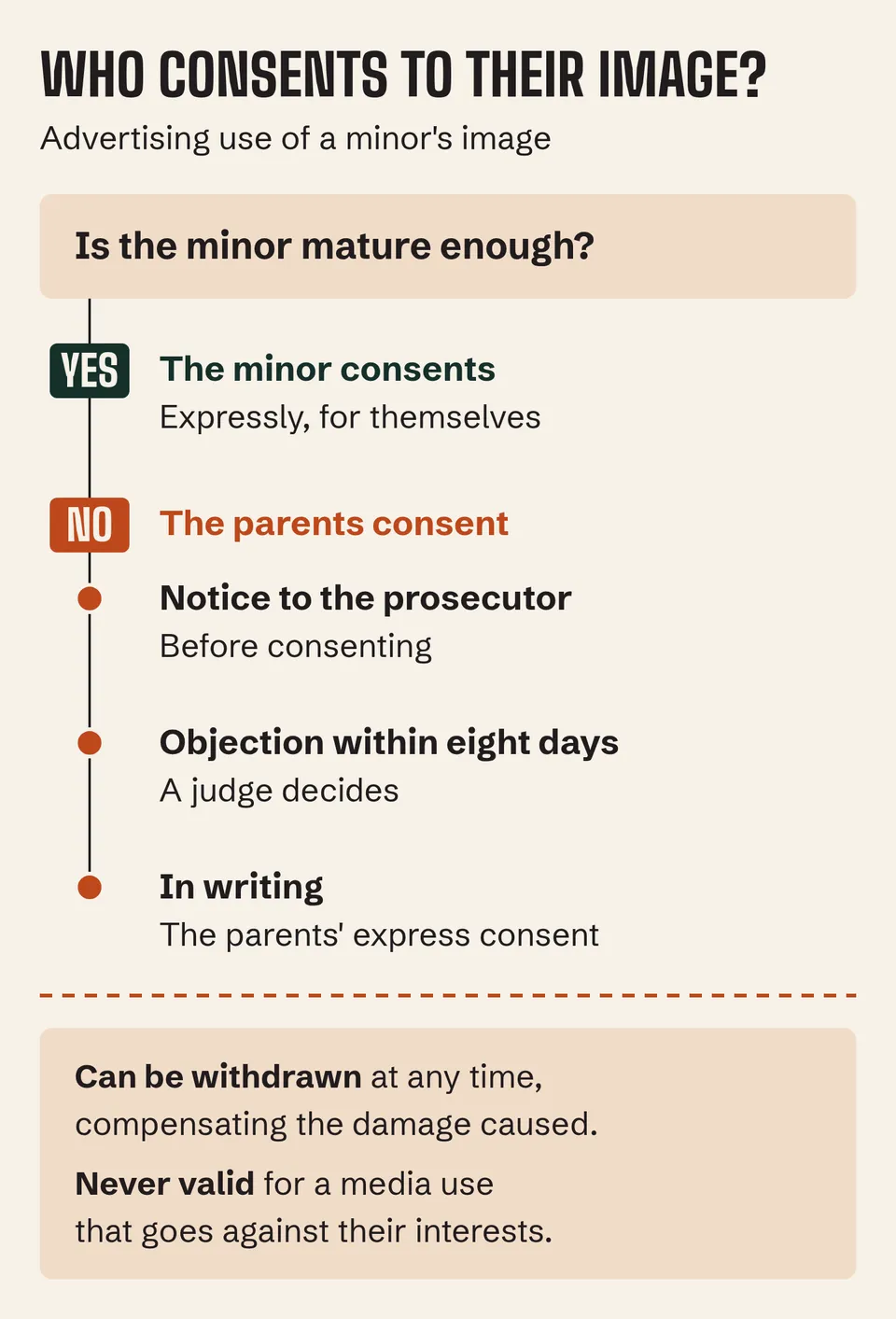
In Spain, a sponsorship agreement (contrato de patrocinio) for an athlete under 18 is signed by the parents, who are the child's legal representatives. If the contract commits the young player to do something in person, such as wearing a logo or attending events, the player must also give prior consent when mature enough. Using a minor's image in advertising needs express consent: the minor's own if their maturity allows it, otherwise the parents' in writing, notified in advance to the public prosecutor. No consent makes a use in the media lawful if it goes against the minor's interests. On court, which logos a player may wear and how big they can be depends on each competition's rules. At Tennis Europe and ITF junior events, no betting, tobacco, e-cigarette or alcohol brands are allowed on clothing or equipment.
Before signing, have a lawyer check the agreement and a tax adviser its tax effects.
What is a sponsorship contract in Spanish law?
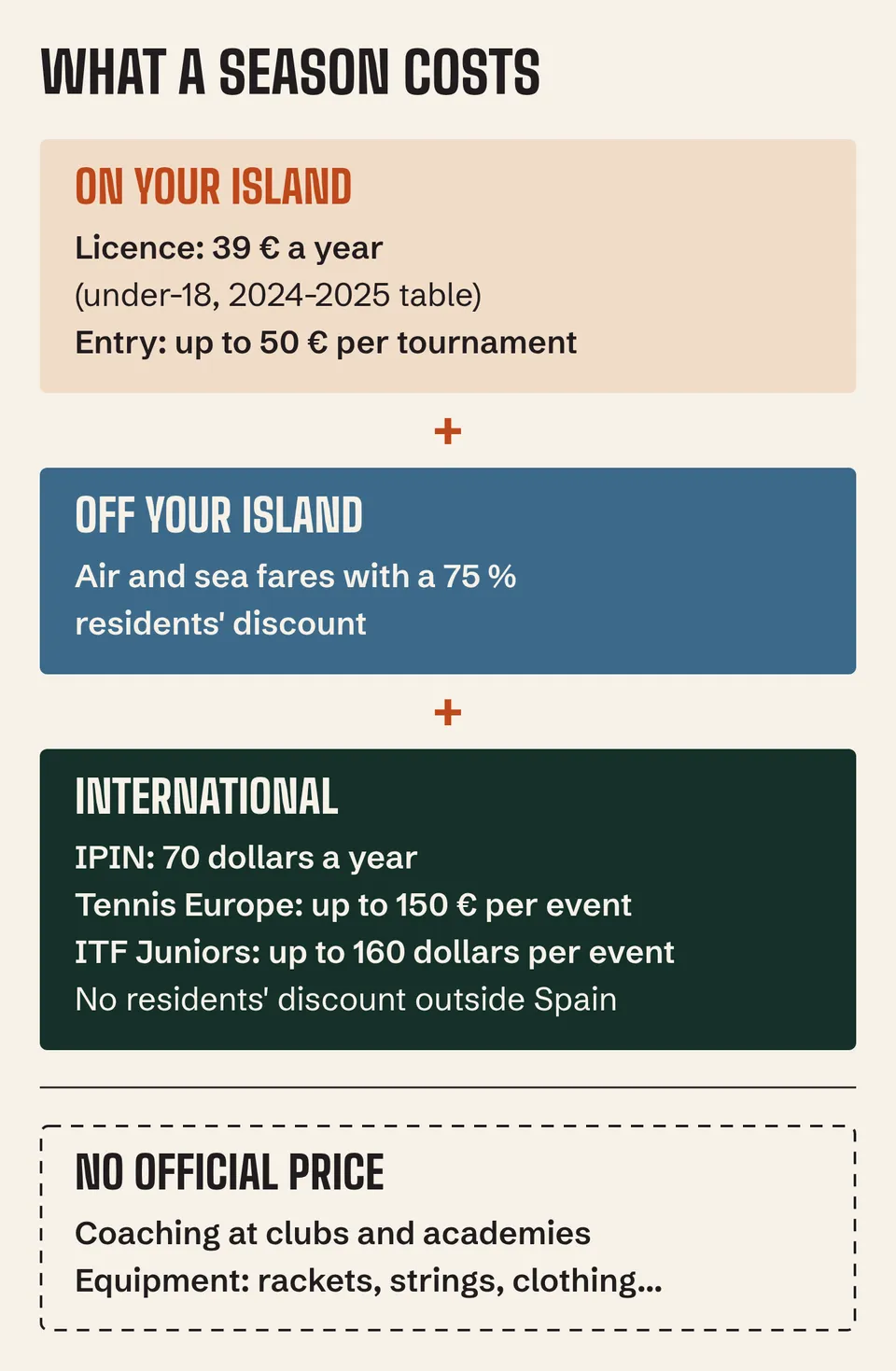
Spain's General Advertising Act (Ley General de Publicidad) defines it in article 22: the sponsored party receives financial support for their sporting activity and, in return, agrees to take part in the sponsor's advertising. It binds both sides, and the Act applies the rules for advertising distribution contracts to it where they fit. Public grants are covered in grants and aid for young players in the Canary Islands, and what a year of competition costs in what a junior tennis season costs. The advantages of high-level athlete status are covered in what high-level athlete status is in Spain.
Who signs when the athlete is a minor?
| Question | What the Civil Code (Código Civil) says |
|---|---|
| Who represents the minor | The parents holding patria potestad (parental responsibility) are the child's legal representatives (art. 162). |
| One parent or both | Both exercise it, or one with the other's express or tacit consent. Acts by one parent in line with social practice and the circumstances, or in an emergency, are valid. Third parties acting in good faith may presume each parent has the other's consent in the ordinary exercise of parental responsibility. If the parents disagree, either can go to a judge, who hears both, and the child if mature enough (and always if over 12), and gives one parent the power to decide (art. 156). |
| The young player | A contract that commits the child to personal performances, such as wearing a logo or attending events, needs the child's prior consent if they have sufficient judgement (art. 162). A child with enough maturity must be heard before decisions that affect them (art. 154). |
| Conflict of interest | Where the parents' and the child's interests clash, the parents do not represent the child in that act (art. 162). |
| What the minor earns | Whatever a minor who is not emancipated acquires through their own work or industry belongs to them; if over 16, they manage it themselves for ordinary matters and need their parents for anything beyond (arts. 164 and 165). |
These articles set no age at which a minor has "sufficient judgement": it depends on maturity. Nor do they say whether money from a sponsorship counts as something the minor acquires through their work or industry.
What does Spanish law say about a minor's image?
- Advertising use needs consent. Using a person's name, voice or image for advertising or commercial purposes is an unlawful intrusion unless there is express consent (Organic Law 1/1982, arts. 2 and 7.6).
- Who consents. Minors consent for themselves if their maturity allows. Otherwise their legal representative consents in writing and must notify the public prosecutor (Ministerio Fiscal) first; if the prosecutor objects within eight days, a judge decides (Organic Law 1/1982, art. 3).
- It can be withdrawn. Consent can be revoked at any time, although whoever revokes it must compensate the damage caused, including justified expectations (Organic Law 1/1982, art. 2.3).
- The limit is the child's interest. Any use of a minor's image or name in the media that could harm their honour or reputation, or that goes against their interests, is unlawful even with the minor's or the parents' consent, and the public prosecutor can act on its own initiative (Organic Law 1/1996, art. 4).
The image permission in a sponsorship deal is separate from the one the federation asks for on the licence form, covered in how to get a tennis licence in the Canary Islands.
Which points of a sponsorship agreement do these rules touch?
These rules touch these points of an agreement:
- Who signs: the parents holding patria potestad, with the minor's prior consent if they have sufficient judgement (Civil Code, art. 162).
- What the company provides: the law speaks of financial support for the sporting activity (General Advertising Act, art. 22).
- What the player does: which logos, on which garments, at which competitions; each rulebook sets what is allowed.
- How the player's image and name are used: this needs express consent and, if the parents give it, in writing (Organic Law 1/1982, arts. 2 and 3).
- What happens if a rulebook does not allow a logo at a particular event, or if the player has to wear their federation's kit, as the travel aid for the Canary Championship requires, explained in what a junior tennis season costs.
- How image consent ends: it can be withdrawn at any time, compensating the damage caused (Organic Law 1/1982, art. 2.3).
Which logos can a junior tennis player wear on court?
It depends on who runs the event. The RFET Reglamento Técnico 2026, the Spanish federation's technical rulebook, states its purpose as regulating official national and multi-region competitions; Tennis Europe and the ITF have their own regulations, with the same measurements for juniors. Island and Canary championships are run by the Canary Tennis Federation and the island federations, as explained in how junior competition works in the Canary Islands. The Reglamento Técnico's Code of Conduct, which includes clothing, says it applies to any authorised official competition; for those events, ask the organiser which measurements apply before preparing the kit. In their rules a "commercial identification", a sponsor's logo in plain terms, is any mark other than the garment maker's, including social media usernames, hashtags and web addresses.
| Item | RFET (Reglamento Técnico 2026) | Tennis Europe and ITF (juniors, 2026) |
|---|---|---|
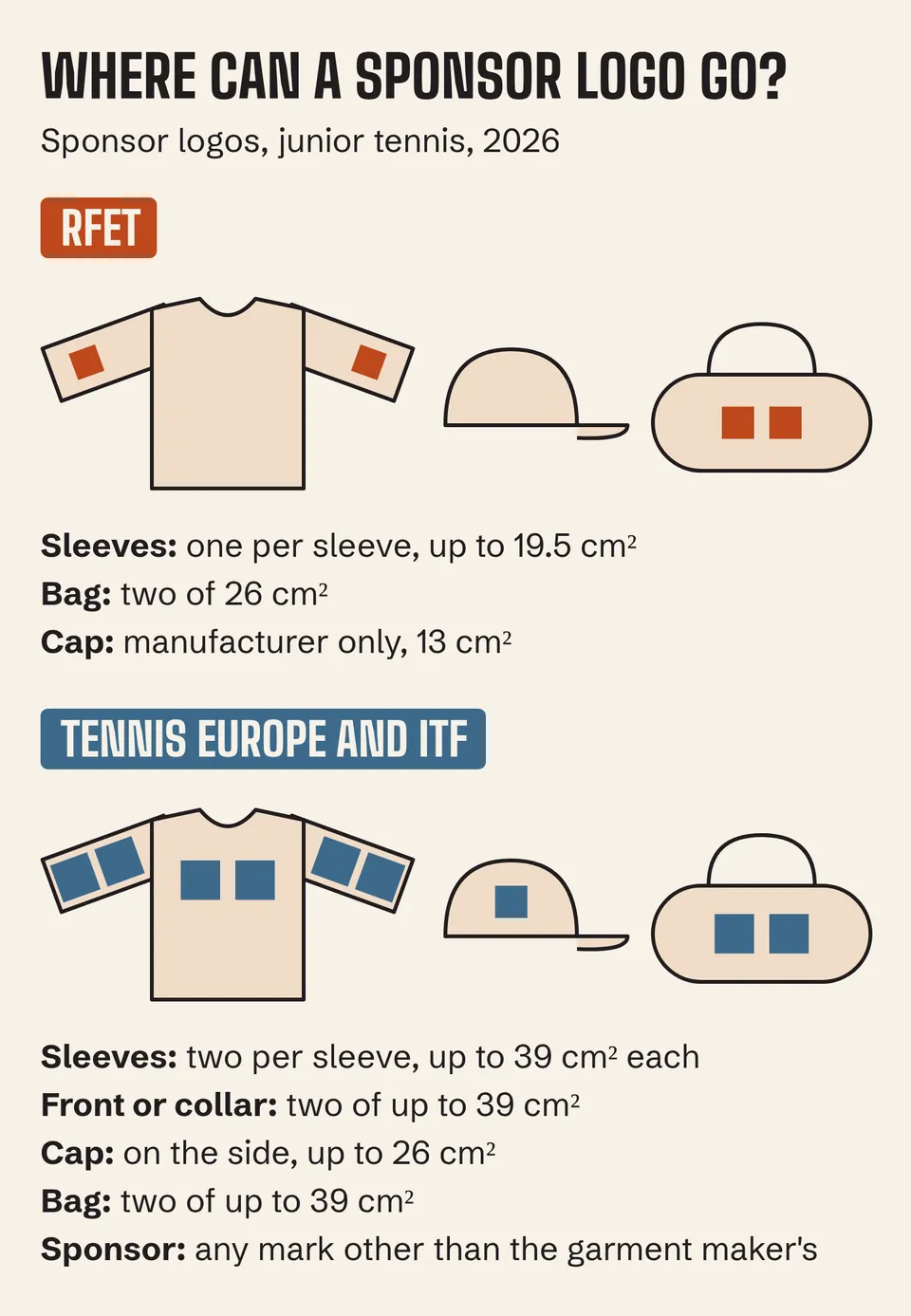
| Sleeves of shirt, sweater or jacket | Per sleeve, one sponsor logo up to 19.5 cm² and one manufacturer logo | Per sleeve, two positions of up to 39 cm² each for sponsor or manufacturer logos, with no more than two logos per position |
| Front, collar and back | Manufacturer: two of 13 cm² or one of 26 cm²; plus a sports body's logo (such as a club or federation) on the front, up to 39 cm² | Two logos up to 39 cm² on the front or collar; or one of 39 cm² plus a manufacturer logo up to 26 cm² on the back |
| Sleeveless shirt | The two sleeve sponsor logos may go on the front | Boys: two logos up to 39 cm² on the front or collar. Girls: up to four, with no more than two sponsor logos on the front |
| Shorts, skirt, leggings or tracksuit trousers | Shorts, skirt or tracksuit trousers: manufacturer only, two of 13 cm² or one of 26 cm² | Manufacturer only: two of 13 cm², or one of 26 cm² on the front and one on the back |
| Cap and headband | Manufacturer, 13 cm² | One sponsor logo up to 26 cm² on the side of the head and one manufacturer logo up to 26 cm² |
| Bag | Two sponsor logos of 26 cm² on one bag | Two sponsor logos up to 39 cm² on one bag |
| Wristbands, socks and shoes | Manufacturer only (13 cm² on wristbands and socks) | Manufacturer only |
| Racket | Not mentioned in the Reglamento Técnico | Manufacturer only, on the racket and strings |
At an RFET competition, a sponsor's logo goes on the sleeves, one per sleeve of up to 19.5 cm² (a square of about 4.4 cm a side), and on the bag. At Tennis Europe and ITF events it can also go on the chest or collar, up to 39 cm² (about 6.2 cm a side), and on the cap.
- Tennis Europe and the ITF allow no logo on a player's clothing or equipment that promotes betting companies, tobacco or e-cigarettes, alcohol or political activity, nor anything that could be mistaken for one, nor the logo of another tournament or event without their approval. This applies on court before, during and after a match, and at press conferences and ceremonies.
- The RFET bans political identifications and offensive symbols, and does not allow players to cover up a non-compliant logo or wear the garment inside out.
- If the clothing does not comply, the official orders the player to change; under all three rulebooks a player who refuses can lose the match. Penalties are explained in conduct and umpiring rules in junior tennis.
How players get into those circuits is explained on the pages about the Tennis Europe Junior Tour and the ITF World Tennis Tour Juniors.
Are there brands that cannot sponsor a minor?
Beyond tennis rules, Spanish law restricts several sectors:
- Tobacco: sponsorship of tobacco products is banned in every medium, with few exceptions, such as publications for professionals in the trade (Law 28/2005, art. 9).
- Gambling and betting: operators covered by Royal Decree 958/2020 may not use images of minors in their advertising, sponsor competitions restricted to minors, or sponsor shirts or sports kit (arts. 11 and 12).
- Alcohol: the General Advertising Act bans advertising drinks over 20 degrees where their sale or consumption is banned, and requires regulations to limit alcohol advertising with sport among the settings to consider (art. 5.5). That article does not by itself bar an alcohol brand from sponsoring a minor; at Tennis Europe and ITF events, however, it cannot appear on their clothing or equipment.
- Any brand: advertising aimed at minors that pushes them to buy by exploiting their inexperience or credulity is unlawful (General Advertising Act, art. 3).
How is sponsorship different from patronage (mecenazgo)?
Spanish law separates sponsorship (patrocinio) from patronage (mecenazgo), which is giving to bodies such as non-profit organisations under the tax incentives of Law 49/2002.
| Sponsoring a player (patrocinio) | Patronage (mecenazgo) | |
|---|---|---|
| Law | General Advertising Act, art. 22 | Law 49/2002 |
| Who receives it | The player | Only the bodies the law lists, such as foundations, associations declared of public benefit, Spanish sports federations and the regional federations that belong to them, provided they meet its requirements (arts. 2 and 16) |
| What the company gets | The player's part in its advertising | For a donation, nothing beyond the symbolic: it must be irrevocable and unconditional (art. 17). Under a business collaboration agreement (convenio de colaboración empresarial), the body publicises the company's support for its activities (art. 25) |
| Law 49/2002 incentives | Not covered by that law | Tax deductions for donations and, under a collaboration agreement, a deductible expense for the company (arts. 17 and 25) |
A player, as an individual, is not among the bodies that Law 49/2002 patronage applies to. The two are therefore different things: sponsoring a player directly, and patronage of a body the law lists, such as a federation, for its activities. Law 49/2002 does not say how direct sponsorship of a player is taxed.
Common questions
Can a player wear their sponsor's logo at a Spanish championship?
Yes, within the Reglamento Técnico's measurements. The 2026 rules for the individual Spanish championships (Campeonatos de España) have no clothing rules of their own and refer to the Reglamento Técnico; the team championships require clothing to meet the logo size limits in force. The page on the Spanish age-group championships explains how they work.
Does anything change at 18?
Yes. A person comes of age on their 18th birthday, and from then on can carry out every act of civil life alone, with the exceptions set out in the Civil Code (arts. 240 and 246): the player signs their own contracts and gives their own consent for their image. Each competition's logo rules stay the same.
Sources
- Código Civil (Civil Code), consolidated text in the BOE (latest update published 3 January 2025), articles 154, 156, 162, 164, 165, 240 and 246. Consulted on 5 October 2026.
- Ley Orgánica 1/1982 on the civil protection of the rights to honour, personal and family privacy and one's own image, consolidated text in the BOE (latest update published 23 June 2010), articles 2, 3 and 7. Consulted on 5 October 2026.
- Ley Orgánica 1/1996 on the legal protection of minors, consolidated text in the BOE (latest update published 5 June 2021), article 4. Consulted on 5 October 2026.
- Ley 34/1988, General de Publicidad (General Advertising Act), consolidated text in the BOE (latest update published 1 March 2023), articles 3, 5 and 22. Consulted on 5 October 2026.
- Ley 49/2002 on the tax regime of non-profit bodies and tax incentives for patronage, consolidated text in the BOE (latest update published 20 December 2023), articles 2, 16, 17 and 25. Consulted on 5 October 2026.
- Ley 28/2005 on health measures against smoking, consolidated text in the BOE (latest update published 18 November 2017), article 9. Consulted on 5 October 2026.
- Real Decreto 958/2020 on commercial communications for gambling, consolidated text in the BOE (latest update published 8 June 2024), articles 2, 11 and 12. Consulted on 5 October 2026.
- RFET, Reglamento Técnico 2026 (January 2026, in Spanish), section I.A and Code of Conduct, letter b (clothing). Consulted on 5 October 2026.
- RFET, sports regulations: 2026 rules for the individual (alevín, infantil, cadete and júnior) and team Spanish championships, clauses on clothing and on applying the Reglamento Técnico. Consulted on 5 October 2026.
- Tennis Europe, Tennis Europe Junior Tour Rules & Regulations 2026 (June 2026 version), Appendix C, section C.2. Consulted on 5 October 2026.
- ITF, ITF World Tennis Tour Juniors Regulations 2026 (published 5 December 2025, updated 24 March), Appendix C, section C.2. Consulted on 5 October 2026.
Keep reading
Grants for junior tennis players in the Canary Islands
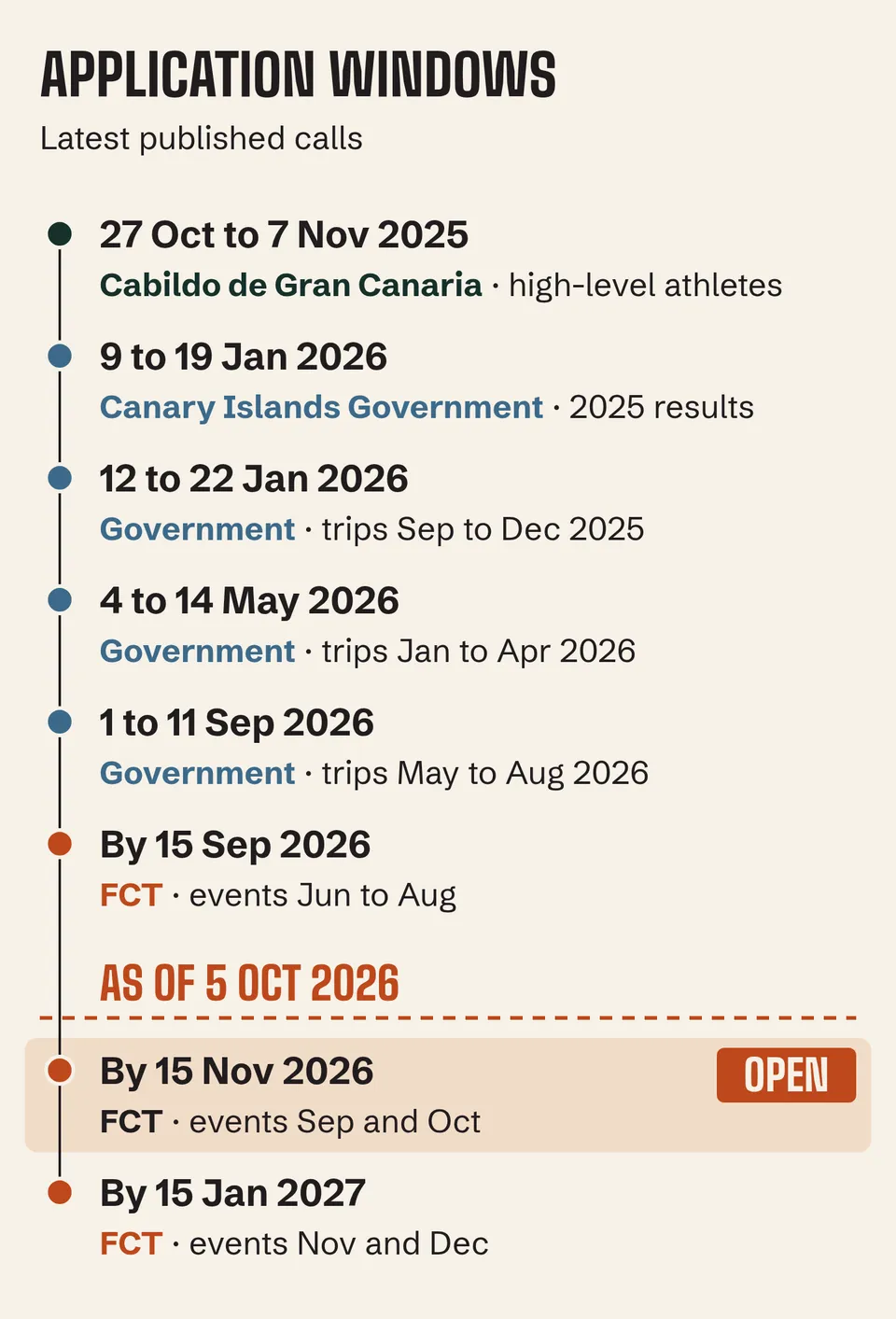
Grants and funding for junior tennis players in the Canary Islands: the tennis federation, the Canary Government and Gran Canaria. Eligibility, amounts, dates.
How do the Spanish junior tennis championships work?
How to get in, how matches are played and when the Spanish alevín, infantil, cadete and júnior championships are held, singles and teams.
How much does a season of junior tennis cost in the Canary Islands?
Licence once a year, up to 50 € per tournament in Spain, 75 % residents' discount on travel and up to 150 € per Tennis Europe event: 2026 costs.