High-level and high-performance athlete status in Spain
Spanish high-level and high-performance athlete status: the tennis results needed, applying in the Canary Islands, and benefits in education.
In this article
- How do the three statuses differ?
- What results does tennis need for high-level status?
- What does Canary high-performance status require?
- How do you apply, and when do the lists come out?
- What does it give you in education?
- What about jobs, social security and tax?
- Does it come with funding?
- Questions people ask
- Sources
In Spain, a deportista de alto nivel (DAN, high-level athlete) is someone on a list of the Consejo Superior de Deportes (CSD, the national sports council) published in the state gazette, the Boletín Oficial del Estado. Athletes get onto it, usually at the request of their Spanish federation, for results among the best in the world or Europe. A deportista de alto rendimiento (DAR, high-performance athlete) has lower but still significant results and is recognised by the CSD or by a regional government. In the Canary Islands the regional government grants Canary high-performance status to players who meet the minimums in Decreto 27/2024, and players can apply themselves.
For a junior tennis player, Canary high-performance status sets the lowest bar: a top-three finish at the Spanish Championship for their age group, or ending the season in the top ten of the Spanish ranking for a junior category. High-level and high-performance status both help mainly with education; high-level status also counts in public-sector recruitment, social security and tax.
How do the three statuses differ?
| High-level (DAN) | High-performance (DAR), national | Canary high-performance | |
|---|---|---|---|
| Granted by | The CSD | The CSD or a regional government | The regional sports directorate (Dirección General de la Actividad Física y el Deporte) |
| How you get it | Your Spanish federation proposes you (for tennis, the RFET), or the CSD recognises you on its own initiative | National team selection, a training programme or regional status | You apply (your parents or legal guardian, if you are under 18), or the Federación Canaria de Tenis (FCT) applies with your consent |
| Where it appears | A list in the Boletín Oficial del Estado (BOE) | Certified by the CSD or the regional government | A list in the Boletín Oficial de Canarias (BOC) and the Canary register |
| How long it lasts | 5 years from the BOE list (7 for Olympic medallists) | Depends on the route; regional status, up to 3 years | 3 years from the decision |
A young player is also a national high-performance athlete if the Spanish federation (RFET) has picked them to represent Spain in an official international competition for their age group in either of the last two years, or if they follow an RFET tecnificación (talent development) programme (Real Decreto 971/2007, article 2.3). Canary status can be held alongside national high-level status, but not alongside a similar status from another region. If a minor with high-performance status moves to another region because their parents move, they can obtain that region's benefits (Ley 39/2022, article 26.2).
What results does tennis need for high-level status?
The annex to Real Decreto 971/2007 sets the finishing positions for singles tennis:
| Category | World Championship or Olympic Games | European Championship | World ranking |
|---|---|---|---|
| Absoluta (open, senior) | Top 20 | Top 10 | Top 20 |
| Junior age groups (15 to under 23), in their own events | Top 12 | Top 6 | Top 15 |
| Under-21s in senior events | Top 24 | Top 16 | Top 30 |
At senior level the Masters and Grand Slams count as World Championships, and a player who reaches a junior Grand Slam singles final (or a doubles final with a Spanish partner) "may be considered" for high-level status. In a draw, a result only counts if you won at least one match, and the rankings that count are the ATP and WTA ones unless the CSD decides otherwise. The junior circuits are explained in the ITF World Tennis Tour Juniors and the Tennis Europe Junior Tour.
What does Canary high-performance status require?
For at least the year before the result, you must:
- Have Canary political status (condición política de canario), which means being a Spanish national with your registered address (vecindad administrativa) in a Canary municipality, shown by a certificado de empadronamiento (certificate of registration on the local census).
- Hold a valid licence from a Canary or Spanish federation (see the tennis licence in the Canary Islands).
- Not be serving a final penalty for a serious or very serious offence.
You also need a result from Annex I. Tennis falls under Olympic sports, individual events, a table that also covers doubles:
| Competition | Absoluta (senior) | Junior age groups |
|---|---|---|
| Olympic Games | Take part | |
| World or European Championship | Take part | Take part |
| Spanish Championship | 1st to 5th | 1st to 3rd |
| World ranking | 1st to 30th | 1st to 20th |
| European ranking | 1st to 20th | 1st to 10th |
| Spanish ranking | 1st to 15th | 1st to 10th |
The assessment committee's published interpretation agreements add:
- A semi-final counts as 4th place and a quarter-final as 8th (agreement no. 2, 6 March 2025).
- Only the end-of-season ranking position counts (agreement no. 1, 14 March 2024).
- An international championship only counts if you represented Spain (agreement no. 2).
- Where a sport splits its Spanish Championship by level (grassroots, first division, second division), only the top-level one counts, and only events that make someone Spanish champion of that year in their category (agreement no. 2). Each age-group Spanish Championship awards that title in its own age group; a national tournament that does not award it is not a Spanish Championship for this purpose.
The decree does not say from what age junior events count. If in doubt about your own case, ask on 012 (the Canary government's information line) before applying.
Example. A cadete (under-16) player who is a Spanish national, registered in the Canaries and has held an FCT licence for more than a year wins the Spanish cadete championship: 1st place in a junior category, so she qualifies. The runner-up (2nd) also qualifies; a losing semi-finalist counts as 4th and does not. At the senior Spanish Championship, by contrast, a semi-final (4th) is enough. Age groups are explained in how tennis age categories work in Spain.
How do you apply, and when do the lists come out?
Canary high-performance status. Applications are online only, on the Canary government's e-office, with an electronic ID or signature, and there is no fee. You need the standard certificate of the result signed by the FCT (the template is on the e-office), your census registration certificate and, if you are under 18, a copy of the libro de familia (family record book).
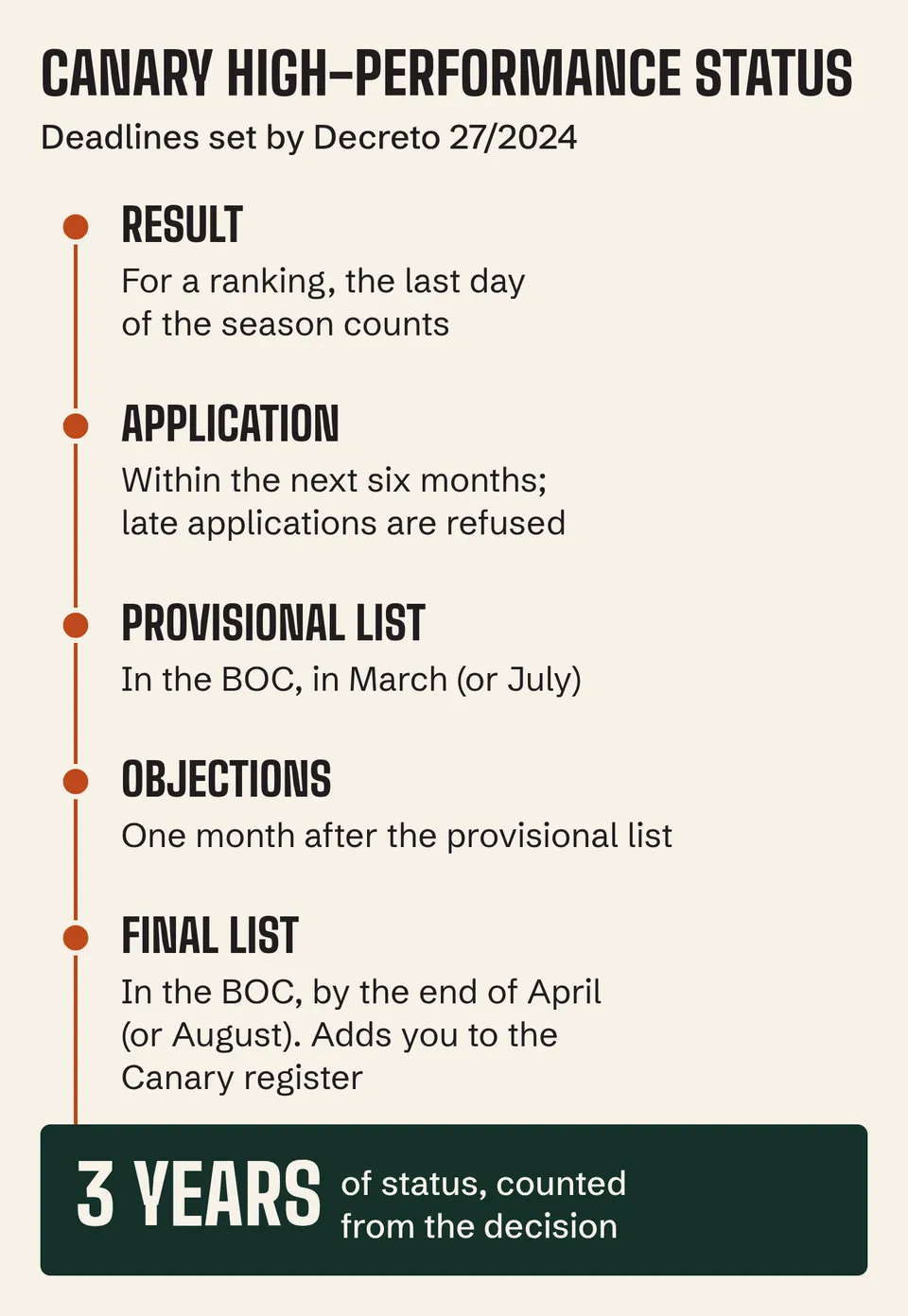
Watch the deadline: apply within six months of the result; for a ranking, counting from the last day of the season. A late application is refused even if the result qualifies.
You can apply at any time of year, and decisions come twice a year. The decree sets the provisional list for March or July and the final one for the end of April or August:
| Applications filed | Provisional list (BOC) | Final list (BOC) |
|---|---|---|
| 1 June 2025 to 15 January 2026 | 5 March 2026 | 23 April 2026 |
| 1 June 2026 to 15 January 2027 | March 2027, per the decree | By the end of April 2027, per the decree |
Real dates can come later: in 2025 the final lists appeared on 19 June and 8 October. After the provisional list there is a month to object. The final list serves as formal notice and adds you to the Canary register.
High-level status. Players do not apply: usually the RFET sends the proposal to the CSD within six months of the competition, and the CSD publishes the lists in the BOE. In 2026 two lists have appeared, on 2 February and 22 June.
What does it give you in education?
- University. National high-level and high-performance athletes: at least 3% of undergraduate places, plus at least 5% more in Sport Science (Ciencias de la Actividad Física y del Deporte), Physiotherapy and Primary PE teaching, and no physical entrance tests for Sport Science (RD 971/2007, art. 9.1; RD 534/2024, art. 42). Canary high-performance athletes share the same quota (Decreto 27/2024, art. 20).
- Secondary school (ESO and Bachillerato). Priority for a place when schools are oversubscribed, and exemption from PE on request (RD 971/2007, art. 9.2 and 9.3). In the Canaries the same applies in schools chosen by the education department, and the PE exemption requires minimum motor skills to be shown (Decreto 27/2024, arts. 21 and 22).
- Vocational training (FP). At least 5% of intermediate and higher places (RD 971/2007, art. 9.3). In the Canaries, also 5% at basic level (Decreto 27/2024, art. 22).
- Sports coaching qualifications. National status meets the specific entry requirements (RD 971/2007, art. 9.5). In the Canaries, exemption from them and 10% of places (Decreto 27/2024, art. 24).
- Classes and exams. Universities take it into account for changes of timetable, group and exam dates (RD 971/2007, art. 9.8). In the Canaries: choice of shift where the school has more than one, the possibility of having up to 25% of absences excused for official competitions with a federation certificate and the fixture calendar, and flexible exam dates as far as possible, except for exams set for all students (Decreto 27/2024, art. 27).
In the Canaries it also opens vacant places in public school boarding residences (residencias escolares) to students who need to live near where they train (art. 26). Within each quota, athletes on the CSD high-level list come first.
What about jobs, social security and tax?
These apply to high-level status only:
- Public-sector jobs: it counts as a merit in competitive exams and selection for sport-related posts, and the rules of a call may waive the physical tests. For the state security forces and the armed forces it counts if held in the last five years, where the call scores specific merits (RD 971/2007, art. 11).
- Social security: from 18, an athlete not already paying contributions through other work can sign a special agreement with the social security system to pay contributions (art. 13).
- Tax: training and development grants paid by the CSD, the Asociación de Deportes Olímpicos or the Spanish Olympic and Paralympic Committees are free of income tax up to 60,100 euros a year (income tax regulation, art. 4). High-level athletes can also pay into the professional athletes' mutual pension fund under its own income tax rules (RD 971/2007, art. 14.2; Ley 35/2006, eleventh additional provision).
The Canary decree gives high-performance athletes no employment benefits.
Does it come with funding?
Not by itself. The Canary sports law provides for high-performance athletes to join training programmes and preparation plans, but sets no sum of money. Results-based grants have their own rules; the Cabildo de Gran Canaria's grant for high-level athletes, despite its name, asks for a notable result and does not require either status. See grants and aid for young players in the Canary Islands, and for the whole junior route, how to move up from island to national and international tennis.
Questions people ask
What does a Canary high-performance athlete have to do in return?
Answer call-ups for Canary teams, take doping tests, and report any final serious or very serious penalty within a month. Failing to report one means losing the status and being unable to reapply for two years.
Can the status be lost before the three years are up?
Yes: if a requirement is no longer met, after a final very serious or doping penalty, for breaching the obligations, or after certain criminal convictions. After an injury that keeps an athlete out for more than three months, they can ask for the clock to be paused: the request goes in within 30 days, on the standard form with supporting documents, and the directorate decides within a month. The pause lasts up to a year, and the status and its benefits are kept meanwhile.
Can one result be used for two applications?
No. There is no limit on applications, but each result counts only once.
Sources
- Real Decreto 971/2007, of 13 July, on high-level and high-performance athletes, consolidated text last updated 13 January 2018; articles 2, 3, 4, 6, 9, 11, 13, 14 and 16, and the annex (tennis). Consulted on 5 October 2026.
- Ley 39/2022, of 30 December, the Sports Act, consolidated text of 25 July 2025; articles 20, 24 and 26. Consulted on 5 October 2026.
- Real Decreto 534/2024, of 11 June, on university entry and admission, consolidated text of 2 July 2026; article 42. Consulted on 5 October 2026.
- Income tax regulation, Real Decreto 439/2007, consolidated text of 2 October 2026; article 4. Consulted on 5 October 2026.
- Ley 35/2006, of 28 November, the Income Tax Act, consolidated text of 2 October 2026; eleventh additional provision. Consulted on 5 October 2026.
- Consejo Superior de Deportes, 2026 high-level athlete lists, listed in the BOE daily summaries of 2 February 2026 and 22 June 2026. Consulted on 5 October 2026.
- Ley Orgánica 1/2018, of 5 November, reforming the Statute of Autonomy of the Canary Islands, consolidated text of 28 December 2022; article 6. Consulted on 5 October 2026.
- Ley 1/2019, of 30 January, on physical activity and sport in the Canary Islands, consolidated text of 9 April 2019; articles 2 and 21. Consulted on 5 October 2026.
- Decreto 27/2024, of 5 February, on Canary high-performance and native high-level athlete status (BOC no. 31, 12 February 2024), articles 4, 6, 7, 9, 11, 12, 17, 18, 20 to 28 and 30, and Annex I. Consulted on 5 October 2026.
- Gobierno de Canarias, sports department, Deportista de alto nivel y de alto rendimiento: documents, deadlines, decisions from 2024 to 2026 and interpretation agreements no. 1 (14 March 2024), no. 2 (6 March 2025), no. 3 (22 September 2025) and no. 4 (4 May 2026). Consulted on 5 October 2026.
- Gobierno de Canarias e-office, procedure 8610, Canary high-performance status (updated 5 October 2026). Consulted on 5 October 2026.
- Instituto Insular de Deportes de Gran Canaria, rules of the call for athletes with notable results in high-level competition (signed 17 October 2025), fourth rule. Consulted on 5 October 2026.
Keep reading
Grants for junior tennis players in the Canary Islands
Grants and funding for junior tennis players in the Canary Islands: the tennis federation, the Canary Government and Gran Canaria. Eligibility, amounts, dates.
How to move up from island to international junior tennis
How a junior tennis player from the Canaries moves up: island, Canary and Spanish championships, Tennis Europe and ITF juniors, with 2026 ages and rules.
How do the Spanish junior tennis championships work?
How to get in, how matches are played and when the Spanish alevín, infantil, cadete and júnior championships are held, singles and teams.