How do you combine school and tennis in the Canary Islands?
Priority places, PE exemption, Bachillerato over three years, absences and exams, and university quotas for high-level and high-performance athletes.
In this article
- Who can use these measures?
- Does the status give priority for a school place?
- Can a player be exempted from Physical Education?
- Can Bachillerato be spread over three years?
- What about absences and exams for tournaments?
- What if travel makes regular attendance impossible?
- How do you get into university through the athletes' quota?
- Frequently asked questions
- Sources
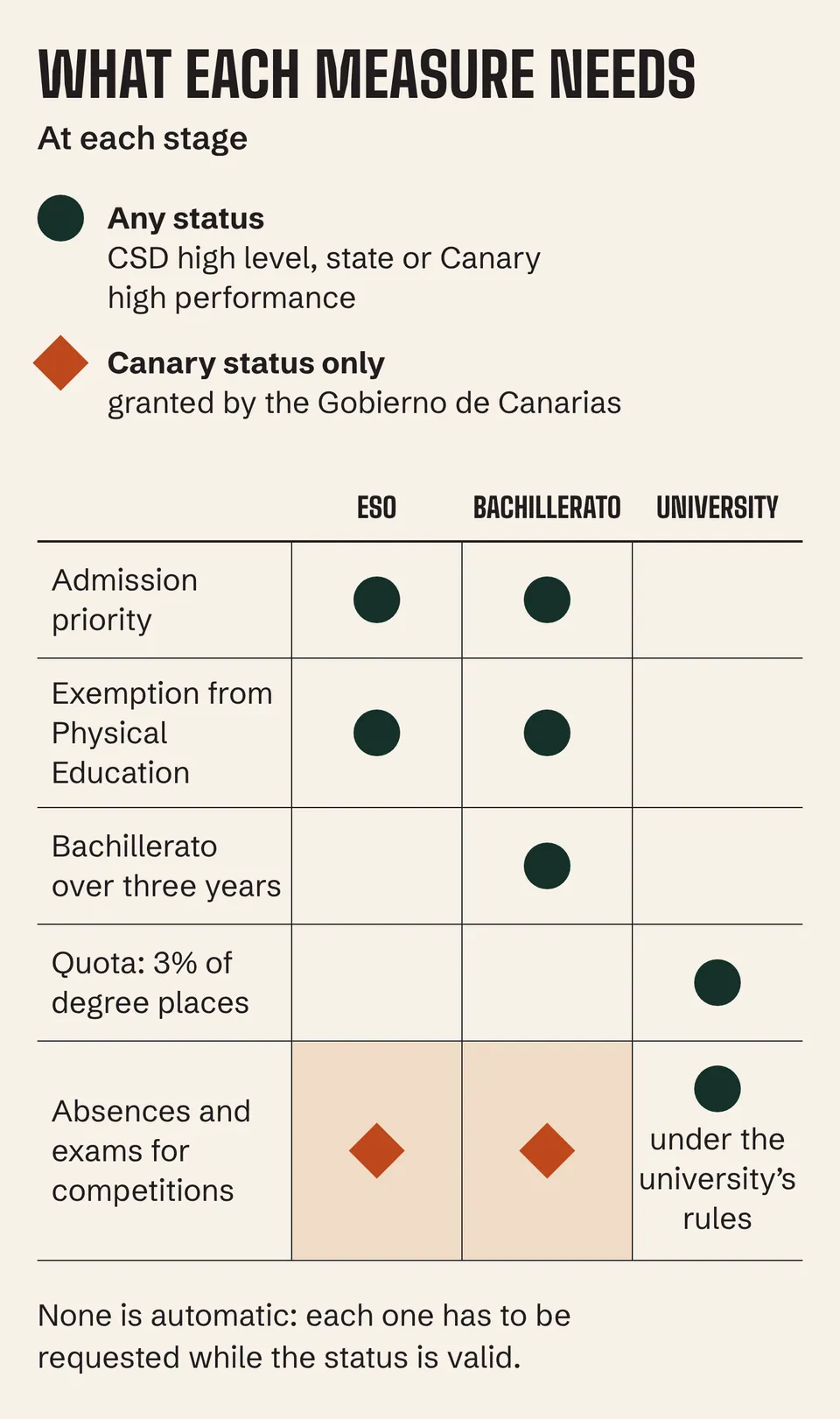
A tennis player with high-level or high-performance athlete status, granted by Spain's sports council (Consejo Superior de Deportes, CSD) or, for results such as a podium at the Spanish championship, by the Gobierno de Canarias, has measures in the Canary Islands for fitting study around competition in ESO (Educación Secundaria Obligatoria, compulsory secondary education) and Bachillerato, the two-year course after it that leads to university. They include priority for a place at certain schools when places run short, the option of an exemption from Physical Education and of taking Bachillerato over three years and, with the Canary status, having absences justified and exams moved for official competitions. The Universidad de La Laguna (ULL) and the Universidad de Las Palmas de Gran Canaria (ULPGC) reserve 3% of places on each degree for these athletes. Nothing is automatic: each measure has to be requested while the status is valid.
Who can use these measures?
Anyone with one of three statuses: CSD high-level athlete (deportista de alto nivel), state high-performance athlete (deportista de alto rendimiento, for example after being picked by the Real Federación Española de Tenis, RFET, to represent Spain) or Canary high-performance athlete. The Canary status counts as high-performance status for the measures in state law (Real Decreto 971/2007, art. 2.3.c) and lasts about three years from when it is granted. What results count and how to apply are on the page about high-level and high-performance athlete status.
Not every measure applies to all three: absences, exams, the choice of shift and boarding houses are for the Canary status only.
Does the status give priority for a school place?
Yes, when there are not enough places for everyone. State law makes it a priority criterion for admission to state and state-funded (concertado) schools teaching ESO and Bachillerato. The Canary rules limit that priority to the schools the regional education department designates, and each yearly admission call publishes the list of reference schools for pupils following high-level or high-performance sports programmes (Decreto 9/2022, art. 13.2; 2026-2027 call, third operative point).
To use it:
- Say so on the application form; if you leave it out, it does not count.
- Attach the proof: the CSD's for high-level or state high-performance status, or the Gobierno de Canarias's for the Canary status.
- Apply on time. For 2026-2027, the admission call (BOC, 16 February 2026) set the application period from 10 to 23 April for ESO and from 20 April to 11 May for Bachillerato. The 2027-2028 call will set its own dates.
Can a player be exempted from Physical Education?
Yes, on request, in ESO and in Bachillerato (Real Decreto 242/2009, arts. 4 and 5). The Canary assessment rules refer back to these state rules.
- Who applies. The pupil or, for a minor, the parents or guardians, with the document that proves the status.
- What the Canary rules add. With the Canary status, the pupil must also show the minimum motor skills for their level, judged against their sport, and the education department assesses them. The decree does not say how, so ask when you apply.
- What happens to the grade. The subject is not assessed, the record shows "Exento/a" (code EX), and in Bachillerato it is left out of the average mark.
- How long the status must last. For the exemption to be recorded for good, you need a certificate showing the status was held until the final ordinary assessment. If the status expires mid-year, the exemption may be at risk.
Can Bachillerato be spread over three years?
Yes. A pupil with high-level or high-performance status can take Bachillerato over three school years in the ordinary system, with subjects from both years at once (Real Decreto 243/2022, art. 15.2.b). In the Canary Islands it is set out in article 47 of Decreto 30/2023, with its own split of subjects and within the general limit of four years in Bachillerato.
What about absences and exams for tournaments?
With the Canary status, the regional decree gives these measures in the athlete's studies (Decreto 27/2024, art. 27):
| Measure | What the decree says | What you need |
|---|---|---|
| Timetable | The right to choose the shift (turno) that fits classes around sport, where the school runs more than one | A school with more than one shift |
| Absences | The possibility of more flexible justification of absences, up to 25%, for official competitions | A certificate from the Canary or Spanish federation and the competition calendar |
| Exams | Flexible exam dates "as far as possible" when they clash with official competitions | A federation or regional sports department certificate; not for exams set for all pupils by a general order or resolution |
| Groups | Possible dedicated groups for athletes at schools the education department designates, with preferential access to their places | A school on that list |
| Tutoring | Academic follow-up, tutoring and advice on combining study and sport | Ask the school |
In tennis, the certificate comes from the Federación Canaria de Tenis (FCT, the Canary federation) or the RFET, as appropriate. A tournament that is not an official competition is not covered.
What if travel makes regular attendance impossible?
Two further routes exist, each for particular cases:
- Adult education from age 16. As an exception, a high-performance athlete over 16 can ask to enrol in adult education; in the Canary Islands, if their sport makes ordinary attendance incompatible (Decreto 27/2024, art. 25).
- School boarding houses (residencias escolares). With the Canary status, where there are spare places, an athlete who needs to live near their training and competition facilities can stay in one.
How do you get into university through the athletes' quota?
Through a reserved quota, with applicants ranked by admission grade within it. State law reserves at least 3% of degree places and, on Sport Science (Ciencias de la Actividad Física y del Deporte), Physiotherapy and Primary PE Teaching degrees, an additional quota of at least 5%: at least 8% in total on those degrees (Real Decreto 534/2024, art. 42). The Canary status falls within the same quota, and within it CSD high-level athletes come first.
| University | General quota | Physiotherapy and Sport Science |
|---|---|---|
| ULL | 3% | 8% |
| ULPGC | 3% | 5% according to its page (state rules require at least an additional 5% on top of the 3%) |
Worth knowing:
- You can apply through two quotas. At the ULL, the general quota and the athletes' quota at the same time; each is assessed separately.
- The academic requirements do not change. The quota does not waive the entry requirements: you compete on grades with the others in the same quota.
- Documents at the ULL: the certificate from the CSD or the regional government, or the official bulletin entry that recognises the status; for high-level athletes, the resolution published in the BOE (documents by quota).
- Once enrolled. Universities must bear the status in mind for changes of timetable, group and exams and in their rules on how long a student may stay enrolled; in the Canary Islands it can also count towards credit recognition.
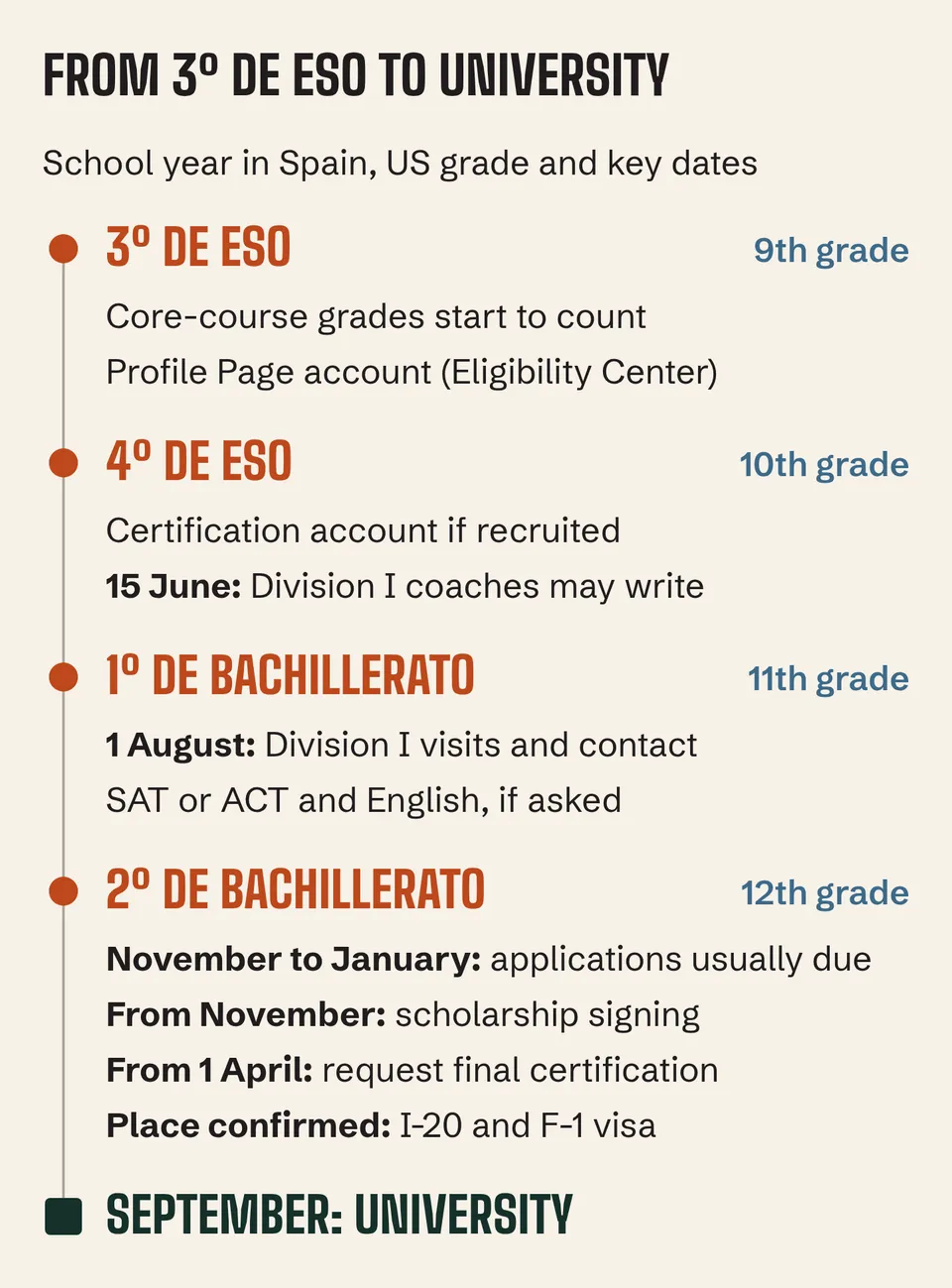
If the plan is to study and play in the United States, the page on US college tennis scholarships explains which ESO and Bachillerato years the NCAA reviews.
Frequently asked questions
Does the status come with money?
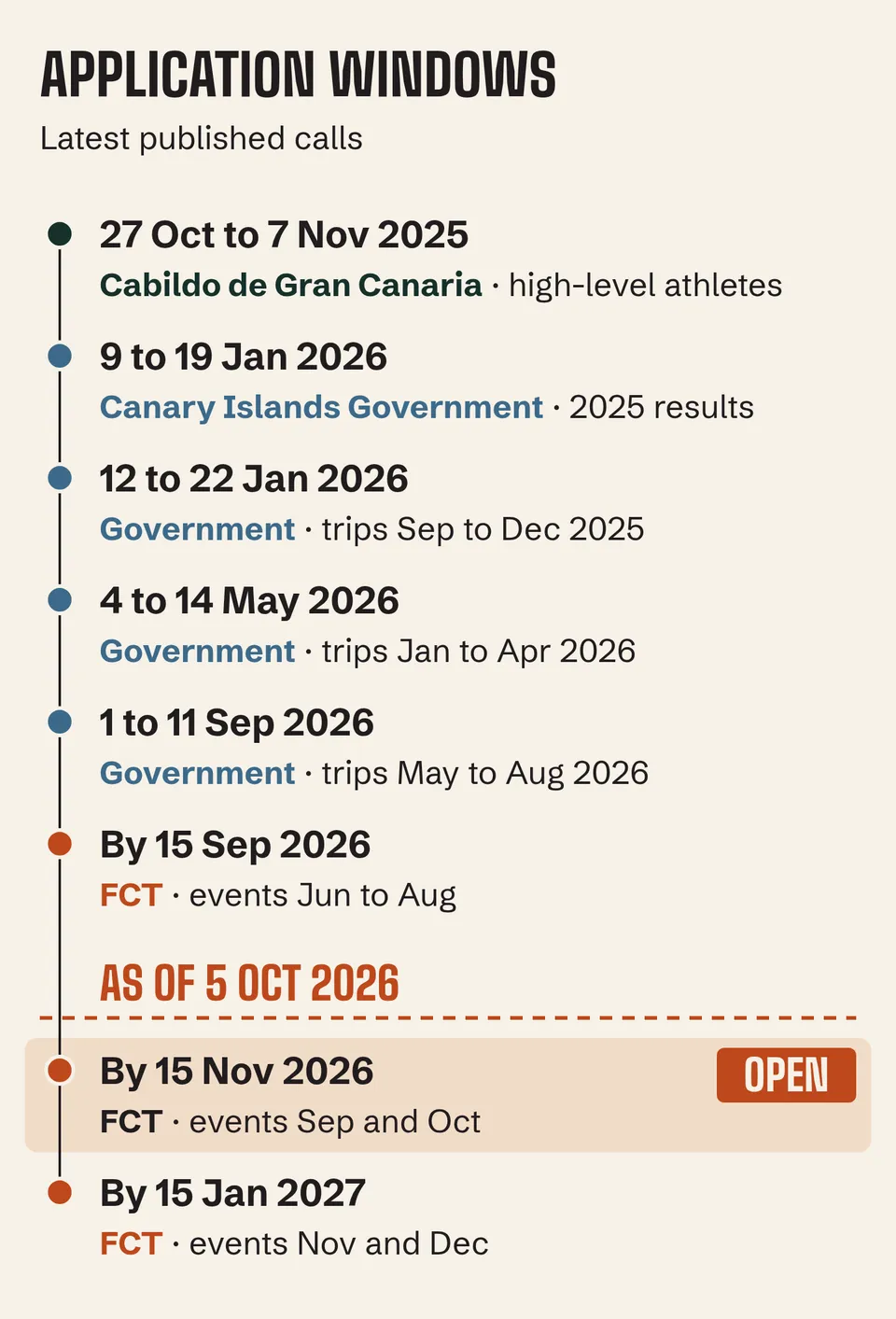
No. The measures are academic and sports-training ones. Grants have their own calls, listed on the page about grants for junior tennis players in the Canary Islands.
Does a status from another Spanish region count?
The Canary status cannot be held together with one from another region. CSD status is valid across Spain. Someone with high-performance status from another region can obtain the Canary benefits if they move here because their parents move, for a minor, or because of a change of address or of academic record, for a student (Ley 39/2022, art. 26.2).
When should a family start thinking about this?
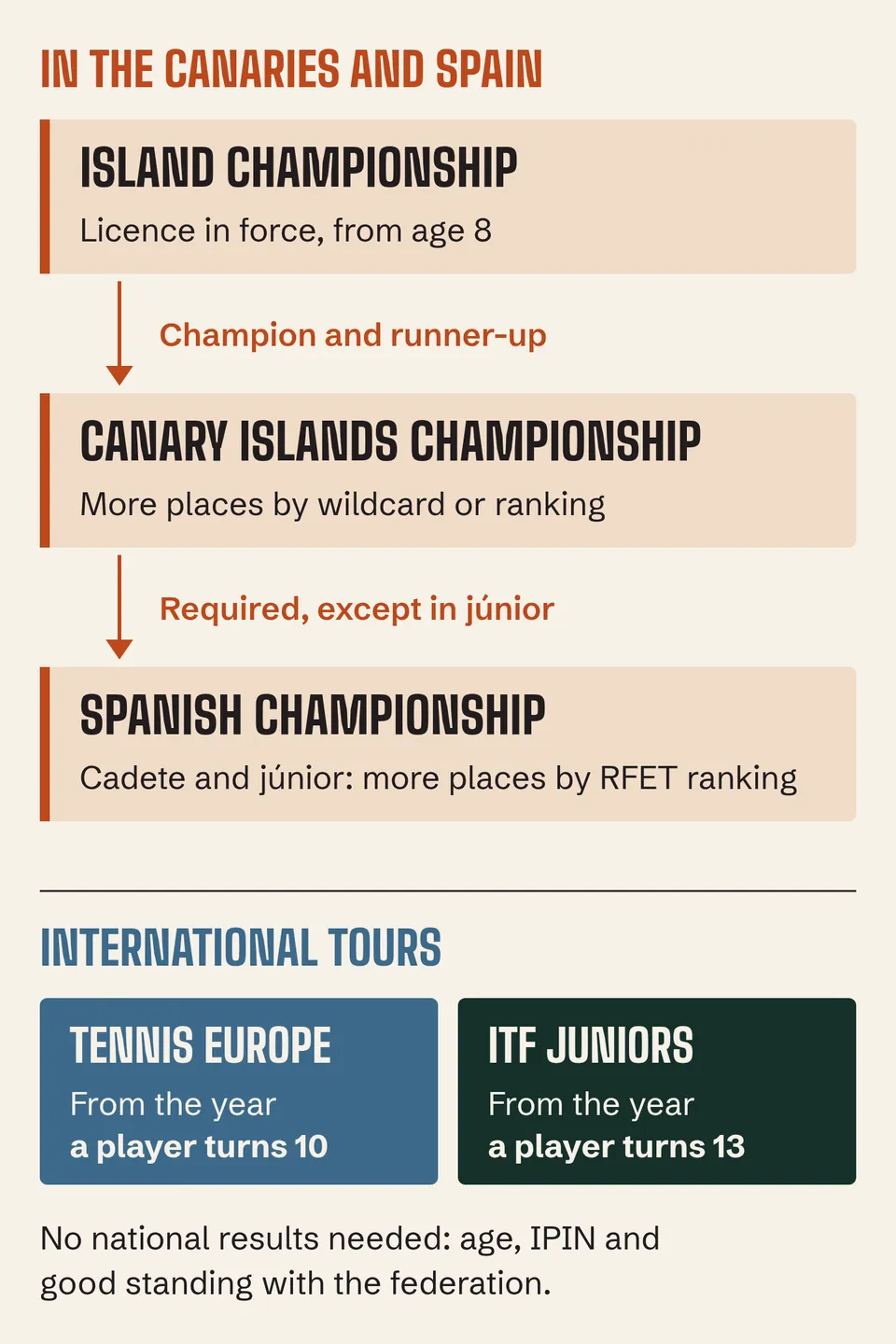
Before each change of stage: starting ESO, starting Bachillerato and applying to university each have fixed application periods. The sporting route that leads to these results is on the page about moving up from island to international junior tennis.
Sources
- Real Decreto 971/2007, of 13 July, on high-level and high-performance athletes, consolidated text last updated 13 January 2018; article 9 (as worded from 24 November 2008). Consulted on 2 November 2026.
- Real Decreto 242/2009, of 27 February, on exemptions and equivalences, including the effect of athlete status on Physical Education, consolidated text of 18 January 2023; articles 4 and 5. Consulted on 2 November 2026.
- Ley Orgánica 2/2006, of 3 May, on Education, consolidated text of 8 June 2024; articles 32.3 and 67.1. Consulted on 2 November 2026.
- Real Decreto 243/2022, of 5 April, on the structure and minimum content of Bachillerato, consolidated text of 2 July 2026; article 15. Consulted on 2 November 2026.
- Real Decreto 534/2024, of 11 June, on university degree entry and admission, consolidated text of 2 July 2026; article 42. Consulted on 2 November 2026.
- Ley 39/2022, of 30 December, on Sport; article 26.2. Consulted on 2 November 2026.
- Decreto 27/2024, of 5 February, on Canary high-performance and native high-level athlete status and support measures (BOC no. 31, 12 February 2024; HTML version); articles 4, 17 and 20 to 29. Consulted on 2 November 2026.
- Decreto 30/2023, of 16 March, on the ESO and Bachillerato curriculum in the Canary Islands (BOC no. 58, 23 March 2023); articles 37.2 and 47 and fifth additional provision. Consulted on 2 November 2026.
- Orden de 31 de mayo de 2023, on assessment and progression in the Canary Islands (BOC no. 110, 8 June 2023); articles 22 and 37. Consulted on 2 November 2026.
- Decreto 9/2022, of 20 January, on admission to publicly funded schools in the Canary Islands (BOC no. 20, 28 January 2022); article 13.2. Consulted on 2 November 2026.
- Resolución of 5 February 2026, admission call for the 2026-2027 school year (BOC no. 31, 16 February 2026); third operative point and annexes II and III (calendars). Consulted on 2 November 2026.
- Universidad de La Laguna, degree preinscription: entry quotas and documents required by quota. Consulted on 2 November 2026.
- Universidad de Las Palmas de Gran Canaria, degree admission quotas (updated 10 December 2025). Consulted on 2 November 2026.
Keep reading
Grants for junior tennis players in the Canary Islands
Grants and funding for junior tennis players in the Canary Islands: the tennis federation, the Canary Government and Gran Canaria. Eligibility, amounts, dates.
How do US college tennis scholarships work?
Who offers tennis scholarships at US universities, the grades a Spanish student needs, when coaches may contact you and what else you need to go.
How to move up from island to international junior tennis
How a junior tennis player from the Canaries moves up: island, Canary and Spanish championships, Tennis Europe and ITF juniors, with 2026 ages and rules.