UTR vs WTN: what is the difference?
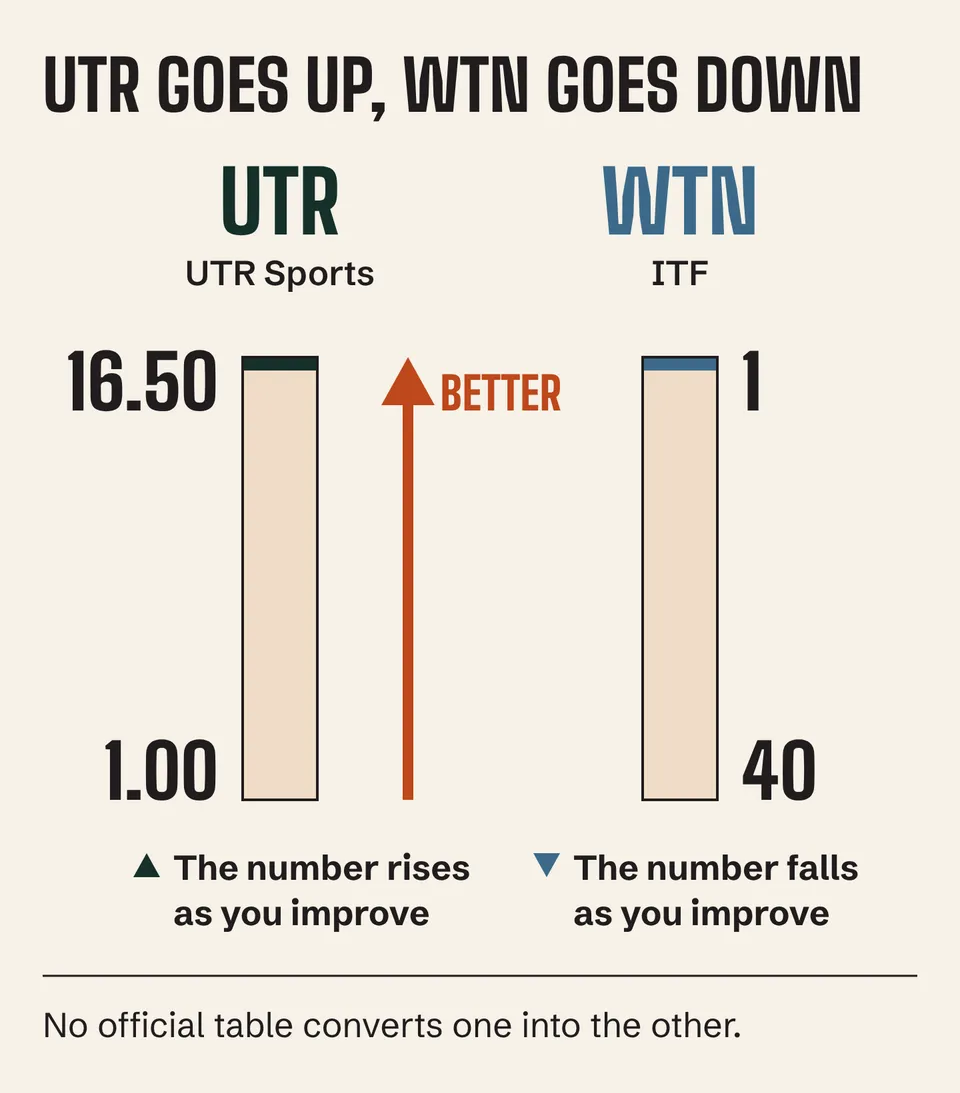
UTR runs from 1.00 to 16.50 and rises as you improve; WTN runs from 40 to 1 and falls. The ITF, Tennis Europe and the ITA use WTN; the RFET ranking uses neither.
In this article
The UTR (Universal Tennis Rating) and the WTN (World Tennis Number) are two ratings of playing level that, according to the bodies behind them, set out to measure the same thing: how well a player plays today, worked out from their results. They run in opposite directions: the UTR, from the UTR Sports platform, goes from 1.00 to 16.50 and higher is better; the WTN, from the International Tennis Federation (ITF), goes from 40 to 1 and lower is better. The ITF junior tour and Tennis Europe use the WTN for entry to their events, after the ranking, and the Intercollegiate Tennis Association (ITA), which describes itself as the governing body of US college tennis, has made it its official rating. On recruiting, UTR Sports says college coaches look at its verified UTR and the ITA presents the WTN as the new standard; no rule obliges a coach to use either.
How do they compare at a glance?
| UTR | WTN | |
|---|---|---|
| Run by | UTR Sports, a platform, not a federation | The ITF |
| Scale | 1.00 to 16.50 | 40 to 1 |
| Better is | A higher number | A lower number |
| What counts | The 30 most recent matches (at most) from the last 12 months; the share of games won matters | Results since 2016, comparing what was predicted with what happened in each match |
| Where results come from | Events UTR Sports treats as verified and, for the unverified UTR, scores players post too | ITF events and results sent by national and regional federations and by the ITA |
| Updated | Every night | Every week |
| Reliability | "Projected" with fewer than about five results | Confidence level; 50% needed for it to count on the ITF junior tour and Tennis Europe |
| Free or paid | The rating is free; two decimals and other features are paid | Free |
| Official use in 2026 | Not in the ITF junior or Tennis Europe rules | Entry to ITF junior and Tennis Europe events without a ranking; the ITA's official rating |
Who runs each one?
- The UTR is calculated and published by UTR Sports, which is not a federation but a platform with a free account and a paid subscription. It describes the rating as a modified Elo system, the kind used in chess, where what you gain or lose depends on your opponent's level, and says it rates players on results regardless of age, gender or nationality.
- The WTN is calculated by the ITF, the world governing body of tennis, on one scale for every age. It comes with a confidence level: how far the system trusts the number, based on how many matches you play and how recent they are. Everything else is in what the World Tennis Number is.
Neither adds up points for rounds reached, which is what the RFET ranking (the Spanish federation's national ranking) and the ITF junior and Tennis Europe rankings do.
How do you read each number?
- UTR: going up means improving. The number can never fall below 1.00 or rise above 16.50.
- WTN: going down means improving. 40 is near a beginner and 1 near a professional. It is used to two decimal places: 20.49 ranks ahead of 20.50.
So after a good season a player can see their UTR rise and their WTN fall: both are saying they have got better.
How is the UTR worked out?
According to UTR Sports' help centre:
- For each match, the algorithm expects each player to win a certain share of the games, based on the gap between their two UTRs. Win more games than expected and your rating for that match goes up; win fewer and it goes down. What counts is the share of games, not only who wins.
- Each match carries more or less weight depending on the format (best of three sets counts for more than an eight-game pro set), how close the two ratings are, how reliable the opponent's rating is, and how recent the match is.
- Your UTR is the weighted average of the 30 most recent matches, at most, from the last 12 months.
- It is recalculated every night.
Some matches never count: withdrawals before the start, matches that end in a retirement before either player reaches four games, and, when the two players are more than 2.00 apart, the expected win by the higher-rated one. One result is enough for a "projected" UTR, marked (P); after about five it becomes reliable.
What is a verified UTR?
UTR Sports publishes two numbers:
- The verified UTR, marked with a blue tick, uses only results from events the platform treats as verified: ATP, WTA and ITF professional events, federation-sanctioned junior matches, ITF junior events, US college tournaments, US high school matches, sanctioned adult leagues and tournaments, and the verified events run on the platform itself.
- The unverified UTR also takes in casual matches, practice matches and scores players post themselves.
UTR Sports does not publish which federations send it their junior results, so a player cannot tell in advance whether their national tournaments will show up.
What is free and what is paid?
- The UTR comes from results: one is enough for a projected UTR, and you can see it with a free account.
- The Power Player subscription is paid, monthly or yearly, priced by country; it adds the two decimals (7.43 rather than 7) and other features.
- The WTN is free and needs no application: any player whose results reach the ITF has one.
Which one does the ITF junior tour use?
The WTN. Under the 2026 regulations it orders entrants who have no ranking and hands out some places of its own at grades J30 to J300 (from the lowest grade to the one just below J500; above them sit J500, the junior Grand Slams and the ITF Junior Finals), always with a confidence level of 50% or more. The UTR does not appear in the regulations. The places and minimum numbers are in what the World Tennis Number is; how to enter is in the ITF junior tour.
Which one does Tennis Europe use?
The WTN, in the 14-and-under and 16-and-under events. Under its 2026 rulebook, players with a Tennis Europe ranking and the national squads the organiser accepts go in first, then players without a ranking, ordered by WTN. It is not used in 12-and-under events, in doubles or for seeding, and the UTR does not appear. The rest is in the Tennis Europe Junior Tour.
Which one do US universities use?
In NCAA college tennis (the NCAA is the body that runs US college sport), the ITA is in charge: it describes itself as the governing body of college tennis and its coaches' association. On 5 January 2023 it announced that the WTN had become its exclusive official rating, and in 2026 it uses it like this:
- Preseason ranking. In Division I, the ranking each season starts with keeps their places for returning players from the previous season's top 125. The remaining places, newcomers included, are filled by WTN.
- Doubles and newcomers. The 90 pairs in the preseason doubles ranking are ordered by the two players' combined WTN, and a separate top-20 list of newcomers is also drawn up by WTN.
- The season's ranking. The computer ranking counts only college matches from that season, with no WTN or outside results, because an NCAA rule requires qualifying standards for its championships to be met in the same academic year. That ranking is part of how players are selected for the NCAA championships.
- Summer events. In the ITA Summer Series, whose presenting sponsor is the WTN, draws are grouped by WTN and the Masters events, the strongest ones, set a minimum WTN.
On recruiting, each side makes its own claim: UTR Sports says college coaches look at the verified UTR, and the ITA presents the WTN as "the new standard in college recruiting". No ITA or NCAA rule obliges a coach to use a particular rating. How the scholarships work is in US college tennis scholarships.
Frequently asked questions
Can a UTR be converted into a WTN?
There is no official conversion table: neither UTR Sports nor the ITF publishes one. Each rating is also fed by different matches, so two players with the same UTR can have different WTNs.
Does either count towards the RFET ranking?
No. The RFET's 2026-2027 ranking regulation does not mention them: what it adds from abroad is points from international rankings (ATP, WTA, ITF and Tennis Europe), not ratings. The details are in how the RFET ranking works.
Sources
- ITF, ITF World Tennis Tour Juniors 2026 Regulations (published 5 December 2025, updated 24 March 2026), rule 43 and appendix H. Consulted on 2 November 2026.
- ITF, ITF World Tennis Number, WTT Juniors FAQs (January 2025). Consulted on 2 November 2026.
- Tennis Europe, 2026 Tennis Europe Junior Tour Rules & Regulations (June 2026 version), sections 7 and 8. Consulted on 2 November 2026.
- UTR Sports, Understanding the Algorithm, Complete Summary (undated). Consulted on 2 November 2026.
- UTR Sports, How is the UTR Rating calculated? (undated). Consulted on 2 November 2026.
- UTR Sports, FAQ: UTR Rating Algorithm (undated). Consulted on 2 November 2026.
- UTR Sports, What's the Difference Between the UTR Rating and Verified UTR Rating? (undated). Consulted on 2 November 2026.
- UTR Sports, What are Power Players? (undated). Consulted on 2 November 2026.
- ITA, WTN Named Official Rating of College Tennis (5 January 2023). Consulted on 2 November 2026.
- ITA, Rankings Explained (updated 30 July 2026). Consulted on 2 November 2026.
- ITA, ITA Summer Series powered by WTN (updated 2 October 2026). Consulted on 2 November 2026.
- USTA, USTA and ITA expand their strategic alliance to elevate college tennis (21 May 2024). Consulted on 2 November 2026.
- RFET, Reglamento de Clasificación 2026-2027 (ranking regulation, from October 2026, signed 23 October 2026), articles 1 and 8. Consulted on 2 November 2026.
Keep reading
How do US college tennis scholarships work?
Who offers tennis scholarships at US universities, the grades a Spanish student needs, when coaches may contact you and what else you need to go.
What is the ITF junior tour and how do you enter?
Who can play the ITF junior tour, what grades J30 to J500 mean, how to enter and what its points are worth in the Spanish ranking.
What is the Tennis Europe Junior Tour and how do you enter?
Europe's junior circuit for 12, 14 and 16 & under: entering with an IPIN, deadlines, fees, the ranking and what its points are worth in Spain.