How do US college tennis scholarships work?
Who offers tennis scholarships at US universities, the grades a Spanish student needs, when coaches may contact you and what else you need to go.
In this article
- Who can offer a tennis scholarship?
- What changed in Division I in 2025?
- What grades does a student from Spain need?
- What else do you need: English test and visa?
- What prize money can you accept before you go?
- How late can you start without losing a year?
- When can coaches contact you?
- What should you do in each school year?
- Do you need an agency?
- Questions people ask
- Sources
A US university can pay some or all of a student's costs in return for playing on its tennis team. These athletic scholarships come from NCAA Divisions I and II, from the NAIA and from Divisions I and II of the NJCAA, the two-year college association. NCAA Division III offers none.
For a player in Spain the process starts in 3º de ESO (the third year of compulsory secondary school), because grades count from that year. Division I coaches may write to you from 15 June at the end of 4º de ESO, and the scholarship is signed in 2º de Bachillerato, the final school year. Since July 2025, at the Division I universities that apply the 2025 court settlement, the limit is no longer on scholarships but on players: 10 per tennis team, men's and women's.
Who can offer a tennis scholarship?
| Body | Universities | Athletic scholarship in tennis | Academic entry requirement |
|---|---|---|---|
| NCAA Division I | 361 in 2026-27 | Yes, up to the full cost of attendance. No cap on scholarships per team | 16 core courses and a 2.3 average on a 4-point scale |
| NCAA Division II | 296 | Yes, mostly partial: up to 4.5 full-scholarship equivalents for men and 6 for women | 16 core courses and a 2.2 average |
| NCAA Division III | 416 | No. Only academic or need-based aid, as for any student | Set by each university |
| NAIA | A separate association from the NCAA | Yes, up to 5 full-scholarship equivalents in tennis | A 2.3 average, or two of three: 18 on the ACT or 970 on the SAT, a 2.0 average, the top half of your graduating class |
| NJCAA (two-year colleges) | Divisions I, II and III | Division I: up to 9 scholarship players per team. Division II: tuition, fees, books and required course supplies only. Division III: none | Finishing secondary school |
An equivalency is a total, not a head count: 4.5 scholarships can be split into halves, quarters or any fraction across more players. In the NJCAA, 3 of a Division I team's 9 scholarships may also cover housing, meals and one return trip home a year; the other 6 are limited to tuition, fees, books and required course supplies.
Two-year colleges (community colleges) award two-year degrees, and their credits can later count towards finishing a bachelor's degree at a four-year university. In the NJCAA the college itself certifies that you can play: you give it proof that you finished secondary school, ideally an evaluation of your diploma by a member of AICE or NACES, two US associations of foreign credential evaluators. The diploma the NCAA accepts also counts.
What changed in Division I in 2025?
Division I universities in the conferences that were defendants in House v. NCAA, or that opted in to the settlement that ended it, have been limited since 1 July 2025 to 10 players on each tennis roster. Within that limit they may give aid to anyone: the 2026-27 Division I Manual no longer sets a number of scholarships per team. The cap is individual: the cost of attendance, which each university calculates (tuition, fees, housing, meals, books and other expenses).
There is a catch: the value of scholarships above the sport's old team limit, the 2024-25 one, counts, up to 2.5 million dollars, against the settlement's benefits cap. In other words, the extra scholarships and the payments to athletes come out of the same budget. Those settlement payments are offered through a separate agreement.
Division I universities that do not apply the settlement have no 10-player limit, and the manual sets them no number of scholarships per team either: the only cap is, again, each player's cost of attendance. Any per-team scholarship figure you see for Division I dates from before July 2025.
What grades does a student from Spain need?
For Divisions I and II you register with the NCAA Eligibility Center, which reviews your record from 3º de ESO onwards. If you are going to a Division III university you register too, with an athletics-only certification account, because the Eligibility Center certifies the amateur status of international athletes in that division. The NCAA maps the Spanish school years like this:
| Year in Spain | US equivalent | Term used in the rules |
|---|---|---|
| 3º de ESO | 9th grade | freshman |
| 4º de ESO | 10th grade | sophomore |
| 1º de Bachillerato | 11th grade | junior |
| 2º de Bachillerato | 12th grade | senior |
Your secondary school sends the grades for those four years in Spanish, with a certified word-for-word English translation by a translator with no link to you or to the university's athletics department. Proof that you finished secondary education can be, for example, the título de Bachiller; the Graduado en ESO (the lower-secondary certificate) does not count. If you are on a vocational route (Formación Profesional), check the NCAA's Spain country page: the Técnico Superior diploma is no longer on the accepted list, though it is still honoured for students who started that programme by 31 May 2027.
Grades are converted to the 4-point scale:
| Spanish grade | Equivalent | Points |
|---|---|---|
| 8.5 to 10 | A | 4 |
| 6 to 8.4 | B | 3 |
| 5 to 5.9 | C | 2 |
| Below 5 | F | 0 |
Example: if all your core courses carry the same weight and half are between 6 and 8.4 and half between 5 and 5.9, your average is 2.5, above Division I's 2.3. The Eligibility Center counts only the courses it accepts as core courses and uses your best grades in them, so the result can differ from the average on your school report.
The NCAA dropped standardised tests such as the SAT and ACT from its entry requirements in January 2023, but a university may still ask for them for admission or for a scholarship. The NAIA uses them as one of its three options and registers players separately, at PlayNAIA, with an InCred evaluation for records from abroad and an international fee of 170 US dollars.
What else do you need: English test and visa?
Athletic certification does not get you into a university: you apply for admission separately to each one, under its own requirements. Undergraduate applications are usually due between November and January for a September start.
- English. Each university sets its minimum level and the tests it accepts. According to EducationUSA Spain, the US State Department's official information centre in Spain, all of them accept TOEFL or IELTS, more and more accept the Duolingo English Test and very few accept Cambridge exams.
- Visa. Once your place is confirmed, the university issues your Form I-20, which you need to apply for the F-1 student visa, with an appointment at the US Embassy in Madrid.
EducationUSA Spain, based at the Fulbright Commission, gives free advice on these steps.
What prize money can you accept before you go?
When you register you declare your whole playing history: tournaments, prize money, expenses paid for you, matches against professionals, contracts and anyone who has advised you or promoted your game. That is what your athletic eligibility is certified on.
In Division I, before you enrol you may accept prize money for your results, provided it is paid by the tournament's organiser. Once enrolled, only up to your actual expenses. Division II, the NAIA and the NJCAA have different rules: check them before accepting any prize money.
How late can you start without losing a year?
In Division I you have five academic years to play. From 1 August 2026 that period starts when you first enrol full time at any university or, if earlier, at the start of the academic year after your 19th birthday. Turn 19 in March 2027 and enrol in autumn 2027, and you lose nothing; wait until autumn 2028 and one of the five years is already gone. Division II also gives five years and since August 2026 starts them the same way, but its wording for players who turn 19 on or after 1 September is different: if that is you, check it.
The NAIA has no age limit: it allows four seasons within ten semesters, but it can charge you seasons for professional-level competition from a year after you finish secondary school.
When can coaches contact you?
The NCAA guide advises emailing coaches with your achievements, highlight videos and your interest in their programme, including your NCAA ID number and the year you finish secondary school. In tennis, your achievements are your results and your ranking; the tournaments behind them are covered in how players move from island to international tournaments and the ITF junior circuit. In Division I coaches may not be allowed to reply until the permitted date. The dates govern what they can do:
| When | Division I | Division II |
|---|---|---|
| Up to 14 June at the end of 4º de ESO | No calls or messages to you | May communicate with you at any time |
| From 15 June at the end of 4º de ESO | Calls, emails, messages and recruiting material | In-person contact and paid visits |
| From 1 August at the start of 1º de Bachillerato | In-person contact off campus, visits paid by the university and your own visits involving the team | As before |
| Second Wednesday of November in 2º de Bachillerato (11 November in 2026) | First day to sign the scholarship | First day to sign the scholarship |
Division III has no recruiting calendar. In the NJCAA the letter of intent can be signed from 1 November. You may sign with only one Division I or II university; from then on the others must stop contacting you unless your university releases you.
What should you do in each school year?
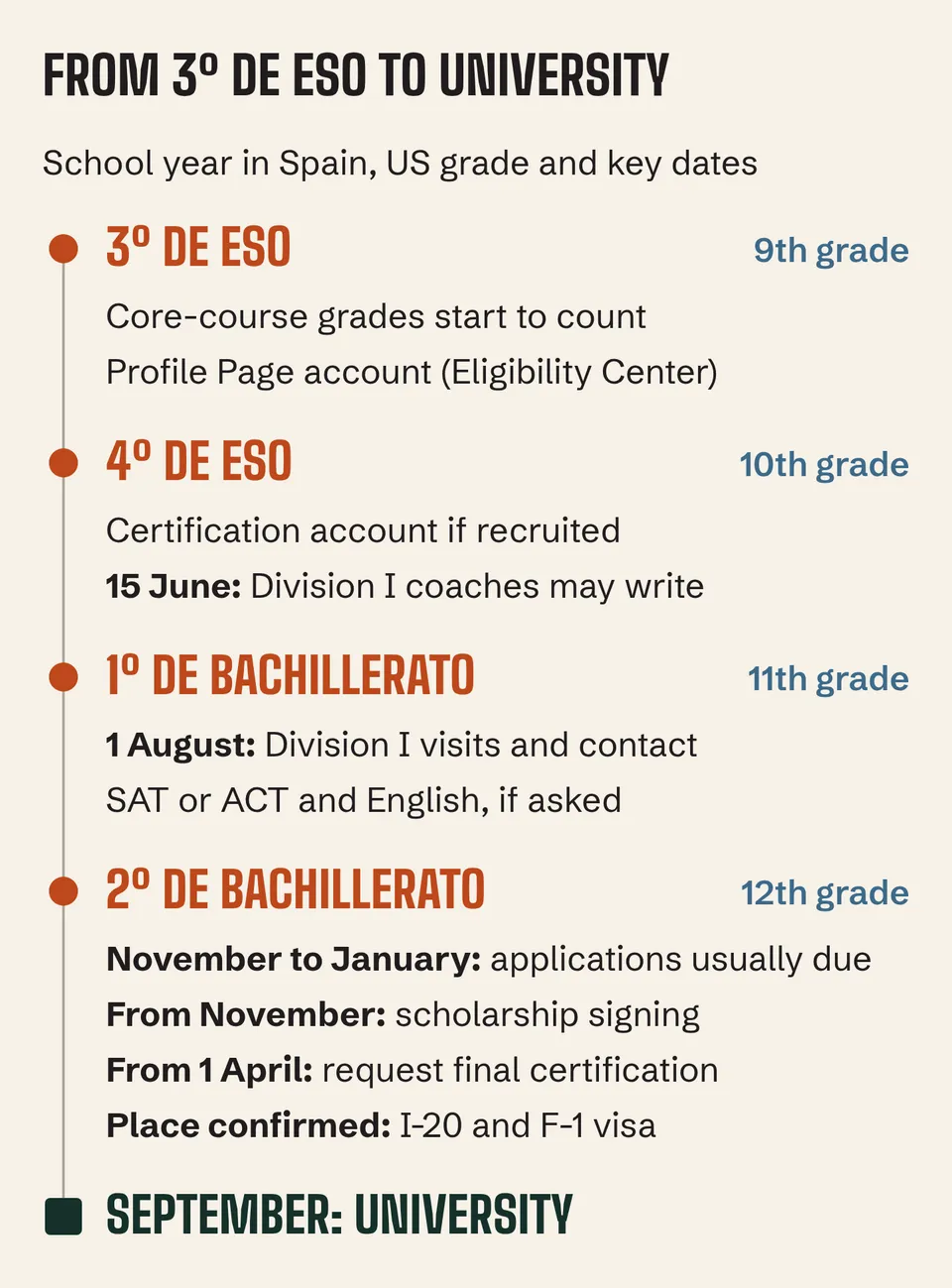
- 3º de ESO: open a Profile Page account with the Eligibility Center and look after your core-course grades: they count from this year.
- 4º de ESO: if a Division I or II university recruits you, switch to a certification account, which carries a fee. Ask your school to send your grades at the end of the year.
- 1º de Bachillerato: visits, conversations with coaches and, if a university asks for them, the SAT or ACT and an English test. Grades sent again at the end of the year.
- 2º de Bachillerato: university applications (usually due between November and January), signing from November, a request for final athletic certification from 1 April if you start in the autumn, the título de Bachiller once you finish and, with your place confirmed, the I-20 and the visa. The NAIA asks for your documents at least two months before your course starts.
Do you need an agency?
No. Every step the NCAA, the NAIA and the NJCAA describe can be done by the player and their family: registering, writing to coaches, sending grades and videos, and negotiating the scholarship. Scholarship agencies are private companies that charge to do part of that work for you, and none of the three bodies requires one.
If you use one, read what you sign. In Division II, anyone who makes an agreement, spoken or written, with an agent to secure a place at a particular university loses their eligibility, and so does anyone who accepts travel or other benefits from an agent or from someone who markets athletes. When you register with the Eligibility Center you declare anyone who has advised or promoted you and any expenses paid for you, including by a sponsor, and the Eligibility Center decides on that information. Public support for young athletes in the islands is covered in grants and support for young tennis players in the Canaries.
Questions people ask
Does a Division I scholarship renew automatically?
Not necessarily: it depends on what you sign, and Division I allows multi-year scholarships. If a Division I or II university plans to reduce, not renew or cancel your scholarship, it must tell you in writing by 1 July and explain how to appeal.
What if I miss the Division I academic standard?
You cannot compete in your first year in Division I. If you still have at least a 2.0 average across the 16 core courses, you are an "academic redshirt": you can practise in your first term and receive the scholarship that year. In Division II, anyone who misses the standard is a "partial qualifier", who may practise and receive a scholarship but not compete in the first year.
Do I need to register with both the NCAA and the NAIA?
Yes, if you are interested in both. They are separate associations with separate registration and certification.
Sources
- NCAA, 2026-27 Guide for the College-Bound Student-Athlete (August 2026), pages 3 to 26. Consulted on 5 October 2026.
- NCAA, Guide to International Academic Standards for Athletics Eligibility 2026-27, pages 3 to 5, and Spain country page (September 2026). Consulted on 5 October 2026.
- NCAA, 2026-27 NCAA Division I Manual (version of 5 October 2026), bylaws 12.1.2.4, 12.6, 13.1.1.1, 13.1.3.1, 13.02.13, 13.4.1, 13.6.2.1, 13.7.1, 14.3.1.2, 15, 16.13.1.5 and 17.2. Consulted on 5 October 2026.
- NCAA, 2026-27 NCAA Division II Manual (version of 5 October 2026), bylaws 13.02.10.1, 13.1.1.1, 13.1.3.1, 14.02.21.2, 14.4.3, 14.4.9 and 15.4.2.1. Consulted on 5 October 2026.
- NCAA, 2026-27 NCAA Division III Manual (version of 5 October 2026), bylaw 15.01.3. Consulted on 5 October 2026.
- NCAA, Division II Coaches Off-Campus Recruiting Guide 2026-27 (30 July 2026) and 2026-27 Division I recruiting calendar, other sports (4 August 2026). Consulted on 5 October 2026.
- NAIA, 2026-2027 Official & Policy Handbook (41st edition, August 2026), Article V Section C and the financial aid policy, items D and H. Consulted on 5 October 2026.
- NAIA, Guide for the International Student-Athlete (July 2026). Consulted on 5 October 2026.
- NJCAA, Handbook, Bylaws 2026-27 (revision of 9 September 2026), Article V, Section 2.B.1, and Article VI, Section 2.B.1, and 2026-2027 Sports Procedures Chart (9 September 2026). Consulted on 5 October 2026.
- EducationUSA Spain, Estudios de grado (updated 8 July 2025). Consulted on 5 October 2026.
- EducationUSA, US Department of State, Apply for Your Student Visa: Undergraduate, Complete Your Application: Undergraduate and Research Your Options: Community College (undated). Consulted on 5 October 2026.
Keep reading
What is the ITF junior tour and how do you enter?
Who can play the ITF junior tour, what grades J30 to J500 mean, how to enter and what its points are worth in the Spanish ranking.
How does sponsorship of an under-18 athlete work in Spain?
Who signs a junior player's sponsorship in Spain, image rights, the logos RFET, Tennis Europe and ITF allow, and how it differs from patronage (mecenazgo).
How does the RFET ranking work?
Which tournaments count, how points are worked out and when the Spanish national tennis ranking is updated.

