What is the World Tennis Number (WTN) and what is it for?
What the ITF's WTN measures, how to read the 40-to-1 scale, where to see your own and which junior events use it for entry.
In this article
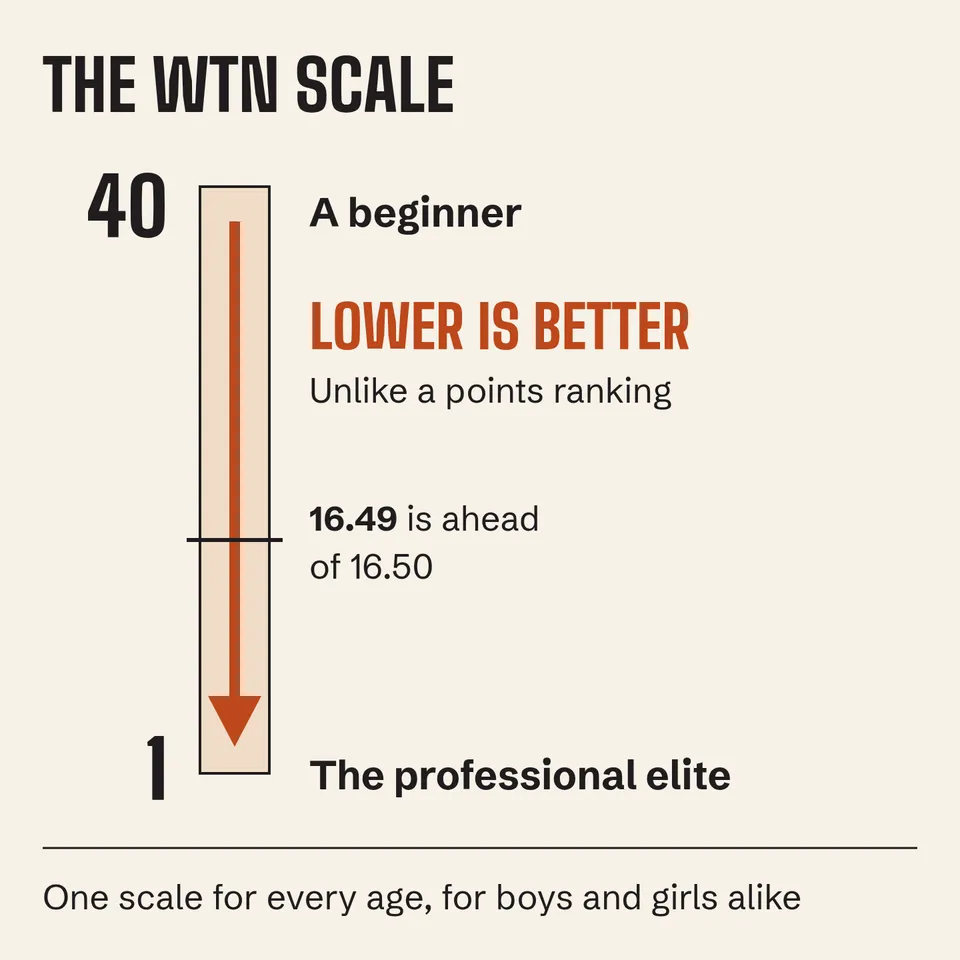
The World Tennis Number (WTN) is the International Tennis Federation's rating of playing level: a number between 40 (a beginner) and 1 (the professional elite); the lower the number, the better, on one scale for every age and for boys and girls alike. Each player has one number for singles and another for doubles, recalculated weekly from their match results. For a junior its main use is getting into the ITF junior tour and Tennis Europe events before they have a ranking.
How do you read the number?
- A scale from 40 to 1. 40 is close to a beginner, 1 close to a professional. Unlike a points ranking, a falling number means you are improving.
- Two decimal places. The ITF works to two decimals, so 16.49 is ahead of 16.50. Some national federations show one decimal or none, which is why the same player can see slightly different figures on different websites.
- Singles and doubles are separate. They share the scale but are not meant to be compared: the ITF says it is common for a player's two numbers to be more than a whole point apart.
- It is not a ranking. The ITF defines it as a rating, not a ranking. It does not award points for rounds; it estimates the level you play at now.
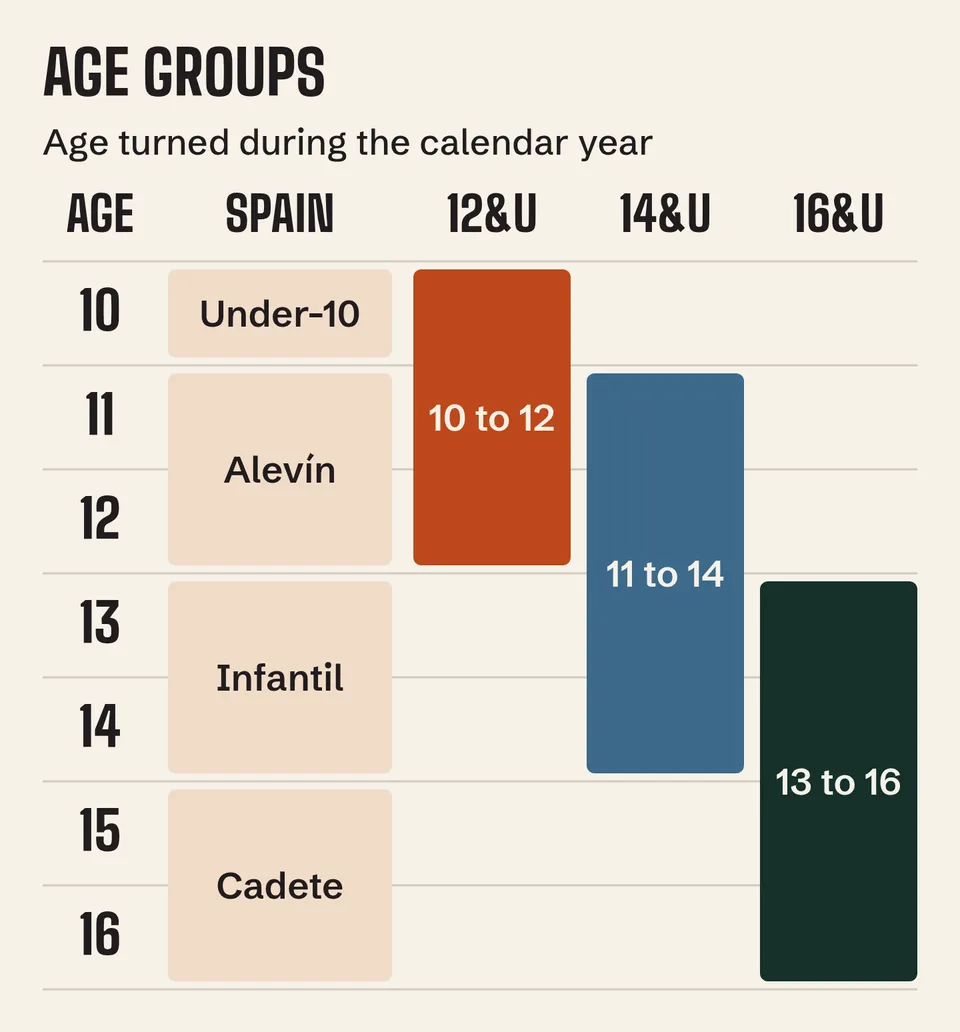
The number is free and nobody has to apply for one: any player whose results reach the system has it. The RFET (the Royal Spanish Tennis Federation) joined the WTN in April 2024 and describes it as meant for licensed players from the age of 9.
How is it worked out?
What the ITF and the RFET explain about the calculation, in general terms, is this:
- Before each match, the system looks at both players' ratings and predicts an outcome.
- Afterwards it compares the prediction with what happened. If the result is better than predicted (beating someone with a better number than yours, for example), your number falls, which means it improves; if it is worse than predicted, it rises.
- It takes results from ITF events and from the national and regional tournaments that each federation sends to the ITF. If your federation has not sent your results, you may have no number even though you have played.
- In doubles, the calculation builds a notional opponent from the other three players on court.
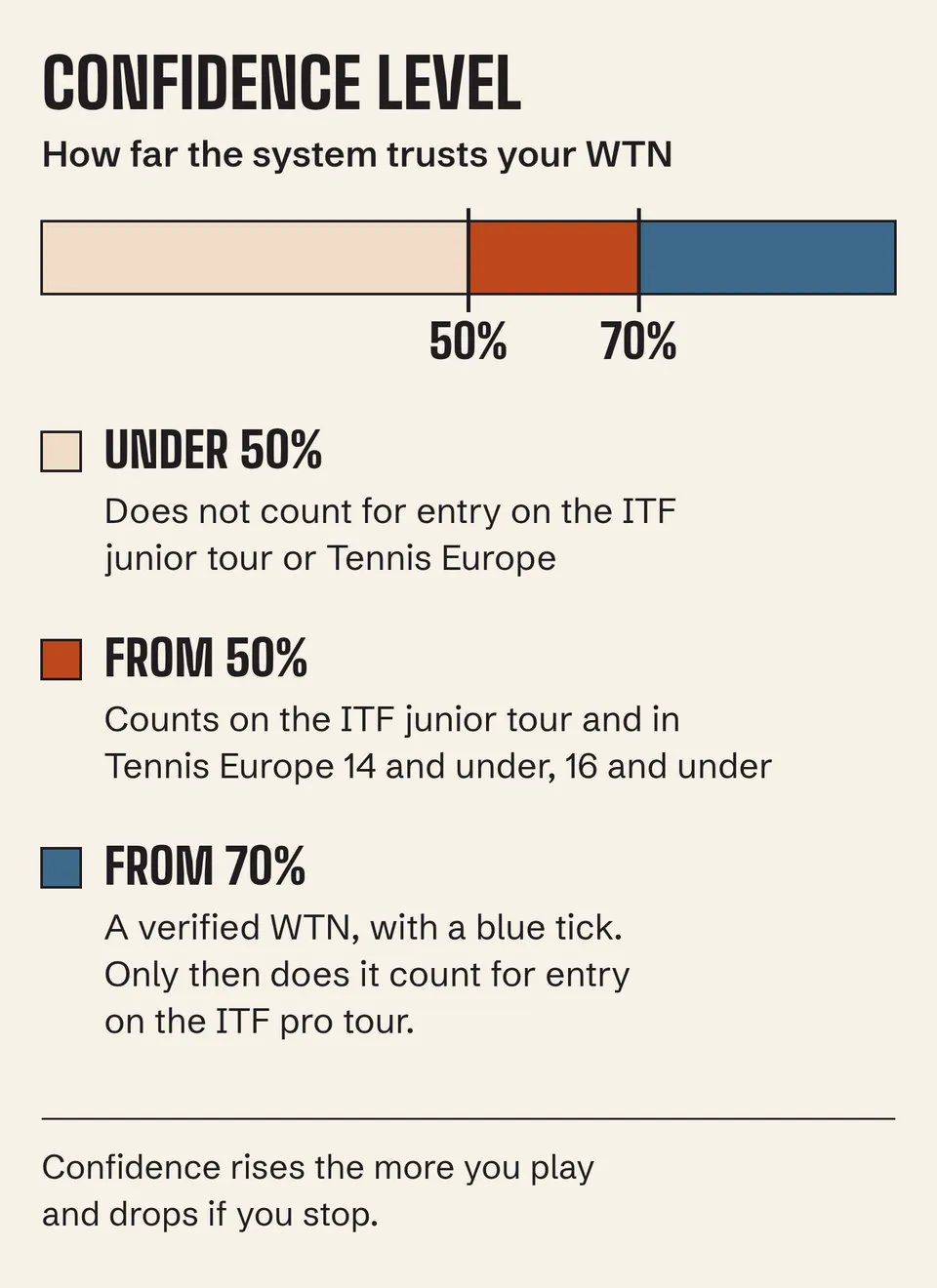
Alongside the number sits a confidence level (also called reliability): how far the system trusts your rating. It goes up the more matches you play and the more recent they are, and drops if you stop playing. On the WTN website it shows as a tick: blue when the number is reliable ("verified") and grey when the system needs more matches. The ITF treats a WTN as verified at a confidence level of 70% or more. Junior tours ask for less, as the table below shows.
How often does it change?
Once a week, on Wednesdays. When you enter a tournament, what counts is not your number on the day but the one from a fixed date:
| Tour | Which WTN is used | Minimum confidence |
|---|---|---|
| ITF World Tennis Tour Juniors | The one from the Monday before the entry deadline | 50% |
| Tennis Europe Junior Tour (14 and under, 16 and under) | The one from the Tuesday before the entry deadline | 50% |
| ITF World Tennis Tour (professional) | The one from the Monday before the entry deadline | Verified WTN (70%) |
On the ITF junior tour, your number at the deadline is frozen for that tournament, even if it improves the following week.
How can you see your own WTN?
- On worldtennisnumber.com, by searching for your name. It is free and you do not need an account to look; registering adds your history and comparisons with other players.
- In your IPIN account, if you have one (the international player number needed for the ITF junior tour and Tennis Europe; the ITF now calls its portal Tour Zone). It also shows your confidence level, which is what decides whether your WTN counts for entry.
- On your ITF player profile, once you have played an ITF junior tour event.
If you appear twice (for example one account from your federation and one from the ITF), you can ask the WTN team to merge them. For the ITF junior tour the request has to arrive at least 10 working days before the entry deadline. And if you have only just signed up for an IPIN, the ITF warns that it takes 10 days before your WTN can be used to enter events.
Where is it used for tournament entry?
| Tour | What the WTN does |
|---|---|
| ITF World Tennis Tour Juniors | Orders entrants with no ITF junior ranking and no ATP or WTA ranking, and breaks ties on equal ITF junior ranking. It also opens places of its own (list below). |
| Tennis Europe Junior Tour | From 2026, in the 14 and under and 16 and under age groups, it orders entrants with no Tennis Europe ranking. It is not used in 12 and under or for seeding. |
| ITF World Tennis Tour, professional (from age 14) | The third route in, after the ATP or WTA ranking and the ITF professional ranking, as long as the WTN is verified. |
| 12, 14 and 16 and under tournaments of the ITF's regional associations (in Europe, Tennis Europe) | The ITF allows them to use it for acceptances and to help with seeding; each association decides. Tennis Europe uses it only as the row above says. |
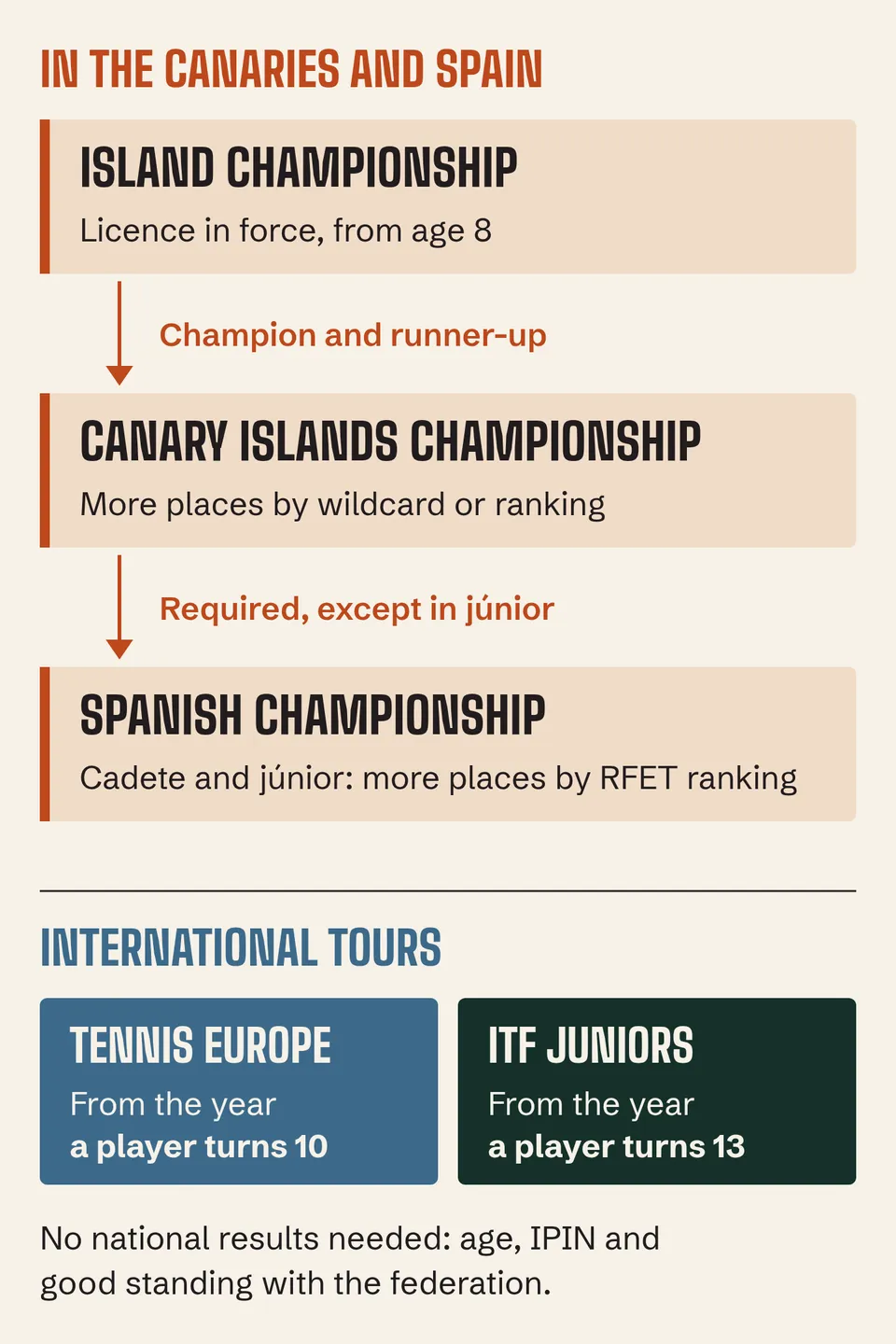
On the ITF and Tennis Europe tours the WTN counts in singles only: it is not used for doubles entry or for seeding. In ITF junior events played in groups it also breaks ties in the group standings. How players move from one tour to the next is on the junior pathway from the Canary Islands.
The ITF junior tour's own WTN places are these:
- J30 and J60: places on WTN alone, ranked or not: 4 in a 32-player main draw and 6 in a 32-player qualifying draw.
- J30 to J300: places for players aged 16 and under from the tournament's region (Europe, for an event in Europe), also chosen by WTN. J300 and J200 events also set a required WTN (table).
- If they are not taken, these places go back to the general acceptance list.
| Grade | Places for 16 and under from the region (Europe, for an event in Europe) | WTN required (or better), boys | WTN required (or better), girls |
|---|---|---|---|
| J300 | 1 | 15.99 | 17.99 |
| J200 | 2 | 17.99 | 19.99 |
| J100, J60 and J30 | 2 | No minimum | No minimum |
A worked example
A boy born in 2012 (14 in 2026) has no ITF junior ranking and no Tennis Europe ranking. His singles WTN is 17.40, at a confidence level of 45%.
- At that confidence, his WTN does not count: on ITF junior and Tennis Europe entry lists he falls into the group with neither a ranking nor a WTN. On the ITF junior tour, half the places left go to players from the host country and the rest are drawn by region, zone and the rest of the world; on Tennis Europe the order is the one his national federation gives. The details are in the ITF junior tour and the Tennis Europe Junior Tour.
- He plays a few more tournaments and his confidence reaches 55%. Now it counts: at a Tennis Europe 14 and under event or an ITF junior event, he is placed ahead of unranked entrants whose WTN is higher (worse) than 17.40.
- For the place kept for players aged 16 and under at a J300 he would need 15.99 or lower, so 17.40 is not enough. At a J200 (17.99 or better) or a J100, J60 or J30 (no minimum) he can be considered.
How is it different from the RFET ranking?
| World Tennis Number | RFET national ranking | |
|---|---|---|
| What it is | A rating of playing level | A points ranking |
| Who runs it | The ITF | The RFET |
| What counts | Every match, weighed by the opponent's level | Your best tournaments of the last 12 months, by round reached and strength of the draw |
| Better means | A lower number | More points and a higher place |
| Updated | Weekly | Monthly |
| Ages | One scale for everyone | One list; your player record also shows your place within your age category |
| What it is for | Entering ITF and Tennis Europe events without a ranking; finding opponents at your level | Entry and seeding in national and regional tournaments in Spain |
How national points are won and lost is explained in how the RFET ranking works.
Questions people ask
Does the WTN count towards the RFET ranking or the Spanish championships?
No. It does not appear in the 2026 regulations for the national ranking or for the Campeonatos de España (the Spanish junior championships). What does add to the national ranking is points from the international rankings, such as the ITF junior and Tennis Europe rankings.
What is World Tennis?
It is the ITF's new trading name, in use since 1 January 2026; the ITF announced that the new brand would be launched in summer 2026. The 2026 regulations still say "ITF World Tennis Number": it is the same number.
Sources
- ITF, ITF World Tennis Tour Juniors 2026 Regulations (published 5 December 2025, updated 24 March 2026), regulations 43, 44, 47 and 57 and appendices G and H. Consulted on 5 October 2026.
- ITF, ITF World Tennis Number, WTT Juniors FAQs (January 2025). Consulted on 5 October 2026.
- ITF, ITF World Tennis Tour + World Tennis Number FAQ. Consulted on 5 October 2026.
- ITF, Men's and Women's ITF World Tennis Tour Regulations 2026 (version of 12 December 2025), section II (definitions) and the acceptance rules (method C). Consulted on 5 October 2026.
- ITF, Key changes to ITF World Tennis Tour Juniors from 1 January 2026 (15 September 2025). Consulted on 5 October 2026.
- ITF, Taking Centre Court: The Rise of the World Tennis Number (28 March 2024). Consulted on 5 October 2026.
- ITF, International Tennis Federation to become World Tennis in 2026 (16 October 2025). Consulted on 5 October 2026.
- Tennis Europe, 2026 Tennis Europe Junior Tour Rules & Regulations (June 2026 version), sections 7 and 8. Consulted on 5 October 2026.
- RFET, ITF World Tennis Number (information page). Consulted on 5 October 2026.
- RFET, España se integra en el nuevo ranking mundial ITF World Tennis Number (19 April 2024). Consulted on 5 October 2026.
- RFET, Reglamento de Clasificación 2026 (ranking regulation, from January 2026). Consulted on 5 October 2026.
Keep reading
How to move up from island to international junior tennis
How a junior tennis player from the Canaries moves up: island, Canary and Spanish championships, Tennis Europe and ITF juniors, with 2026 ages and rules.
What is the ITF junior tour and how do you enter?
Who can play the ITF junior tour, what grades J30 to J500 mean, how to enter and what its points are worth in the Spanish ranking.
What is the Tennis Europe Junior Tour and how do you enter?
Europe's junior circuit for 12, 14 and 16 & under: entering with an IPIN, deadlines, fees, the ranking and what its points are worth in Spain.