How does junior team tennis work in Spain?
How a tie is won, which club team championships there are in the Canary Islands and Spain, who can play and how team results count for the RFET ranking.
In this article
- How is a tie won?
- Which team competitions are there in the Canary Islands?
- How does a club get into the Spanish championship?
- Which licence is needed, and can a player play for two clubs?
- How is a team put together, and who plays which match?
- Do team matches count for the RFET ranking?
- Frequently asked questions
- Sources
Junior team tennis in Spain is played between clubs: each club enters a list of players in ranking order. It meets another club in a tie (eliminatoria) of several singles and doubles matches, where every match won is worth one point. In the Canary Islands there is first an island championship and then the eight-team Canary Islands Championship; separately, the Royal Spanish Tennis Federation (RFET) runs a Spanish club championship that any affiliated club can enter. A player needs a licence through that club, and can play for only one club in a season.
How is a tie won?
Every match won, singles or doubles, gives the team one point, and the team with more points wins. Teams are either boys' or girls', and the format is the same at the Canary Islands and Spanish championships:
| Matches | Points to win | If it is level | |
|---|---|---|---|
| Boys | 4 singles, 1 doubles | 3 | Cannot happen once all five are played |
| Girls | 3 singles, 1 doubles | 3 | At 2-2, an extra doubles match decided by a single match tie-break to 10 points |
Singles come first, then doubles. Matches are two sets with a tie-break, and at one set all a match tie-break to 10 points replaces the third set (explained in how a junior tennis tournament works). At the Spanish championship, doubles use no-advantage scoring.
If a team is a player short, it concedes the walkover (W.O., a match lost without playing; see the glossary) in the bottom positions of its order, never the top ones.
At the Canary Islands Championship, a team that turns up without enough players to be able to win loses the whole tie by walkover.
At the Spanish championship, turning up with fewer players than required is enough to lose by walkover, unless a player is injured or ill and a medical certificate is provided. Losing by walkover there can keep a club out for one or two years.
Which team competitions are there in the Canary Islands?
There are teams for benjamín (under-10), alevín (under-12), infantil (under-14), cadete (under-16) and júnior (under-18), with boys' and girls' events from alevín to júnior. There are two stages:
- Island championship. This is the first stage, and it decides each province's teams. Clubs from Fuerteventura and Lanzarote can also enter the Gran Canaria championship, and clubs from La Palma the Tenerife one. The Tenerife federation publishes its own team championship rules (updated 20 May 2024).
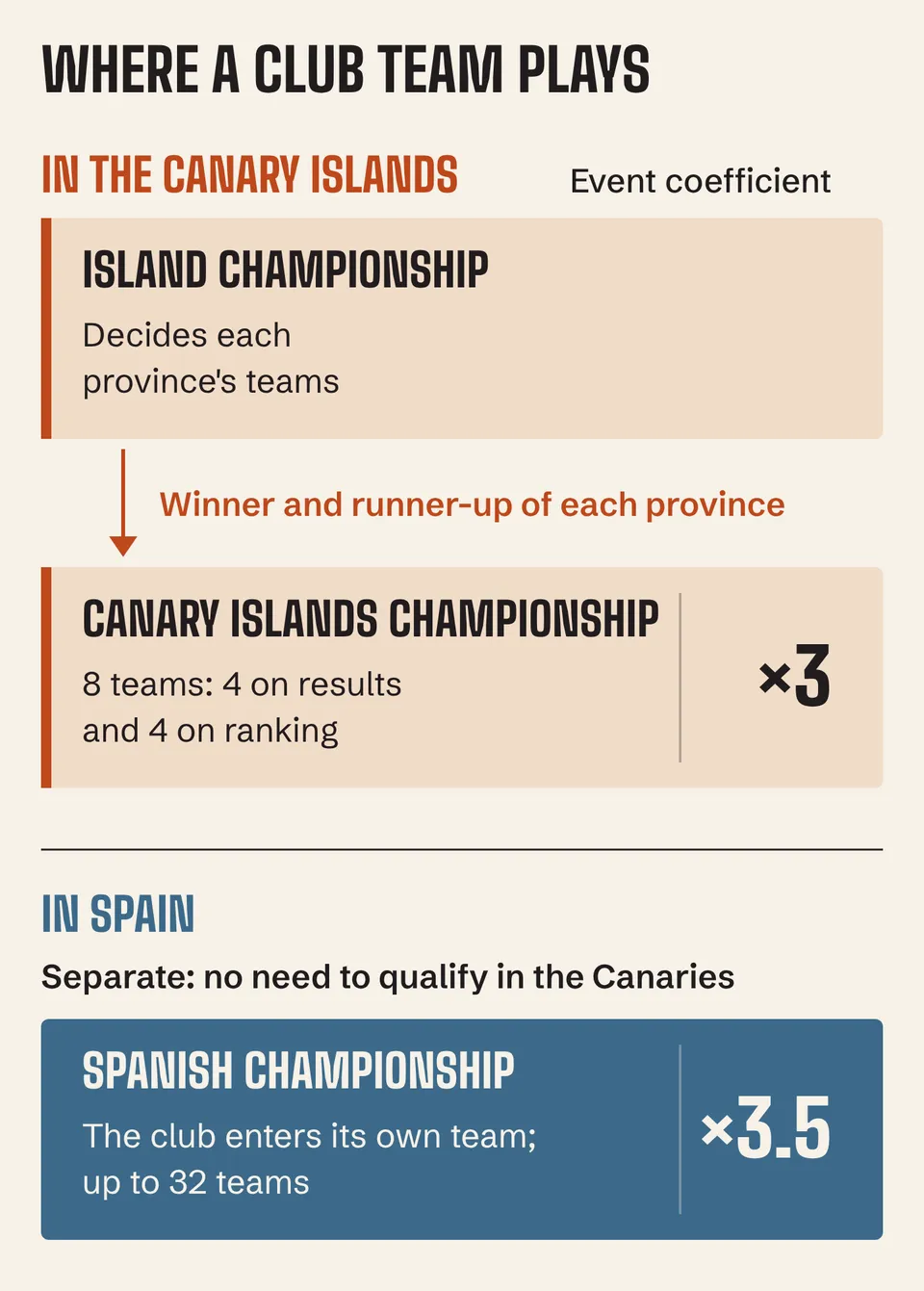
- The Canary Islands team championship (Campeonato de Canarias por equipos). Eight teams play: the winner and runner-up of the province of Las Palmas and of the province of Santa Cruz de Tenerife, plus four more on ranking, under criteria set by the FCT. The four qualified on results are seeded, play their first tie at home and pay no entry fee. Each tie is played once, on the courts of one of the two clubs. In 2026, alevín to júnior were played between April and June, and benjamín is being played from 30 October to 8 November.
How this fits with the individual events is on the page about junior competition in the Canary Islands. The travel support in the FCT's rules is for the individual championships (the Canary ones and, where a family lacks the means, the Spanish ones) and for the Canary Islands squad; it makes no provision for club teams. What getting between islands costs is on the page about competing from an island.
How does a club get into the Spanish championship?
The club enters its own team on the RFET website, as long as it is affiliated and up to date with its payments. Winning in the Canaries is not required: each event takes up to 32 teams. If more than 32 enter, the champions of each autonomous community, among others, go in first, and the remaining places are shared out by licence numbers, with at least one team per federation.
There is one championship for each of alevín, infantil, cadete and júnior. They are knockouts, and teams that lose their first tie go into a consolation draw. Dates, ages and what the host club pays for are on the page about the Spanish junior championships, which also covers the infantil championship for regional squads, where federations, not clubs, field the teams.
Which licence is needed, and can a player play for two clubs?
A club licence (licencia de club), taken out through that club, is needed; an independent licence (licencia independiente) does not cover team play, except with an RFET authorisation that in the junior age groups requires moving to another autonomous community. How to choose between them is on the page about getting a tennis licence in the Canary Islands.
Within one licence period (October to September) a player cannot play team championships for more than one club, and simply being on a team's list counts as having played for it. The FCT adds two rules:
- Changing club: once a year only, and only if the player has not played team championships that season.
- Island: a player who has played an island qualifying event for the Canary Islands Championship can only be on a team from the island where they played the first one that season.
How is a team put together, and who plays which match?
The club enters a list of players ordered by the national ranking, and that order stays fixed for the whole championship. For each tie the captain chooses who plays, but always in that order: the highest-ranked of those chosen plays singles number 1, the next one number 2, and so on. If a captain's mistake puts players out of order, at the Canary Islands Championship the team loses the matches of the misplaced players; at the Spanish championship it loses the whole tie.
| Canary Islands Championship (alevín to júnior) | Spanish club championship | |
|---|---|---|
| Largest list, boys | 20 players | 15 players |
| Largest list, girls | 12 players | 10 players |
| Smallest list | As many as there are singles | As many as there are singles |
| Captain | Named by the club | An adult with a licence |
At the Spanish championship, at least half of the players in each tie must meet the nationality or residence rules explained on the page about the Spanish junior championships. Before the draw, players sign in with the referee in person to confirm they are there; in cadete and júnior, a team can use at most seven players (boys) or six (girls) over the whole championship.
Apart from the girls' deciding doubles, a player can play at most one singles and one doubles match in a tie. Doubles players do not need to have played singles.
Do team matches count for the RFET ranking?
Yes. The RFET ranking regulation adds team competition to each player's best individual tournaments (14 in cadete and júnior, 10 in infantil, 8 in alevín and 6 up to age 10), and only events between clubs or regional squads count. It comes on top: it does not take the place of one of those tournaments.
In team events there are no points per round; instead each opponent beaten is worth points according to their ranking on the day of the first draw:
| Win over a player ranked | Points in the table |
|---|---|
| 1 to 5 | 200 |
| 6 to 10 | 175 |
| 11 to 15 | 150 |
| 16 to 20 | 125 |
| 21 to 25 | 100 |
| 26 to 50 | 75 |
| 51 to 75 | 50 |
| 76 to 100 | 40 |
| 101 to 200 | 30 |
| 201 to 300 | 20 |
| Below 300: third-category groups 10 to 1, set by position and, at the bottom, by points | 10 down to 1 |
A defeat gives no points, and neither does a win by walkover. Those points are then adjusted by the event's coefficient (3.5 at the Spanish team championship, 3 at the Canary Islands team championship, 1.25 in other team events) and by the age-group coefficient (0.15 up to age 10, 0.20 alevín, 0.35 infantil, 0.65 cadete, 0.75 júnior). Doubles in a tie score the same way, per pair beaten, for the doubles ranking, and doubles points feed into the singles ranking multiplied by 0.20. The full calculation is on the page about the RFET ranking.
Frequently asked questions
Does the family have to pay anything?
The club pays the team's entry. Both the FCT and RFET rules refer to clubs' entry fees but set no amounts. What a club asks of each family (travel, team kit) is up to the club.
Can an alevín player play in an infantil team?
At the Spanish championship, each set of rules gives an age range: alevín 8 to 12, infantil 11 to 14, cadete 13 to 16 and júnior 13 to 18, by age on 31 December. Within that range a younger player can be on a team in an older age group, still for only one club per season. In the Canary Islands, the FCT's own age rules apply.
Sources
- RFET, Reglamento de Licencias 2026-2027 (23 October 2026), articles 4.2, 4.3, 5.2 and 5.3. Consulted on 2 November 2026.
- RFET, Reglamento de Clasificación 2026-2027 (23 October 2026), articles 1, 7, 10, 11, 12, 18 and 21. Consulted on 2 November 2026.
- RFET, rules of the Spanish club team championships, alevín, infantil, cadete and júnior, updated 29 January 2026. Consulted on 2 November 2026.
- RFET, Reglamento Técnico 2026, section F, team competitions. Consulted on 2 November 2026.
- Federación Canaria de Tenis, Normativa de los Campeonatos de Canarias 2025/2026 (16 March 2026): team championships, playing format, club changes and licence authorisation. Consulted on 2 November 2026.
- Federación Canaria de Tenis, Reglamento de Competición por Equipos (2025), articles 3, 4, 6, 9, 11 and 12. Consulted on 2 November 2026.
- Federación Canaria de Tenis, Campeonatos de Canarias por equipos 2026 (dates). Consulted on 2 November 2026.
- Federación Insular de Tenis de Tenerife, Reglamento de Campeonatos por Equipos (updated 20 May 2024), article 1. Consulted on 2 November 2026.
Keep reading
How do the Spanish junior tennis championships work?
How to get in, how matches are played and when the Spanish alevín, infantil, cadete and júnior championships are held, singles and teams.
How does a junior tennis tournament work?
How players get into a federated junior tournament in Spain: the RFET ranking list, qualifying, seeds, byes, lucky losers, consolation and formats.
Spanish junior tennis glossary: previa, W.O., seeds and more
What W.O., previa, bye, seed, wildcard, coeficiente, estrellas and IPIN mean in Spanish junior tennis, term by term.